


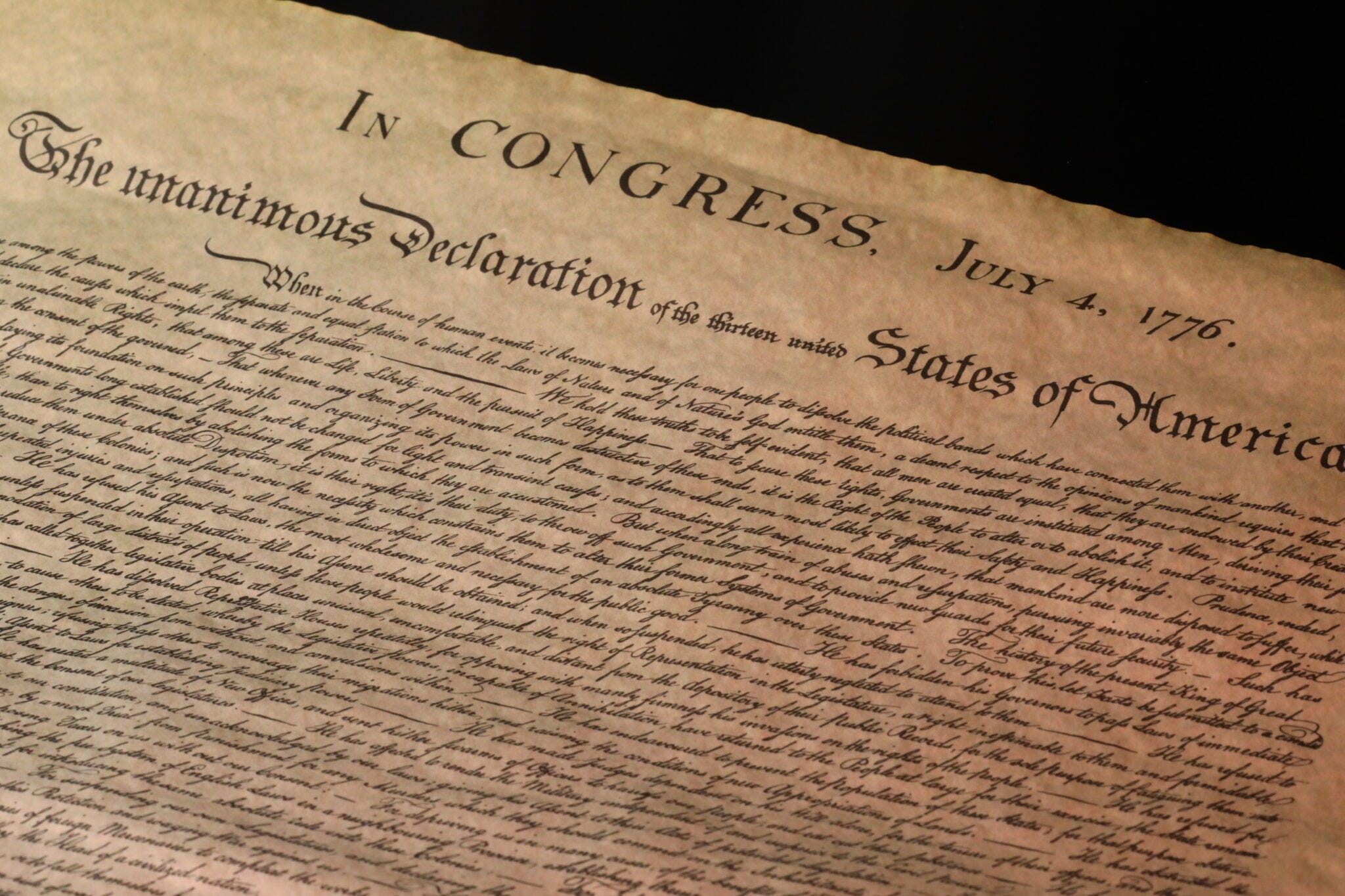
Hey everyone, don’t worry, I have not forgotten you. We have some awesome things coming very soon, and because this is America’s 250th birthday, I figured I’d write my own reflections on American identity, that for-some-reason-always-controversial topic. This is much more stream of consciousness than usual, so please forgive its meandering style. But I hope you enjoy what I have to offer on this auspicious day.
…
I will be the first to admit that historians, political commentators, and other kinds of theorists often tend toward the negative valence of the human experience. War, conflict, tragedy, suffering. These have always been the things that define narratives, and for good reason. And there has been no shortage of stories that can be classified in those ways during the shared lifetimes of both Millennial and Gen Z Americans. Therefore it is unsurprising that examples of strife that our generations have faced since the dawn of the 21st century have come to define how many of us perceive life. Global terrorism reaching its apex on September 11th, 2001, the Iraq and Afghanistan Wars, the Great Recession, the rise of unchecked populism, the COVID pandemic; those are the big stories, all with their own terrifying side quests and disturbing subplots. Thanks to our collective fixation on these objectively dramatic and terrifying stories, amplified by 24 hour news channels (which truly changed everything at the turn of the millennium) and later social media, that negative valence of the human experience became seen as the norm.
More disturbingly, however, was the shift toward recognizing that negative valence as a kind of moral virtue. Like many, I have been (and probably still am, to some extent) very guilty of this habit. Recognizing evil, malice, cruelty, and injustice is quite important; it is a very effective way to demonstrate one’s moral compass. Given this, it can very understandably feel crass to celebrate something—like a nation and its history—that has racked up a tally of evil, malicious, cruel, and unjust actions in its past. In the case of the United States, look no further than our infamous use of slavery, or our violent dispossession of thousands of indigenous peoples, or our many imperial interventions and adventures overseas. And yet, it does not feel like there is any kind of meaningful reflection that comes alongside this recognition; it often feels more like a pose, or, like I implied a moment ago, a signal. It also only ever seems to come from those born in the United States, and never from those who came here to make a new life for themselves and their families, especially from countries with far different values than our own.
This was on my mind this morning, on America’s 250th anniversary, as I sat drinking my coffee with my partner Molly. She is an immigrant to this country, having moved to the United States when she was nine years old, and therefore has an immigrant’s perspective on the country. It is usually a fool’s errand to try and generalize perspectives, but more often than not I have encountered a very similar perspective from immigrants to America, especially from non-Anglophone countries. The main thing is that, while they recognize the horror stories like those I mentioned above, they also reject the idea of America being defined by those horror stories. And they certainly reject the notion that recognizing these horror stories as being some kind of moral virtue. After all, why would they buy into that? They are the ones who came here, after all. The point Molly ultimately made was that it has become easy for us to forget the success stories, or the stories about how we came out the other side of those tragedies and calamities.
“So why do you love America?” I asked her.
She considered the question for a little while before saying, “It’s valuable to be different, or unique, rather than be punished. And that you can communicate and express yourself however you want. You know, that we have rights, and people can and do get in trouble if they take away your rights.”
I pointed out that the negative valence people, as I suppose I’ll call them, would claim that those things aren’t true for everyone at all times in the United States and that, at times, they have a point. She simply frowned and said, “well yeah, but that’s not what I mean. The fact that they can even make that claim, and complain about it publicly, and sometimes even become adored or even rich saying it is what makes things different than places like China.” In other words, however imperfectly these features manifested in our culture, both now and across time, the fact that it’s even possible is a blessing, and something for which she is grateful. That imperfection, she explained, is expected everywhere; the fact that it’s not expected here is both a.) an incredible mindset that can be cultivated, and b.) a sign of immense privilege.
This kind of framing is something that has increasingly resonated with me in the sixteen years I’ve spent with this woman, and even gotten to appreciate first hand as I have gotten to know her family, and especially so after we visited China many years ago. China is a different place in many, many ways than it was in 2012—after all, that was the year Xi Jinping first seized power—but Molly’s core observations about Chinese culture contrasted with American culture hold to this day. They also mirror things I have been told by other people I’m fortunate enough to have in my life who come from authoritarian and post-authoritarian cultures. My friend Kristaps Andrejsons of the Eastern Border podcast has made this abundantly clear over the years I’ve gotten to know him. His stories of what he was told by fellow Latvians after revealing his plans to be a podcaster were the same as what Molly or any other Chinese person would likely hear: in essence, “why the hell would you do that?” The expectation is to get a “real job.” There can be a lot of unpleasant naysayers—haters, if you will—one comes across in the United States, but by and large, the American ethos is “you do you,” if not, “That’s awesome! You do you!”
This enthusiasm is something worth loving. But I think enthusiasm is the secret to understanding the far more difficult question I asked Molly after asking what she loved about America. That is, the question that has always vexed our culture, and likely will never stop: what does it mean to be American? Molly frowned at this and stared into space, sitting in silence for a very long time. Finally, smirking, she said, “Hot dogs and beer.” This answer is fascinating because I had literally no idea what she meant, but I also figuratively knew absolutely what she meant.
…
So what does define American identity? It isn’t a shared ethnic makeup. It isn’t a particular brand of religious belief. It isn’t a shared language. It isn’t even the civil creeds laid out in our Constitution or the spirit of our Declaration of Independence from the British Empire. American identity is none of those things. American identity at its best is simply reciprocal excitement about individual and group differences.
That claim can sound counterintuitive, especially in a country that places such obvious weight on its institutions and founding documents. Some of these things are vital to the nation functioning as it does. The Constitution structures political authority and adjudicates conflict; a shared language, however loosely enforced, enables commerce and public life; certain civic norms like free speech, associational rights, and religious liberty make pluralism possible in the first place. But those are civic and social arguments. They explain how the system operates. They do not fully explain why it holds together.
People might object to the idea that we get excited by individual and group differences, pointing to persistent instances of xenophobia and anti-immigrant sentiment, which has not just grown in the past decade or so, but has also been a feature of our populist politics since at least the early-to-mid 19th century. On the surface, that seems like a fair criticism. But it doesn’t explain the very real excitement we see play out between our native-born population and foreign-born visitors, especially during recent viral moments like those seen during the World Cup this year, when national difference becomes spectacle, celebration, and shared curiosity rather than threat. The key here is that the excitement is reciprocal.
You see, when we get immigrants to this country who share our excitement at our shared differences—usually introduced through food—that’s the glue that binds us together. Food is the most obvious and least controversial medium, but it stands in for something larger: a willingness to participate in exchange rather than retreat into insulation. That reciprocity then often expands into discussing and learning about the cultural differences we have, from linguistic idiosyncrasies to stories of strife. When it comes down to it, humans—not just Americans—love to learn about one another. What makes America unique is that this desire has become hard-coded into our culture. We are obviously imperfect in our ability to tap into that cultural coding, especially when incentivized not to do so by politics and other priorities, but imperfection, again, is the norm. The standard is still there, and if you’ll permit a little American exceptionalism, it at least appears to be quite unique to us, at least from the perspective of immigrants and visitors to our country.
The best way to understand this is to look at how Americans respond to overt expressions of cultural insularity, particularly when it comes in the form of ethnic or religious enclaves. There is a reason that enclaves make most Americans uncomfortable, both outside and inside them. It’s not suspicion of foreigners or simple bigotry; it’s a suspicion of people not buying into the reciprocity of excitement. Enclaves are, by their very nature, in a perpetually defensive posture, and that, in turn, makes everyone outside of them suspicious. But unlike the ghettos that Europeans shuffled their Jews into many centuries ago (or the outright expulsions indigenous Jews saw throughout the Middle East after 1948), in America most ethnic or religious enclaves are voluntary and thus relatively rare, and they, in fact, help reveal that mechanism that binds us: excitement.
Obviously, our freedoms make it impossible to ban voluntary enclaves—and that is all for the good—since generally speaking, enclaves are perfectly legal to create as long as no laws are violated that prevent actual discrimination of those outside of them (or against those who opt into them). But they represent the exact opposite of what has always made America work, and at a gut level, most Americans recognize this and thus disapprove of it. Enclaves make our capacity for reciprocal excitement over differences essentially impossible. If you’re excited about us, we will be excited about you, and if you’re here and not excited about us, what the hell are you doing here to begin with? That’s the American attitude—the American cultural glue.
That is what is meant by “beer and hot dogs.” Beer and hot dogs are particularly American in their symbolic power, of course. But beer and hot dogs can mean anything; they represent our ability to come together not despite our differences but because of them. This symbol could just as easily be baijiu and dim sum, or falafels and lemonade. The point is not the meal itself, but the exchange it represents: a mutual recognition that difference is not merely to be tolerated, but enjoyed, displayed, and shared. Thus, at 250 years, that may be the closest thing the United States has to a unifying principle—not sameness, not even agreement, but a kind of ongoing, reciprocal curiosity.
…
I am not here to say that one needs to be wholly grateful for what we have as Americans. People can feel however they want. And am I saying that we should not criticize America’s more unseemly features in its history? Am I saying that we should celebrate America for good or ill? Am I saying that we should love it or leave it? Obviously not. Am I saying that focusing on the negative valence of our history, especially after doing the impossible and making it 250 years, is a poor substitute for a personality or identity, or as a means to demonstrate moral sophistication thanks to the negative valence people like me have normalized over the past 25 years or so?
You bet I am.
There is no sophistication in oikophobia, which is essentially what focusing on America’s failings actually is. Americans who do this are no different than the shadows they are boxing, the avatars of imaginary mandatory nationalism they need to believe exist in order to justify their meaning-seeking. Those kinds of people and forces do exist, but the amount of meaningful control they actually exert is nonexistent. Again, all one has to do is speak to the immigrants in their lives, especially if they came from a place that does not have our same standards of reciprocal excitement and curiosity baked into their own culture. They will tell you stories about real mandates, real shadows with form and substance, which you and I have never actually experienced.
The promise of moral sophistication is extremely tempting, especially when it is seemingly so easy to obtain. But it’s often just another form of self-gratification. In the case of native-born Americans finding nothing to like about their own culture or history, there is certainly a lot of masochism fueling the impulse. But at its core, it is really just another form of chauvinism, something I have spoken about at length on History Impossible. To believe that America can do no right is not meaningfully different from believing that America can do no wrong; in fact, it is functionally the same: to provide a shortcut to a sense of moral sophistication. The reality is America can and often has done both right and wrong. It is not special in this regard. It is special in its own, peculiar ways that cannot be neatly fit into categories of “wholly good” or “wholly bad.” That is what is worth celebrating. That and, of course, beer and hot dogs.
Happy birthday, America.
I enjoy your work and this essay has strong elements, especially the immigrant perspective and pushback against negative valence/oikophobia. That said, it leans into a propositional view of American identity and largely sidesteps the Anglo-Protestant and Judeo-Christian foundations (English common law, biblical views of rights and dignity, Puritan-influenced habits) that made the experiment viable. Those cultural fundamentals enabled the pluralism, not the other way around.
Thank you for the post. That was a pleasure
Yesterday in synagogue (because July 4th fell on Shabbat this year)I gave a little talk after the kiddush about two things. The origins in the Hebrew Bible for the concept of natural rights (that we are made in Gods image), and the dual gift of yesterday. One was the gift of Shabbat to The Jewish people, and the other was how this nation has been a gift to the Jewish people. It was the first non Jewish majority nation to give full and equal rights to Jews as Jews. Our nation has been a safe haven for Jews for a long time, and we have flourished here as nowhere else, at least until 1948. One small if significant example of American exceptionalism.