


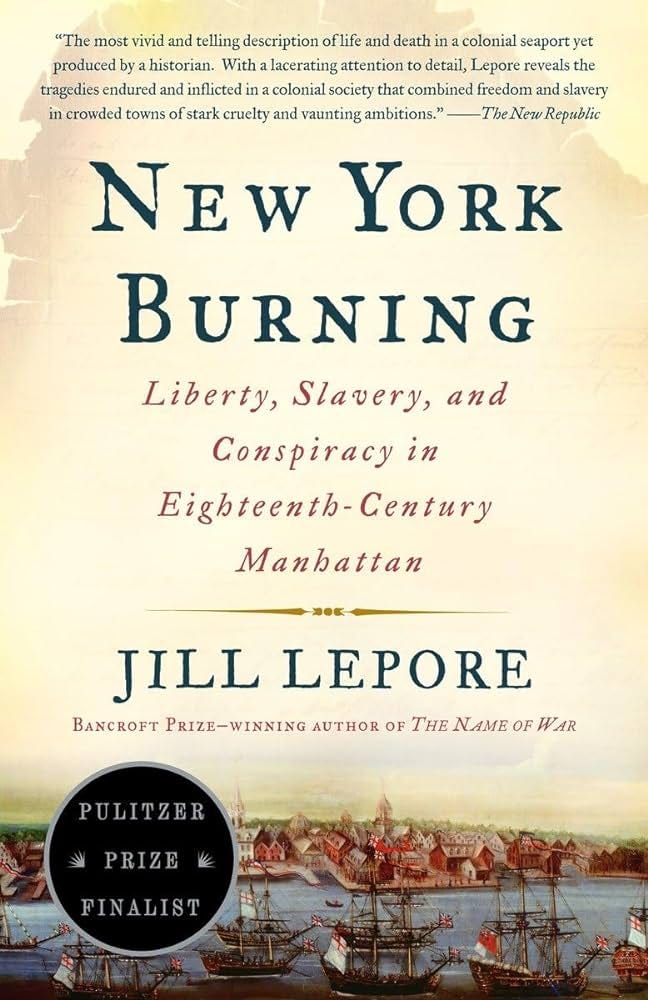
Hello all. While you’re all patiently waiting for me to just put out a new narrative episode already (I’m recording!), I figured I’d thank you all for your patience with another bit of writing I did for graduate school in my first semester. We actually learned how to write “proper” book reviews (i.e. the kind that appear in academic journals) and the one that I was assigned was for Jill Lepore’s excellent 2005 book, New York Burning: Liberty, Slavery, and Conspiracy in Eighteenth Century Manhattan. This book both inspired me in my final project concerning the Salem witch trials, as well as my thesis that I’ve started working on, and even though it wasn’t exactly obvious that Lepore was making the argument I saw embedded in the work, I think I make a good case that the argument can be made.
So please enjoy this short review of New York Burning, and feel free to let me know your thoughts in the comments.
Much talk is had in 21st century about American citizens' falling trust in institutions, thanks largely to institutional failures in the face of crises, from financial collapse to global pandemics. What is less obvious, except perhaps to the historian, is the fact that American institutions have been under threat of decay throughout and even before the country's official history began. This is the central concern of Jill Lepore's New York Burning: Liberty, Slavery, and Conspriacy in Eighteenth-Century Manhattan (2005). The story the book tells centers around the fires that broke out around the city in the spring of 1741 and the social panic it unleashed, leading to the arrest and execution of thirty black slaves (both by hanging and burning). Despite the arrest of twenty whites and the execution of four, it was clear that the social panic that drove the hundreds of arrests was rooted in racial fear. As Jill Lepore notes, “across the city, panicked citizens fled their houses in confusion. […] From street to street New Yorkers began to cry, 'The Negroes are rising!'”1 Lepore makes it clear that race and racism was at the center of this panic, but throughout the book, she is also making a broader, more complex point about New York in the 18th century. What is ultimately clear is that the decay of New York's institutions, and thus the city's social fabric, is on trial—from aspects as granular as responses to the fire to aspects as fundamental as the city's legal system itself. Through Lepore's analysis, we are treated to a vision of a society built upon institutions moving through a process of decay, with the most morally decayed institution—that is, American slavery—at its center, acting as a gravitational force on all of this decay. This is all demonstrated by the story Lepore weaves and the structure on which it's built, in which each chapter's symbolic titles—named after various “elements” including fire, ice, stone, paper, water, blood, and ink—explores how each of these symbols represents the decay faced by New York citizens in 1741.
Drawing from mostly primary sources like newspaper articles, surviving court documents, and the summaries written by one of the principal actors (Judge Daniel Horsmanden, whose perspective is inherently problematic to the issues at hand), Jill Lepore uses these symbols as launchpads for the evidence that illustrates her broader point about the “granite island” that was New York: that “one in five inhabitants was enslaved, making Manhattan second only to Charleston, South Carolina, in a wretched calculus of urban unfreedom.”2 After spending the prologue describing the alleged plot in which “the island's slaves had allegedly formed a conspiracy whose 'grand design was to choose them a King,' who would lead them in killing white men, burning their houses, and taking white women as wives,” Lepore begins her exploration of New York's institutional decay by looking at the environmental context of the events in question: bitter cold.3 This is evidenced by newspaper reports from the time, with the printer John Peter Zenger's Weekly Journal reporting that “the poor [are] in great want of wood,” and Lepore noting that while the more well-to-do of New York's citizens could escape the cold seeing George Farquhar's play The Beaux' Strategem, many of the less fortunate—slaves among them—escaped the cold by venturing into less reputable locations, including John Hughson's tavern.4 The implication of this contrast seems to be that institutional failure is evidenced by the contrast between rich and poor, but more to the point, free and enslaved.
From this implication, we move onto a closer examination of the fires that consumed parts of Manhattan in the spring of 1741, getting both the context of Manhattan's firefighting codes and procedures formed earlier in the century, and in the events of the blazes themselves. The notion of failed institutions comes across most prominently in the reactions of a number of witnesses to it. Lepore notes the alleged reaction of a slave named Dundee who, upon witnessing the Governor's House burning, said to his friend Patrick that “'he wished the governor had been burnt in the middle of it.'”5 This is paired with the reaction of another slave named Cuffee, who, after laughing at an outraged onlooker, “danced, [as] the flames spread from the roof of the Governor's Mansion to the chapel and the barracks.”6 This doesn't demonstrate guilt or complicity; this demonstrates celebration at the symbolic destruction of the very institution that enslaved both Dundee and Cuffee.
The theme of institutional decay is most pointed in the chapters called “Stone” and “Paper,” in which Lepore conducts her careful examination of the trials that sought to wring guilt from the enslaved population of New York. This can be seen most clearly when Lepore writes that “City Hall stood solid, stone upon stone, but the court that met inside its walls rested on a shaky foundation.”7 What makes this the most pointed is how directly tied to the other major event that defines the book, which is the outcome of the John Peter Zenger trial of 1738. Through careful documentation of the dismissals and promotions of judges in the Supreme Court of New York, Lepore demonstrates that this “shaky foundation” was formed by the bruised egos of the judges in charge—particularly in the figure of Justice John Horsmanden. Despite the best efforts to convict Zenger in the libel case brought against him, the jury found Zenger not guilty, “'upon which there were three Huzzas in the Hall.'” In our modern context, this is a victory of justice: a jury of Zenger's peers found him not guilty. But because of the context in which this court was operating—New York in the 1730s under the purview of ethically compromised judges—this was seen by the authorities as disrespect to their authority. And thus, Lepore suggests, Horsmanden had it on his mind—up to and past the 1741 arson cases—that he needed to not just rehabilitate his reputation but assert his authority. The irony that this in and of itself undermined institutional authority was no doubt lost on him. The institutional failings are made all the more plain by Lepore's exploration of the actual process, which she describes as being one of a “pageant, intended to produce a confession,” in which “the imprisonment, interrogation, and trial” as well as “execution” all played parts.8 In the subsequent chapters focusing on “water” and “blood,” Lepore also makes it clear that the institutions had fundamental holes through the presence of “Spanish Negroes,” whose case for freedom was largely ignored, and that thanks to the recent outbreak of war between Spain and England there was a fear among New Yorkers “of religiously inspired rebellion flow[ing] from Catholicism.”9 Ultimately, what makes the theme of failed institutions the most apparent is the fact that there was at least one person at the time who felt the same way (and the thematic focus of the “ink” chapter): the anonymous writer of the letter that made explicit the disturbing parallels between the clear miscarriages of justice that had occurred in the court—thanks to lack of real evidence, contradictory testimony, and the inability for blacks to testify against whites (all evidence of institutional decay)—and the gross violations of decency and law that had taken place in Salem only half a century earlier.10
But what is made clearest by Jill Lepore throughout her book is that the ultimate institutional failure was the one that arguably had the most systemic power at the time—that of human bondage. In the end, hundreds of black New Yorkers had been arrested and over two dozen had been killed, often in a gruesome, medieval manner. This was indeed made possible by the racism in place—like that in the heart of Daniel Horsmanden—but that racism meant very little without the institutional decay that allowed for its fortitude in the first place, in a social panic-driven courtroom and snow-choked city.
Bibliography:
Lepore, Jill. New York Burning: Liberty, Slavery, and Conspriacy in Eighteenth-Century Manhattan. New York: Alfred A. Knopf, 2005.
Van Buskirk, Judith. “New York Burning: Liberty, Slavery, and Conspiracy in Eighteenth‐ Century Manhattan by Jill Lepore.” The American Historical Review, 111, no. 5 (December 2006): 1503-1504. https://www.jstor.org/stable/10.1086/ahr.111.5.1503
Citations:
1. Jill Lepore, New York Burning: Liberty, Slavery, and Conspriacy in Eighteenth-Century Manhattan (New York: Alfred A. Knopf, 2005), 50.
2. Lepore, preface in New York Burning, xii.
3. Lepore, New York Burning, 11.
4. Ibid., 6-9, 15-16.
5. Ibid., 43.
6. Ibid., 44.
7. Ibid., 70.
8. Ibid., 105
9. Ibid., 183.
10. Ibid., 203-205.