



It is not often that I review another creator’s and, now, scholar’s work. I have certainly done so more often recently, namely with my attempt to challenge Darryl Cooper (aka Martyr Made) and his assertions about the Third Reich, though if I am being honest, that had more to do with my personal relationship with Darryl and wanting to clear up any confusion my listeners and readers might have had with my position on the guy and his work. However, as I have spent more time in graduate school, I have started to see a lot more value in constructive critique in fellow historians’ (in training, in my case) work, if only to strengthen my own positions and force them to do the same. This is another reason I have become a fan of the new podcast Crackpot History, which is currently doing close (if at times, in my opinion, overly harsh) critiques of Darryl’s “Fear and Loathing in the New Jerusalem” series, acting as essentially a one-man peer review machine and doing something I’ve been hoping would become more common in the historical podcasting space.1 However, this kind of critique from me also does not happen often because there is only so much in which I feel confident to call myself well-versed, limiting me mostly to World War II, proto-Israeli history, and a smattering of other topics from the late 19th and early 20th centuries.
Therefore, when I had a chance to read the historian Matthew Ghobrial Cockerill’s 2024 academic paper “Did the Nazis plan to extend the final solution beyond Europe? Assessing the evidence”, I felt there was enough I could contribute to the discourse in which it engages to provide a substantial and, hopefully, compelling critique of some of its aspects.2 The closer I examined the paper, however, the clearer it became that Cockerill was omitting some particularly significant pieces of information that are part of the historical record—these omissions included the extent of the Third Reich’s interventions and propaganda in the Middle East, the relationships the Third Reich cultivated with various Arab nationalist groups in Egypt and the Palestinian Mandate, and most relevantly to my own interests and those of my listeners/readers, the significance of the Grand Mufti of Jerusalem Hajj Amin al-Husseini’s collaboration with the Third Reich. Thus, the only possible explanation for these omissions, as best I could and can tell, was that they harmed his paper’s thesis and, by extension given the context of his presence, political preoccupations, and behavior online, his overall goals and motivations for writing the paper in the first place.
For context, Cockerill is not simply a historian (though he is indeed that, as a Ph.D. candidate at the London School of Economics, which is no small feat). He is also the host of the YouTube channel/podcast History Speaks, and a frequent and relatively successful poster on X. He is mostly known there for being a little more than combative, angrily sparring with various figures, especially those who defend Israel and its conduct in the ongoing Israel-Hamas War, and firmly establishing himself within the anti-Israel camp when it comes to the ongoing debate. Outside of that and this paper I am about to review, I must confess I know precious little about him or his work, but similar to Darryl Cooper, there does appear to be a pretty fundamental disconnect between his professional work and his online conduct.
To be clear, I do not particularly care for Cockerill’s online conduct, but that does little to dampen what respect I do have for his seemingly solid knowledge on this fraught subject, and his willingness to put himself out there despite being an academic (not many of us are willing to take such risks). From my perspective, his passion seems to cause him to often get out over his skis, but that is for him and his opponents to contend with. I recommend people watch his lengthy and occasionally heated debate with Noam Dworman to both get a sense of this passion (including some cheap shots implying Noam simply thinks Arabs are “primitive aliens,” if you’ll allow me to poison the well a little), but also his positions on current events.
When he is not spending hours on X repeating the genocide accusations that have become so en vogue in Israel-Hamas War discourse over the last nearly two years (and ones I have and continue to dispute as an obvious example of, at best, ideologically-motivated concept creep), Cockerill is indeed engaging with some important historical questions that exist on the margins of Third Reich and World War II history, a place I currently consider one of my intellectual homes. In his aforementioned paper, the question he seeks to tackle is right in the title: Did the Nazis plan to extend the final solution beyond Europe? This is a fraught question and one, as Cockerill demonstrates, many historians—including truly reputable ones—have struggled with for many years. In the narrowest sense (a distinction whose importance will soon become clear) seeks to provide a more definitive answer, using the evidence that is available.
The first thing that I believe is worth mentioning is positive: Cockerill makes a compelling case for giving a relatively resounding “no” to this question. He sticks to the evidence he provides, and makes it clear that, despite what some historians have claimed, their claims of the Final Solution explicitly targeting French colonial holdings in North Africa and the Middle East, as well as the Palestinian Mandate under the British, are largely unfounded based on the evidence that he claims has thus far been presented in previous scholarship. According to Cockerill, these claims have rested on interpretations of the infamous Wannsee Protocol’s reference to the Jews found in “Unoccupied France,” which Cockerill summarizes as follows:
Citing the Protocol’s reference to a Jewish population of 700,000 in “Unoccupied France”—a population that was to be exterminated—Peter Longerich, Francis Nicosia, and other scholars contend that this figure referred to French North-African Jewry, and therefore conclude that there was a concrete German plan to exterminate these Jews.
Continuing, Cockerill cites the work of Klaus-Michael Mallmann and Martin Cüppers in their 2006 monograph, Nazi Palestine: The Plans for the Extermination of the Jews in Palestine. According to Cockerill, “the book aspires to prove that Nazi extermination of the Jews in Egypt and Palestine was planned and imminent in 1942, forestalled only by German military defeat in North Africa,” claiming that in their citation of the planned establishment of an Einsatzgruppe Egypt in both Egypt and the Palestinian Mandate, “Mallmann and Cüppers interpret the planned establishment […] as evidence of a German plan to exterminate the Jews of the Middle East and North Africa.” I have not yet read the Mallmann and Cüppers book (though it is on my list and will likely be a source for the final episode of the “Muslim Nazis” series), so I cannot speak to the accuracy of this interpretation. However, Cockerill contrasts their work well with the work of the former chief historian at Yad Vashem in Israel, Dan Michman, who “concludes that there was no concrete German plan or program to do so” and “that the category of Jews in ‘unoccupied France’ referred only to Jews in the southern region of continental France unoccupied by the Germans.” Cockerill thus demonstrates that there is not a historical consensus on the Nazis’ plans for the Middle East in the context of the Wannsee Protocol (emphasis there being the key distinction for our purposes here).
Cockerill also contests the arguments made by scholars Marvin Tokayer and Mary Swartz about the Nazis’ plans to go after the small Jewish community that had established itself in Shanghai, known as the Meisinger Plan, named after its alleged architect, the SS functionary Josef Albert Meisinger, known as the “Butcher of Warsaw.” As Cockerill explains, this plan “probably did not exist” because “[i]t lacks any documentation, is contradicted by contemporaneous Japanese documentation, and relies on a single—and highly problematic—piece of eyewitness testimony.” This is an interesting-enough tangent and one that I will likely revisit in History Impossible one day (since no matter what I say, I am sure I will have trouble escaping the gravitational pull of WWII as a subject), but it is, again, something I have not examined so I cannot effectively critique this part of Cockerill’s analysis either. He seems, again, to have his sources in order when it comes to this, and the skepticism he deploys here feels more than reasonable.
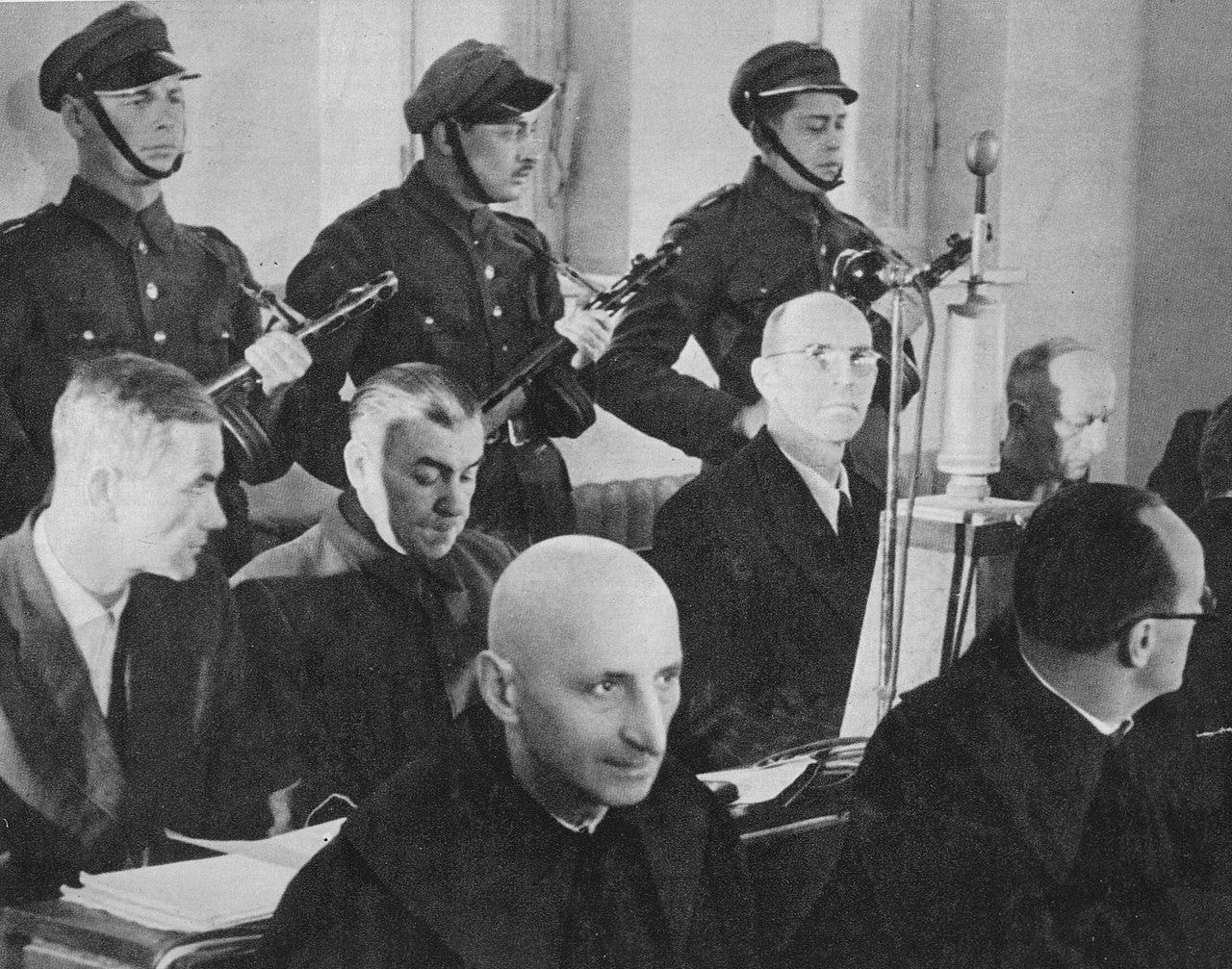
Things begin to deteriorate from here on out. Cockerill appears to provide the appropriate lip service to the conclusions from Dan Michman, pointing out that Michman “believes that a victorious Nazi Germany would have moved to exterminate North African and Middle Eastern Jewry.” However, this is also where Cockerill’s argument starts to feel like it is standing on shakier ground. This is not due to any factual inaccuracies—not necessarily—but more due to what can only be described as an almost lawyer-like act of pedantic suggestion. As Cockerill writes, “an examination of numerous statements by top Nazi leaders—people in a position to know about state policy towards the Jews—provides further grounds to doubt that the German ‘Final Solution’ policy applied to non-European Jews” [emphasis added]. Continuing later, Cockerill explains that in looking “various incriminatory statements by Hitler, Rosenberg, Ley, SS-Reichsführer Heinrich Himmler, Reich Security Main Office director Reinhard Heydrich, General Government administrator Hans Frank, and Nazi Propaganda Minister Josef Goebbels […] none refer to a plan or policy of exterminating Jewry outside of Europe.”
There is nothing controversial on the face of these statements because they are, in essence, all true, but specifically—as I alluded to above—in the context of policy, rather than the more overall context that also encompasses vital aspects of decision-making that leads to policy. That is, the question of overall intent, which is key for establishing that serious of a crime—genocide, in this case—has taken place, is left unaddressed. One might wish to claim that actual policy is all that matters because this is merely what Cockerill is examining in his paper, and that is certainly true if we are to critique this paper in a vacuum, but it also clashes with an acknowledgement Cockerill made earlier that any scholar of the Holocaust must make: that outside of the Wannsee Conference, there was never anything even resembling a written order for the Holocaust from Adolf Hitler. As Cockerill writes, “no original copy of a Führer order for the extermination of the European Jews has been identified” and that “common sense requires us to accept that such an order existed, given the systematic and homogeneous nature of the exterminations.” Common sense indeed.
This matters because it can both be true that explicit, documented orders were made regarding aspects of the Holocaust, but also that explicit, documented orders were not needed for the Holocaust to happen in its entirety. There is a reason that Hitler’s famous “prophecy” from January 30th, 1939, to the Reichstag in which he said “the extermination of the Jewish race in Europe” would happen if “they” plunged Europe back into war is so often invoked as a significant piece of evidence for the Fuhrer’s intentions. Early on his paper, Cockerill himself invoked this very claim to make his case that no actual order was needed to prove that Hitler was complicit in the execution of the Holocaust; as Cockerill himself said, this is “common sense.” So the question becomes: why should this common sense not apply to other, potential plans the Nazis had for the world’s Jews? Why should there be painstaking documentary evidence of such an order, when it is not required to establish not just the policy of exterminating Europe’s Jews, but also the Nazis’ intent to do so? These questions become hard to avoid given the standards Cockerill applied.
It might seem odd on the face of it to focus on this inconsistency, small as it might appear. On the one hand, this simply could be reduced to direct statements of fact and nothing more. But on the other, they must be taken in the context of both a.) the priorities Cockerill at the very least appears to possess in his online conduct, and b.) some of the other omissions and possibly even distortions that occur later in his paper. Needless to say, this small inconsistency set off the proverbial alarm bells that there could be other issues with this otherwise solid academic paper. This is why these contexts cannot be separated when examining this paper’s quality. And indeed, upon closer examination of what is stated—and more to the point, not stated—in this paper, some pretty jarring issues and, by extension, implications start to emerge.
…
When it comes to the context of Cockerill’s online conduct, one does not need to go through his frequent daily posts over on X to witness the problem of Cockerill’s own bias. He is free to have his bias, as we all are, and he does not hide it or hide behind anonymity, which, despite his views largely aligning with most historians (or at least history students) in academia, is a relatively rare and brave thing to do. Reckless, too, might be another way to describe it, given the amount of times he personally attacks people by calling them “frauds” and the like, but nevertheless, credit should be given where credit is due. He is calling balls and strikes as he sees them on a contentious issue—that is, the ongoing Israeli-Palestinian conflict—and doing so loudly and publicly, despite the potential for harming his professional reputation. Regardless of what one thinks of his assertions, the fact that he does it at all, especially as a true academic, is admirable in a way, even if he is more likely than not surrounded by likeminded people when it comes to the Israeli-Palestinian conflict.
However, the reason one does not need to perform a social media autopsy of Cockerill’s online conduct is that he essentially play-acted that conduct live for all of us to see in his contentious conversation with Noam Dworman that was mentioned above. While that particular debate was frustrating to watch and listen to, it did contain some valuable information; namely that Cockerill is often unwilling to concede certain points without qualification as a matter of his own stubbornness rather than seeking to find a common baseline. That tendency reveals nothing apart from perhaps a character trait that often serves online content creators well—a stubborn refusal to bend in the face of your opponents is good optics, especially when you position yourself as a valiant (and suppressed?) truth teller. What was more revealing about his debate with Noam is exactly what he had difficulty conceding: namely, that blame and, thus, moral responsibility for the ongoing war and suffering in Gaza can be reasonably applied to Hamas in particular, and, in some cases, more radical Islamic culture in general. Cockerill never went full-scale, mask-off radical the way Mahmoud Khalil did on Ezra Klein’s podcast, but he made it very clear that he believes Israel is the primary, if not sole, actor with moral responsibility in this war. The problem, as I see it from my perspective as a historian in training, is a fundamental misunderstanding (willful or otherwise) of universal human agency, and this potentially helps explain some of the shortcomings in Cockerill’s scholarship, which we will more closely examine shortly.
To make my stance clear, I believe accepting that all human beings and groups have agency—and thus moral responsibility—is the most important part of understanding history. This is because providing agency to people many years—centuries, millennia—long-dead connects us to them and reminds us that these are not aliens; they are human beings just like us, relatively unchanged outside of cultural values, geographic dispersion, and technological sophistication. I suspect Cockerill understands this—he is a trained historian, after all—but I am not certain he accepts it as the truth or a valid perspective, at least consistently, especially when it comes to this conflict. This is understandable when one has a vested interest in the outcome of a conflict that has not yet ended, because when a true respect for agency enters the mix, things start to become quite morally gray, and that can often be a very ugly thing to witness. Primo Levi made this abundantly clear in his masterpiece, The Drowned and the Saved, in which he discussed the phenomenon of the Jewish Sonderkommando forced to dispose of their Jewish brethren’s bodies for an additional six months of relatively comfortable life (before they too would be gassed like the rest). This is the challenge to which Cockerill must rise, and in the context of his online behavior, he fails to do so. And unfortunately, it appears that this is also a problem in his paper.
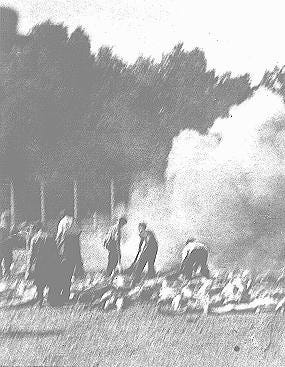
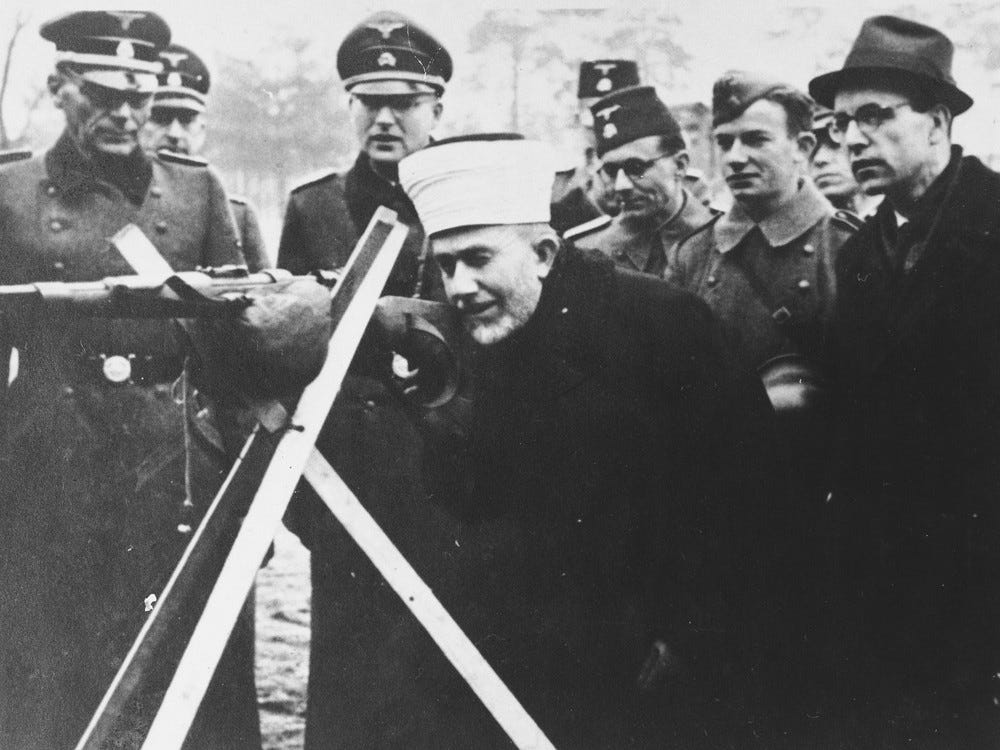
In looking to provide the definitive negative on “the question as to whether Nazi Germany had, in our real historical timeline, developed a plan or policy to exterminate Palestinian Jewry,” Cockerill makes some problematic omissions that at first seemed like an honest, if still major, mistake on his part. Specifically, he addressed the always-controversial presence of the Grand Mufti of Jerusalem, Hajj Amin al-Husseini, and accounts of his meeting with Adolf Hitler, and even his knowledge of what would come to be known as the Final Solution. To first be fair, Cockerill highlights some inconsistencies in how the meeting was recorded that are worth highlighting, if only because there is still a wealth of misinformation about that meeting. First, he points out that the claim made by many historians—including the celebrated Christopher Browning—that the Nazis’ plan for the Jews of the Palestinian Mandate, which came from Dr. Paul Otto Schmidt, Hitler’s interpreter, conflicts with the account given by the Nazi Orientalist Fritz Grobba. As Cockerill writes, “Grobba quotes Hitler as saying that following German victory, Germany would carry out the destruction of the ‘power protecting the Jews’ in Palestine, i.e. the destruction of British colonial power.” This is corroborated by Hajj Amin’s own recollection of the 1941 meeting in his own memoirs, in which he also admitted his own knowledge of the extent of the Final Solution by 1943, thanks to his many conversations with Himmler.
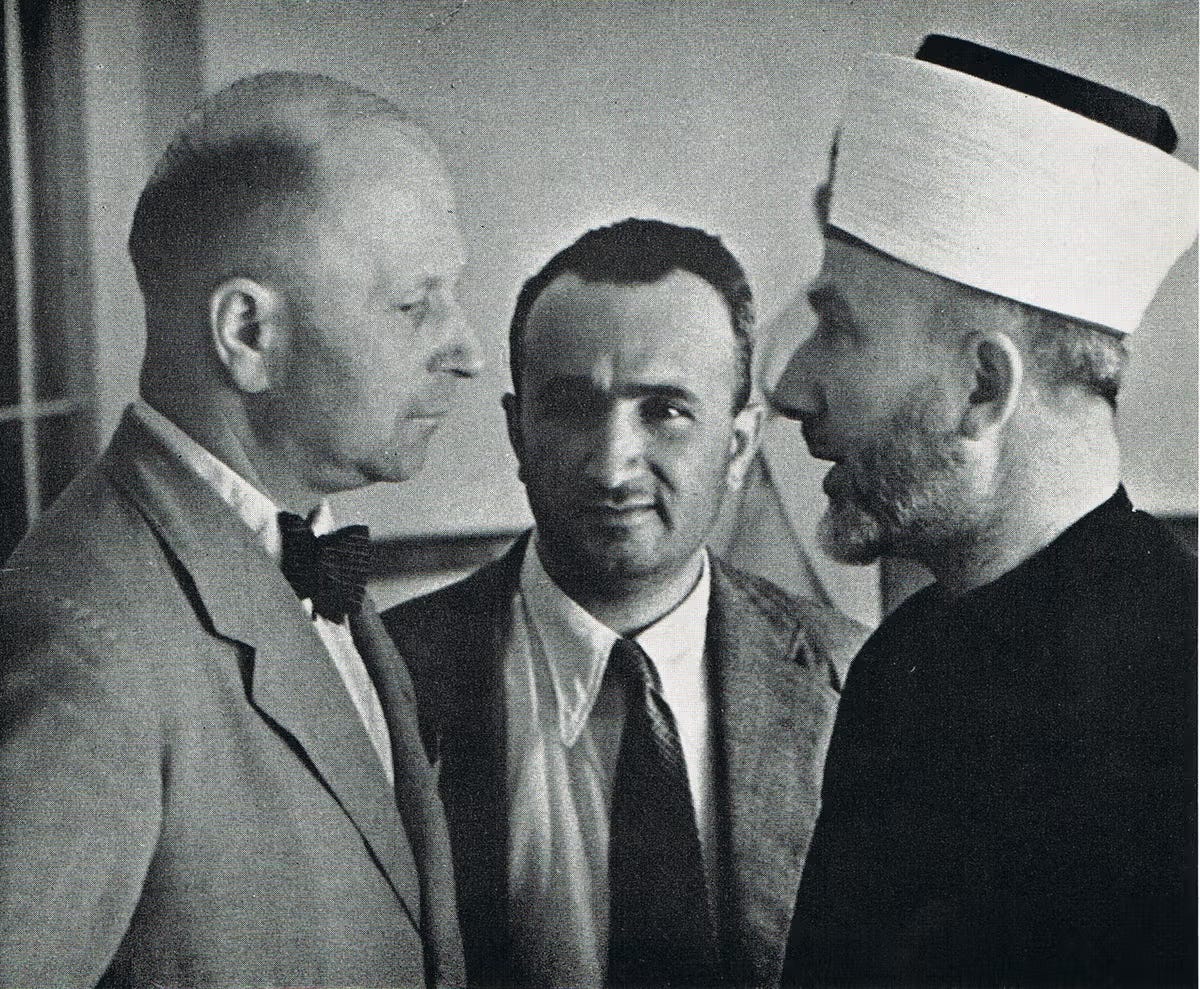
From there, Cockerill uses this fact to claim that Grobba’s account, in which nothing was directly stated by Hitler about the Jews of the Mandate being targeted, is the likely accurate one, because Hajj Amin would not have lied about what was said in the meeting with Hitler while at the same time being more than willing to admit that he was aware of the liquidation of Europe’s Jews at the hands of the Nazis. This is where the problems arise: this assertion is fine to claim on the face of it and—as is Cockerill’s wont—proves his central point, but there is missing context that ultimately harms what Cockerill is seeking to do, which is, it should be clear, to place all moral agency upon those who opposed Palestinian nationalism and thus, by extension to today, Israel. This becomes more difficult to do—and I suspect Cockerill knows this—if the complete picture provided by Hajj Amin’s associations with the Nazis and their shared influence on Palestinian nationalism is provided.
By the time Hajj Amin wrote his memoirs—which, starting in 1968, were published serially in Palestine magazine up until his death in 1974—the Holocaust was so well-documented that very few people were in any position to deny anything about it, particularly when so much had been said and written about Hajj Amin’s own knowledge and, as Cockerill notably leaves out of his analysis, documented complicity in it. In fact, Hajj Amin even admitted this complicity, in however a roundabout way, in his own memoirs (which Cockerill claims to have at least in part translated), when he stated the following:
There were other serious occurrences during the war, such as the attempt by world Jewry in 1944 to bring about the immigration of Eastern European Jewry to Palestine […] just as today they are trying to prompt countries in the East, such as Russia, the Balkan states, and Eastern Europe, to allow Jewish immigration to occupied Palestine. I objected to this attempt, and wrote to Ribbentrop, to Himmler and to Hitler […] until I succeeded in frustrating the attempt. [Emphasis added]
The important thing for us to notice is that in this passage, Hajj Amin was admitting that he “succeeded in frustrating the attempt” in the late 1960s and early 1970s while he was writing his memoirs. And yet, this completely contradicts his defenses against being considered a war criminal by the Allies after the end of the war. Hajj Amin was careful, as his one of his biographers Zvi Elpeleg points out, to “continually [insist] that he had not been involved in the destruction of the Jews, [because] he was afraid that he would be brought to trial for crimes of which, according to him, he was falsely accused.” It appears, at least to me and several modern scholars who have studied the life and deeds of Hajj Amin, that the mufti simply could not help himself and gloat about his attempted role in the Final Solution, which he framed “simply” as stopping the emigration process of Jews into the Palestinian Mandate, instead of outright admitting to what he was referring.
To return to a key point of the last episode of History Impossible’s “Muslim Nazis” series—perhaps the most significant point when discussing the Grand Mufti—it had also long been known that Hajj Amin had attempted to insert himself into the Nazis’ Final Solution that he, by his own admission and according to other Nazis’ testimony, was more than aware was occurring during his time spent with the Third Reich. The evidence for this was unearthed as early as 1946, when American journalist Edgar Ansel Mowrer obtained, translated, and published, in the New York Post, the letters Hajj Amin had written to the Hungarian and Romanian foreign ministers. What was in these letters? In his June 28th, 1943, letter to the Hungarian foreign minister Yenő Gitsi, Hajj Amin complained of a “wicked” plan by the Hungarian government to send 900 Hungarian Jewish children to Palestine. Hajj Amin then demanded that the Jewish refugees needed to be stopped from leaving Hungary. In explaining—justifying, really—why he thought this was necessary, Hajj Amin wrote the following:
[This emigration of Hungarian Jews to Palestine] would by no means solve the Jewish problem and would certainly not protect your country against their evil influence […] for this escape would make it possible for them to communicate and combine freely with their racial brethren in enemy countries [these are mostly children he's talking about, remember] in order to strengthen their position and to exert a more dangerous influence on the outcome of the war. [Behind the ambition for a Jewish state in Palestine] lies the hope which the Jews have never relinquished, namely the domination of the whole world through this important strategic center, Palestine. […] However, the war, as well as the understanding which the members of the [Tripartite Pact] have of the responsibility of the Jews for its outbreak, and finally their evil intentions towards those countries which protected them until now—all these are reasons for placing them under such vigilant control as will definitely stop their emigration to Palestine or elsewhere.
As I said in that episode of History Impossible, that last bit is key: Hajj Amin did not want to see the Jews escape to Palestine, but he also did not want to see the Jews escape to anywhere. And better yet, he had a solution. In that letter, he recommended that “it would be indispensable and infinitely preferable to send them to other countries where they would find themselves under active control, for example, in Poland, in order thereby to protect oneself from their menace and avoid the consequent damage.” It is also important to point out that this was in June of 1943. In the same passage Cockerill quoted from Hajj Amin’s memoirs, the mufti wrote that, “In his remarks during the summer of 1943, Himmler told me, so far we have exterminated about 3 million of them.” Thus, as the journalist Mowrer wrote in his 1946 article, “To anyone who, like Hajj Amin, knew that Poland had been set aside as the extermination hell of European Jewry, this meant sending the Balkan Jews, including children to certain and horrible death.”
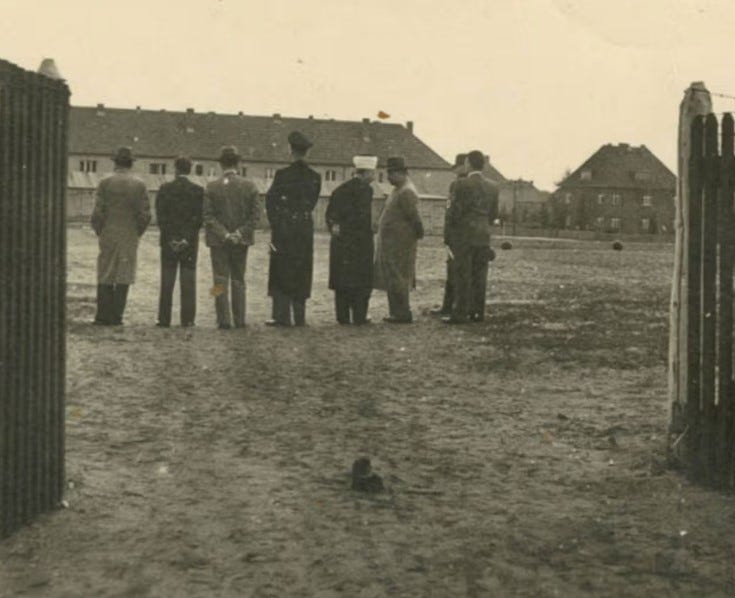
So of course, to return to Cockerill’s original assertion, Hajj Amin had no incentive to lie and pretend that he did not know about the Final Solution by the time he wrote his memoirs, given the mountains of evidence suggesting otherwise, and his complete lack of shame regarding the issue. However, despite his reckless semi-admission of guilt in his memoirs, Hajj Amin had every incentive in denying his attempted role in the Final Solution because he knew that would be the one thing that could put him at risk for prosecution at Nuremberg or in Israel, as had happened with Eichmann. There had, after all, been a target on his back since his escape from postwar Europe, from several different sources including the Americans, the British, and, eventually, the Israelis.
This level of pedantry matters because for Cockerill to point to Hajj Amin’s admitted knowledge of the Final Solution but not acknowledge this well-known and well-sourced claim that Hajj Amin attempted to contribute to it is a glaring omission of context. While again, one can say in Cockerill’s defense that he is simply trying to disprove any historical claims of Nazi plans to exterminate the Jews of Palestine, his use of Hajj Amin’s own testimony—hardly the only evidence upon which such a claim can be disproven or at least called into question—makes one raise an eyebrow. While there is likely no way to know this for sure, it seems probable that Cockerill used Hajj Amin’s admission of knowledge as a way to deflect criticism of easily-demonstrable bias while also confirming his own thesis. Hajj Amin is a contentious figure and often times those who consider themselves advocates for the Palestinian people—as Cockerill no doubt does—like to either downplay Hajj Amin altogether or even outright lie about him.
Cockerill, to his credit, does neither, and is too-sophisticated a historian for that. On the face of it, it is admirable that he, an outspoken advocate for the Palestinian cause, is willing to demonstrate that Hajj Amin was indeed aware of the Holocaust in that context, given both Hajj Amin’s own words and the more recent documentary evidence discussed in Tablet in 2021. This places Cockerill in a league far beyond most of those currently engaging in the Palestinian historiography, including some of the most well-known luminaries of that persuasion like Ilan Pappe and Rashid Khalidi, who similarly do what they can to evade the contentious reality of the Grand Mufti. In addition, Cockerill translating that part of Hajj Amin’s memoirs is a welcome addition to any scholarship.
In effect, however, Cockerill’s recontextualization of Hajj Amin in this way, absent the other vital context also appears to essentially sanitize Hajj Amin to a certain extent. This may be more of a coincidence than anything calculated on Cockerill’s part, but it nonetheless is the effect of his framing. Thus, in a curious twist, by highlighting Hajj Amin’s willingness to admit his knowledge of the Final Solution in order to absolve the Third Reich of any claims that they were planning to target the Palestinian Mandate’s Jews, Cockerill essentially downplays Hajj Amin’s own attempted complicity in the crime that the mufti almost certainly would have loved to see applied to his old homeland.
…
This leads us to a much broader problem with Cockerill’s thesis and its implications. By focusing on the Third Reich’s policies, or lack thereof, regarding the Jews living outside of the Third Reich, Cockerill neglects the other, no less significant efforts made by the Nazis to influence the perception of Jews in these places, particularly in the Middle East in and around the Palestinian Mandate, as well as thwart the Zionist project itself in the context of making emigration to the Holy Land all the more difficult. This is the real gaping hole in Cockerill’s particularist approach to disproving the claims that the Nazis planned to expand the Final Solution outside of Europe.
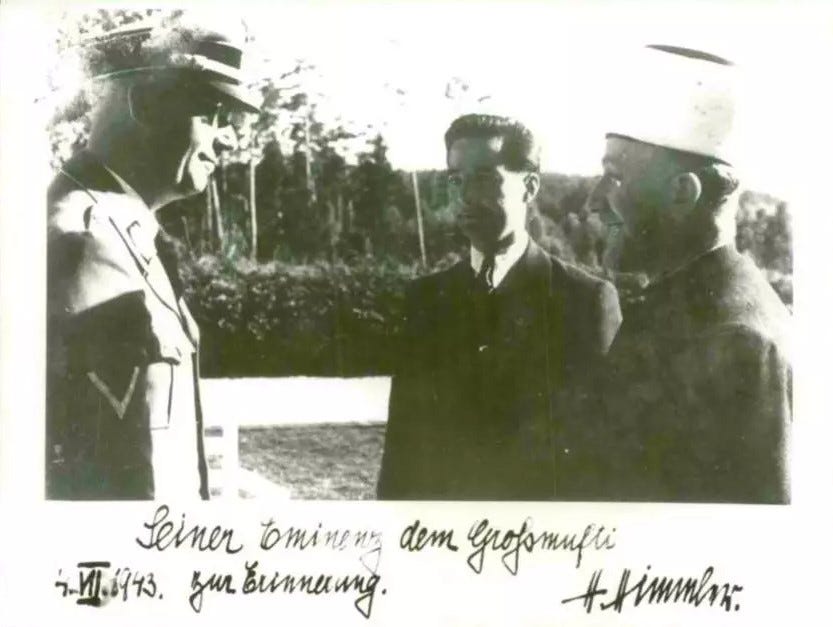
In the case of the former issue, Cockerill never addresses a very significant part of the Nazis’ antisemitic propaganda efforts: that is, the propaganda campaigns that had been expanded into the Middle East. As historian Jeffrey Herf has revealed in his own scholarship, the Nazis’ Arabic language propaganda program was second only to their Russian language propaganda program in terms of scale. This is a curious omission on the part of Cockerill because Herf’s book, Nazi Propaganda for the Arab World, is cited in his bibliography, likely because a not-insignificant amount of Cockerill’s secondary information came from this book, if only from its extensive bibliography. Given this, it is unlikely that Cockerill could have missed Herf’s summary of the Nazi propaganda efforts in the Middle East:
In coordination with [Joachim von Ribbentrop's Foreign Ministry], the Orient Office [in the Reich Political Department under the direction of Orientalist Wilhelm Melchers] established guidelines for propaganda and political strategy toward Egypt, Afghanistan, Saudi Arabia, Palestine, Syria, Turkey, India, Iran, Sudan, and Ceylon. […] The [other] Orient Office in the Radio Department [of the Foreign Office] met regularly with the Orient Office in the Political Department, one that included experts on the region and officials responsible for contact with prominent Arab exiles, such as Hajj Amin al-Husseini and Rashid Ali al-Gaylani. Among the various divisions of the Foreign Ministry working on foreign-language broadcasts to Europe and indeed all over the globe, only the Russian division's staff of 51 was larger. [Emphasis added]
We have covered the kinds of things stated in the Nazi propaganda spread throughout the Middle East that has not been lost to history in the aforementioned episode of History Impossible, but it is important for us to revisit some of it so it can be apparent what is being left out of the equation being provided by Cockerill. Most of the propaganda pumped out the Orient Offices always lighted upon one central theme: that the British, Americans, and Russians were all degenerate tools of the manipulative Jews and were thus dangerous to Arab autonomy and Islamic moral supremacy. This theme was one approved by Hajj Amin al-Husseini and other supposed Arab and Islamic experts working within these offices. On July 7th, 1942 a broadcast approved by Hajj Amin al-Husseini went out that was titled “Kill the Jews Before They Kill You,” allegedly in response to a fabricated rumor that Egyptian Jews were being issued “revolvers with ammunition.” The broadcast included the following exhortations that are worth quoting at length:
In the face of this barbaric procedure by the British, we think it best, if the life of the Egyptian nation is to be saved, that the Egyptians rise as one man to kill the Jews before they have a chance of betraying the Egyptian people. It is the duty of the Egyptians to annihilate the Jews and to destroy their property. Egypt can never forget that it is the Jews who are carrying out Britain's imperialist policy in the Arab countries and that they are the source of all the disasters, which have befallen the countries of the East. The Jews aim at extending their domination throughout the Arab countries, but their future depends on a British victory. That is why they are trying to save Britain from her fate and why Britain is arming them to kill the Arabs and save the British Empire. You must kill the Jews, before they open fire on you. Kill the Jews, who have appropriated your wealth and who are plotting against your security. Arabs of Syria, Iraq, and Palestine, what are you waiting for? The Jews are planning to violate your women, to kill your children, and to destroy you. According to the Muslim religion, the defense of your life is a duty which can only be fulfilled by annihilating the Jews. This is your best opportunity to get rid of this dirty race, which has usurped your rights and brought misfortune and destruction on your countries. Kill the Jews, burn their property, destroy their stores, annihilate these base supporters of British imperialism. Your sole hope of salvation lies in annihilating the Jews before they annihilate you.
There are plenty of other examples of propaganda sent out from the Orient Offices found within the Propaganda and Foreign Ministries of the Third Reich, but this should provide a helpful baseline for the kind of influence the Nazis were trying to exert on various parts of the Middle East.
This therefore begs the question: why would Cockerill omit some of the most striking, and damning, findings from Herf’s scholarship? It is likely because it harms the reliability of Cockerill’s thesis, which is, as he states in the introduction, “that the Germans did not have a concrete plan or policy to exterminate non-European Jews.” As said earlier in this essay, Cockerill demonstrates this particular claim ably enough in the most literal and technical sense, but by sidestepping an analysis of the Third Reich’s propaganda efforts, it at the very least appears that he is trying to make the reader believe that there is nothing to see here at all. Because he cannot completely eschew a discussion on the Nazis’ propaganda efforts if he wants the paper to appear thorough, he focuses instead on “the promotion of anti-Semitism among Japanese intellectuals, politicians, and laypersons.” No doubt this is a fascinating discussion—and it is—but it makes the absence of any analysis of the Nazis’ Middle Eastern efforts—again, the most significant foreign language propaganda program outside of the Russian program—all the more stark. Add this to the aforementioned context of Cockerill’s online conduct and his political preoccupations vis-à-vis the Israel-Hamas War, it starts to create further questions in the reader’s mind.
However, Cockerill’s particularist sidestepping goes deeper, because by confining his claims to there being no concrete plan to expand the Final Solution into other parts of the world (particularly in the Palestinian Mandate and other Middle Eastern countries where nearly a million Jews resided), he is allowing the reader to assume that the Nazis did not truly concern themselves with what was going on in the Middle East, particularly with the Zionists. Cockerill does admit that “after the outbreak of world war, Hitler’s (and thus, the Nazi) view on Jewish immigration to Palestine reversed. Now […] the idea of a Jewish national state was considered ‘a national hub for the destructive influence of Jewish interests.’” However, aside from also admitting that “Hitler prohibited all Jewish emigration out of the Third Reich and Nazi-occupied Europe” after the onset of the war itself, Cockerill does not dwell on what was happening with either the propaganda efforts described above, nor does he discuss what was happening before the Führer’s meeting with Hajj Amin al-Husseini.
In his 2024 book, Nazis, Islamic Antisemitism, and the Middle East, German political scientist and historian Matthias Küntzel explains that “1937 was the year when the Nazi leadership began to give active support to the Mufti’s policy [of keeping Jews out of the Palestinian Mandate].” According to a report from Fritz Grobba, who was the German envoy to Baghdad at the time, two of Hajj Amin’s emissaries approached him for support in the ongoing Arab Revolt that had begun the year before. Once the Peel Commission Plan involving a two-state solution was made known, the Nazis shifted their priorities in the region, which had been relatively ambivalent in the previous four years. They had been aware of Hajj Amin’s activities in the Palestinian Mandate, since he had been gradually forging a diplomatic relationship with the Third Reich (in secret from the British, with whom he was still officially working) since March of 1933. However, when it became clear that supporting the Palestinian cause could act as “a counterweight to any such increase in the power of the Jews,” in the words of Nazi Foreign Minister Konstantin von Neurath, a newfound interest developed. In the words of a Foreign Office circular dated June 27th, 1937 and quoted by Küntzel, “there is […] a huge German interest in developments in Palestine.”

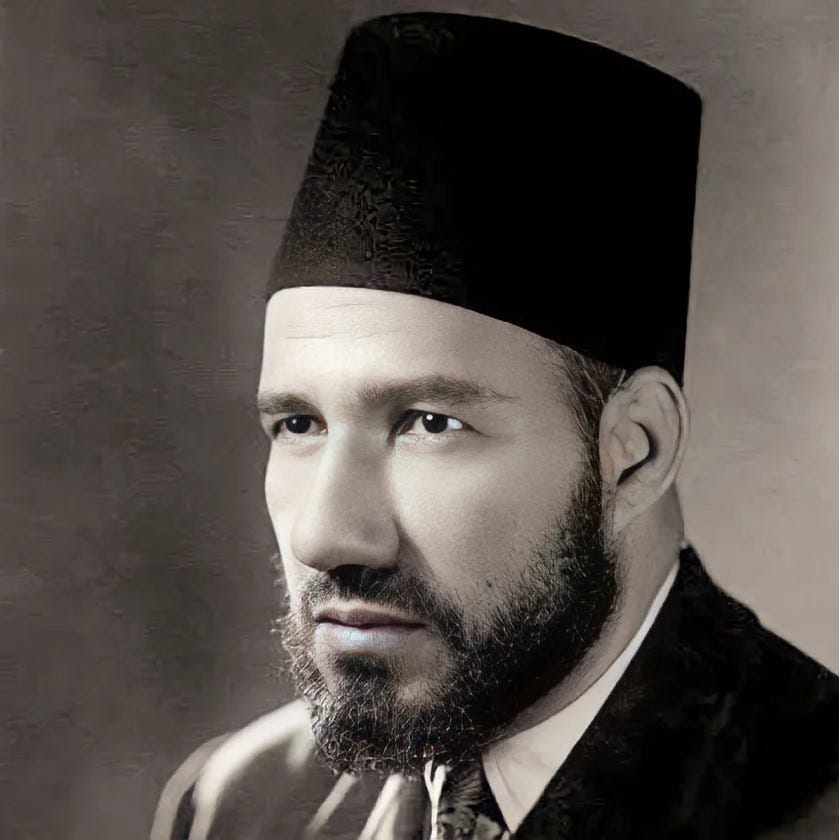
Küntzel notes that much of the primary source documentation for this support “went up in flames in 1945,” like so much valuable historical data, but that there is evidence such documentation did indeed once exist. As Küntzel explains, while looking through the existing archives, he came across a handwritten note regarding a report made on September 4th, 1937, which explained that “Syrian support for a new Arab uprising in Palestine and telegram concerning this of 4.9.37 are located in the records marked ‘Geheim’ [or ‘Secret’].” The “Secret” records were among those lost in 1945. However, it aligns with the little-known facts regarding the Nazis’ early connection to the Muslim Brotherhood, suggesting a preexisting network that helped distribute the propaganda the Nazis were using to try and radicalize the populations of various places, including Egypt and by extension, the Palestinian Mandate. As Küntzel explains, Rudolf Hess’ brother Albert helped organize the “Egyptian section of the Nazi foreign organization, numbering several hundred members,” as early as 1926, two years before the founding of the Muslim Brotherhood by Hasan al-Banna. The relationship between the two organizations began almost immediately. As Küntzel explains:
Until the beginning of the war in September 1939, the Brotherhood’s propaganda efforts were supported by the German Embassy in Cairo and the Deutsche Nachrichtenbüro (DNB), a department of the Nazi propaganda ministry with a broad remit. The DNB furnished the Brotherhood with funds, according to records found in the home of Wilhelm Stellbogen, the head of the DNB office in Egypt.
Documents that revealed this connection between the Muslim Brotherhood and the DNB were recovered by British secret services after the outbreak of the war and the Nazis based in Cairo DNB office had to flee, given the British influence in the region. As the scholar Brynjar Lia explains, the information that the British managed to recover from the vacated office reveal that the funds given by the DNB “were considerably larger than the subsidies offered to other anti-British activists,” and that “these transfers appear to have been coordinated by Hajj Amin al-Husseini and some of his Palestinian contacts in Cairo.” The information retrieved from the abandoned offices of the DNB also revealed the extent to which the Nazis had been involved with the Muslim Brotherhood and how far they were willing to collaborate with them in orchestrating terrorist attacks in the Palestinian Mandate. In the first case, there was a note from Wilhelm Stellbogen that read the following:
Further advance payments to the Moslem Brothers are, in my opinion, very necessary, because these people can do very much. An immediate connection with Berlin through the Legation should be started and more funds asked for. The conversation with Hassanal-Banna about the Palestine question is very satisfactory and likewise Goebbels has spoken about it with much praise.
In the second case, the deputy chairman of the Nazis’ Cairo branch named Ernst Engelen reported the following in another memo:
The last 200 kilos of chlorate have been delivered to Helwan [suburb of Cairo]. We have ourselves advised that, instead of making explosives here, young chemists should be trained for such manufacture and should be sent to Palestine. So far several have left already. The expenses have been paid by the Arabs. We have been asked to assist regularly at the meetings of the Moslem Brethren.
What this shows is that, to directly use Matthias Küntzel’s words, “the Nazis sought to sustain unrest in the Mandate.” More to the point, “In Palestine itself, the Nazis also sought to fan the flames of anti-Jewish and anti-British revolt. German assistance was not confined to advice and encouragement; it also involved supplies of arms and large-scale funding.” These appeals to and material support of the Muslim Brotherhood was not even primarily about resisting the British or causing them trouble in one of their colonies. Küntzel points to another piece of evidence recovered from the DNB office that references the branch’s “Training Officer,” a one Dr. Walter Uppenkamp, who “invited Egyptians and especially Brotherhood members to lectures on ‘the Jewish Question.’”
However indirectly, all of this evidence significantly complicates Cockerill’s core claim that “there was no concrete plan or policy to exterminate Jews outside of Europe.” Certainly, as is the case with any claim that Hitler put pen to paper to approve the Final Solution, there is no memo or report stating “the Final Solution will continue to occur in the Middle East.” However, to use some of my earlier terminology, to even suggest that this absence of direct evidence is proof-dispositive of the Third Reich’s murderous impulses being expanded to include the rest of the world is an almost lawyer-like act of pedantry on Cockerill’s part.
It is best to consider the following: if the Nazis went to all of this trouble to try and radicalize the people of the Middle East against the Jews through their propaganda, and to provide radical Arab nationalists with the means to create further suffering and destruction upon them, is not just as probable that they were attempting to pave the way to either a.) make it easier for them to endear themselves and their genocidal program to Arab locals, b.) try and incite the radicals and radically-inclined among those locals to get the proverbial party started before the Nazis could bring their forces to bear, or c.) perhaps, probably, both?
Cockerill would likely say, as he does regarding the possibility of the Nazis occupying the Mandate at some future date, that this is “a matter of counter-factual history.” Fair enough; most historians are not in the business of counterfactuals. But this strains the patience of anyone annoyed by such obtuseness. In fact, to point out the obtuseness of what amounts to a dismissive hand-wave feels almost redundant, especially given what kinds of attitudes about Jews that the Nazis were trying to engender within the Arab populations of the region. And this is to say nothing of the Nazis’ efforts to materially supply the more radical among these populations, particularly with weapons designed to create terror and death. It was, as we have seen, not just about causing trouble for the British Empire (though that was certainly part of it); that is, unless, there is some kind of tactical advantage from imploring locals over radio broadcasts to annihilate any Jew they could find before the Jews annihilated them, or to educate the masses—particularly the radicals among them—on matters of the so-called “Jewish question.”
…
In sum, Matthew Ghobrial Cockerill’s paper, “Did the Nazis plan to extend the final solution beyond Europe? Assessing the evidence,” seeks to disprove some specific claims made by other scholars and, lest we forget, manages to effectively do so within its very narrow parameters. However, given the other contexts present—namely Cockerill’s online conduct and clear political mission combined with his contextual omissions within his analysis—the paper’s narrow parameters can and should be called into question, as far as overall scholarly usefulness goes. Cockerill does admit in his conclusion that “one can reasonably predict that the Nazi exterminations would have—eventually, at some point—extended to all Jews under Axis control, including outside of Europe.” He also admits that “non-European Jews were victims of genocide.” But his ultimate conclusion is that “in history as it actually unfolded, there was neither an ongoing nor imminent plan to carry this dream out.” [Emphasis added]. If one is willing to admit this, but also disregard all of the evidence that exists suggesting a post-European Final Solution was absolutely in the cards, particularly via the leader of the Palestinian nationalist movement, then why write this paper at all? What could possibly be gained by keeping the focus so narrow as to prove one’s very specific thesis, while omitting the details and surrounding context—including of one’s own cited evidence—that is inconvenient to such claims? The answer, I submit, should be pretty damn obvious.
It is clear from Cockerill’s statements on podcasts and in his claims made via social media and his own Substack, that he seeks to prove that Israel possesses all relevant agency in its current war with Hamas, while Hamas—and Palestinians as a whole—possess none, including within the context of history. It appears that Cockerill also believes that one of the most effective ways to demonstrate this is to suggest that the attempts made by the Third Reich—one of the most morally damning aspects of Palestinian nationalism’s sordid history—at expanding the Final Solution overseas amounted to nothing in a material sense, thus relieving any possibility that Nazi ideology could have provided fuel for what was still relatively nascent Palestinian nationalism.
By leaving out the other attempts by the Third Reich and its most prominent Arab ally, Hajj Amin al-Husseini, to both spread their ideological influence to the Arab world and to increase the number of Jewish victims respectively, Cockerill is essentially removing the possibility that there was an influence of Nazi ideology within the Palestinian nationalist movement after the Second World War ended. By removing that possibility, it helps frame Palestinian nationalists—up to and including Hamas in the 2020s—as passive actors in the face of an Israeli juggernaut hellbent on finishing the job of the Nakba in Gaza, if not wipe the Palestinian people off the face of the earth in summa. Thus, as self-styled “anti-Zionist” activists like to claim, Israel reveals itself to be a dark mirror of the Third Reich with no moral claims to be made on their own behalf, no matter what is done to them, and everyone who opposes them is a de facto victim of genocide by virtue of picking fights they cannot possibly hope to win.
To be fair, even with its myriad flaws and omissions and Cockerill’s own questionable motives, this paper does have value. It has the potential to further add interest to a particularly niche subject of Third Reich and Middle East histories, while providing a handy bibliography. However, this paper also serves as a sufficient warning against approaching academic history with motivated reasoning, something to which we are all vulnerable. It provides a helpful object lesson for how we must contextualize crimes against humanity, and when a narrow, particular view clashes with the broader truth of reality. When one stays confined solely to the realm of policy, especially in history, and especially when trying to make sense of crimes against humanity (particularly genocide), one is always going to come away with a reduced view of what makes such a crime so unspeakable. Cockerill’s efforts to confine the Third Reich’s murderous ambitions to mere policy, given the context of his own highly emotional preoccupations vis-à-vis the Israel-Hamas War, strike one as almost comical in their pretense of objectivity, and then, unfortunately, chilling in what they imply about what he appears to believe about the nature of historical and human agency and responsibility.
And something I hope to discuss with the host one day.
This by no means is a formal or peer-reviewed critique; just my own observations and opinions and should thus be taken as such.
»he focuses instead on “the promotion of anti-Semitism among Japanese intellectuals, politicians, and laypersons.”
Really hilarious to focus on it for, as I assume, a native Arabic speaker.
Found your article while browsing to check his educational background (couldn’t believe he had a MA with history major), as his fresh vicious “good and bad Jews” tweets emerged in my feed. But actually I cannot absorb that a 3rd year PhD student published nothing but this article.
Luckily, I learned more reading this post about Nazi propaganda in MENA and Asia than about this toxic guy.
Good, solid critique. Your points are well-taken.