


“The formation of reactions against certain impulses give the deceptive appearance of a change of content, as if egotism had become altruism and cruelty had changed into sympathy. The formation of these reactions is favored by the fact that many impulses appear almost from the beginning in contrasting pairs; this is a remarkable state of affairs called the ambivalence of feeling and is quite unknown to the layman. This feeling is best observed and grasped through the fact that intense love and intense hate occur so frequently in the same person.”
—Sigmund Freud
“There is a powerful craving in most of us to see ourselves as instruments in the hands of others and thus free ourselves from the responsibility for acts which are prompted by our own questionable inclinations and impulses.”
—Eric Hoffer
“We all have enough strength to endure the misfortunes of others.”
—François de La Rochefoucauld
…
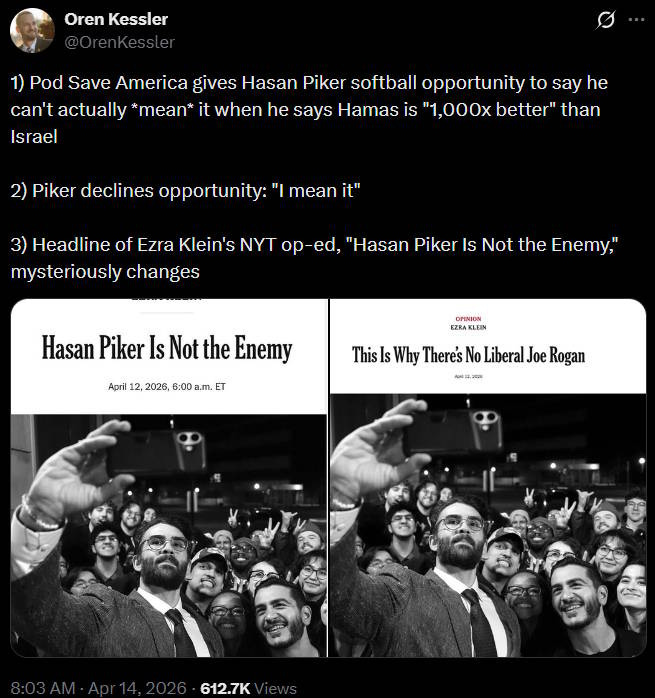
On April 12th, 2026, Ezra Klein, the 2000s policy wonk boy-wonder, wrote for the New York Times an article the reheats the usually-reasonable argument that left-liberals’ inability to engage with their critics is the Democrats’ real problem. While the main thrust of the article focused on the somehow-continually-rising neutron star of internet leftist punditry—and, to name just one recent example of internet leftist brain vomit, bemoaner of the Soviet Union’s collapse—Hasan Piker, Klein shared what are apparently his thoughts on Zionism and anti-Zionism. In the article, Klein repeats a variation of an argument that has become a bit of a meme at this point, given that it is going on three years since the massacre of October 7th, 2023, kicked off the series of events that, almost certainly, has led to the U.S. and Israel’s 2026 war on Iran. That argument, in Klein’s words, is as follows:
Anti-Zionism is rising as a response to what Israel is doing. It will simply not be possible to treat it as a marginal viewpoint that can be shamed or shunned into invisibility. Yes, antisemitism often cloaks itself in anti-Zionism. So don’t do the antisemites’ work for them. If you keep telling people that if they oppose the Jewish state then they must hate the Jewish people, eventually, they will believe you.
When looking at this line, which has been making the rounds among Israel-focused commentators, without squinting too hard, it comes across as a perhaps-reasonable, most-certainly-framed-as-pragmatic approach to winning elections as a Democrat in the foreseeable future; emptily performative pledges of rejecting “AIPAC money” certainly suggest it. Maybe that’s true; I honestly don’t know, nor care, as long as this newest incarnation of the “JQ” doesn’t become a major plank of any politician in the running for the 2028 ticket. It’s just not that important, all things considered. But what is important is the voodoo morality play in which Klein, and an increasing number of otherwise-smart people, are engaging. It is probably one of the more galling inversions of how we, at least should, understand agency when it comes to human behavior, both in the present and in the past. The argument essentially goes like this:
“The recent rise of antisemitism or dislike of Israel didn’t come from nowhere. It’s obviously a reaction to Israel’s behavior since October 7th if not long before!”
Or, the ostensibly more nuanced version:
“The recent rise of antisemitism or dislike of Israel might not be just because of Israel’s actions, but it’s obviously not not a factor!”
Really? Is it really that obvious? There has indeed been a rise in measurable antisemitism and a decline in measurable support of Israel, particularly among young voters. But to simply attribute that to people being aware of alleged war crimes or misbehavior on the part of the IDF, or to resentment—as Klein suggests—at being called antisemitic for having a fixation on Israel and its behavior, strikes me as, to be blunt, stupid and ethically childish. This is primarily because the “anti-Zionist position” has not changed since it became the de facto position of people identifying as postcolonial or anti-imperialist leftists over half a century ago. As Eli Kowaz writes:
For most of the people who hold anti-Zionist views today, the framework came first. Not as a response to Israeli conduct, but as a prior — built over decades in activist spaces, campus culture, and international institutions long before Gaza. The question isn’t what Israel did to produce this moment. It’s what was already waiting when the moment arrived. [Emphasis added]
Blaming Israel for people unaffected by things Israel does or does not do—that is, 99% of Americans—disliking the Israeli government, Israeli citizens, or, most unfortunately, Jews as a whole including those in the diaspora, is not a nuanced position. This is despite being framed that way by people like Klein, or anyone else; not when similar “nuance” is not granted to any other conflict or state, including those of our own allies (after all, where are people blaming any anti-Arab sentiment on the atrocities committed by the Houthis in the Yemeni Civil War?). This double standard exists all over the place, but this is a particular problem on the American left; the American right was already playing around with this argument (and way of thinking) for years. There is distrust or even hatred of Ukraine in America’s right wing coalition; I personally think that position is steeped in conspiratorial thinking, a weird proxy for postliberal fantasies that involve Russia, and other pseudo-intellectual premises, but at least it’s more consistent with their distrust or even hatred of Israel. Much of the American left has no such consistency, flawed as it might be. But the point is that neither of those positions—a knee-jerk distrust or hatred of Israel or Ukraine (or any country with whom the United States is allied, for that matter)—are coming from an informed, or honest place.
To be clear at least about my position on things: people can hate Zionism, or Israel, or, yes, even Jews, all they want. But what they cannot do is pretend that it is coming from some magically nuanced and informed place that also just so happens to provide an agency-free cover for the person hating Zionism, Israel, or the Jews. This is peak “look at what you made me do” schoolyard bully logic. Such logic is the jet fuel that powers the populist impulse that has been infecting American psychopolitics for the last decade and a half. If it were based on being informed, then the people engaging in such anti-logic—especially those who should clearly know better, like Klein—would realize the exact same kind of thing they are now defending is something they would find abhorrent if they saw it in a different, historical light. Because Americans have done this song and dance before, where we use stories of horror and strife overseas to create justifications for distrust, conspiratorial thinking, and bigotry here at home, as if the former has anything to do with the latter.
…
In 1937, the Japanese Empire attacked and invaded China and, in many ways, marked the true beginning of the Second World War. There had been localized conflict in northern Manchuria as early as 1931, but total war broke out across China in July of 1937. It was a smashing defeat for the Chinese, resulted in the occupation of Shanghai, and left the way open for the Japanese to invade and occupy the Chinese capital of Nanjing.
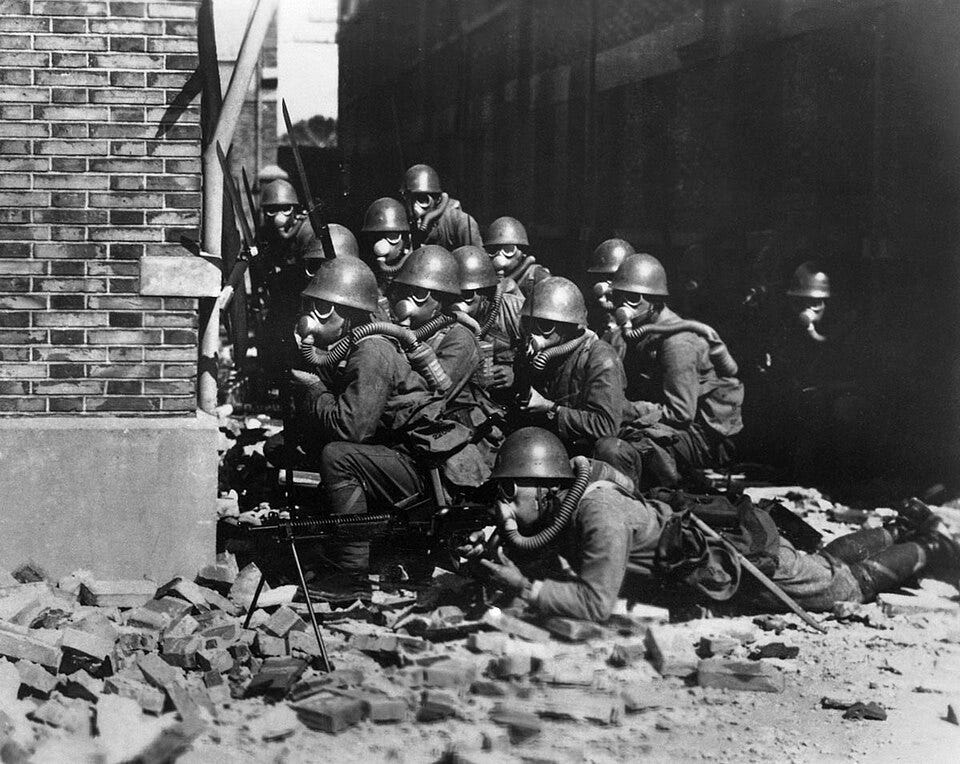
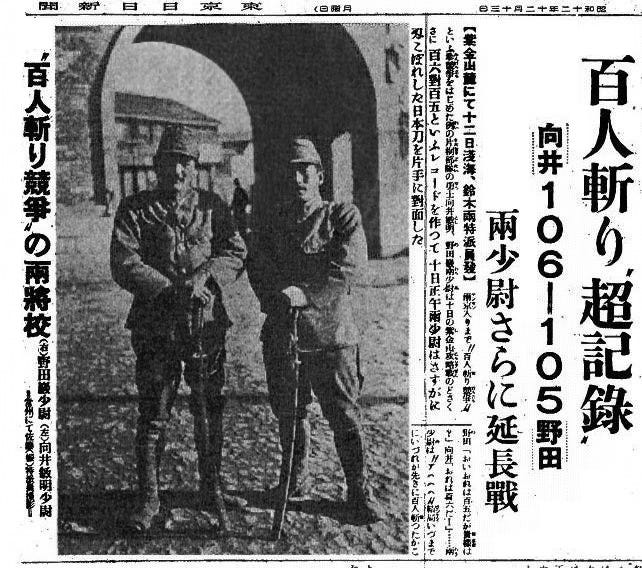
The Japanese forces entered Nanjing in December of 1937 and the genocide known as the Nanjing Massacre—sometimes the Rape of Nanjing—began almost immediately. The destruction seen in Shanghai had been shocking, as could be expected, but no one observing (or likely experiencing) the violence brought upon by the Japanese Imperial Army to the people of Nanjing to be so horrific. The late historian Iris Chang immortalized this horror in her 1997 book, The Rape of Nanking: The Forgotten Holocaust of World War II, and there are far more stories from this phantasmagorical event to tell than can possibly be covered here, but the essence of what Chang described cannot be ignored. Amid systematic mass executions of thousands of Chinese civilians, there were killing contests held by the Japanese, often via the method of beheading with a katana, something witnessed by many Chinese and even glowingly reported on in Japanese newspapers. One witness and miraculous survivor, Tang Shunsan, recalled that after each bound prisoner was beheaded, the Japanese soldiers would shout in unison “Kill and count! Kill and count!” as one of the men would pick up the head and toss it into a pile. Tang was able to survive after getting buried by corpses and playing dead for several hours.
There were also hideous stories of death by torture, including live burials and subsequent crushing, mutilation, burning, freezing by exposure, being fed to dogs, and other ghoulishly creative methods. There were also, of course, almost uncountable cases of mass rape, with the Japanese soldiers paying no mind to age in the most literal sense. Iris Chang, calling it “one of the greatest mass rapes in world history,” cites Susan Brown Miller, who “believes that the Rape of Nanking was probably the single worst instance of wartime rape inflicted on a civilian population with the sole exception of the treatment of Bengali women by Pakistani soldiers in 1971,” and that it probably “surpasses in scale even the raping of women in the former Yugoslavia” in the 1990s.
The point, Chang later explains, is that “there seemed to be no limit to the Japanese capacity for human degradation and sexual perversion in Nanking.” Unlike Japan’s closest European ally, Nazi Germany, the Japanese government and media, at least initially, did very little to hide what they were doing. Indeed, it was clear many were proud of it. Thus, many Americans, especially those who followed international news, were aware of all this horror and many were disgusted. But China was still a world away, and the desire to avoid entanglement in another global war was still strong in 1937-1938, at least among much of the populace (if not in the Roosevelt administration). That all changed on December 7th, 1941, when the Japanese attacked the American forces stationed at Pearl Harbor.
The attack on Pearl Harbor was shocking; thousands were dead, seemingly out of nowhere. War was immediately approved by Congress and declared. The almost 130,000 Japanese Americans, thanks to their heritage and, in many cases, familial connections to the home islands, were immediately seen as suspect by many of their non-Japanese countrymen. Many first generation Japanese immigrants had already been compiled onto FBI lists for several months before the Pearl Harbor attack, thanks to the increasingly tense situation between the Japanese Empire and the United States. It seemed clear to many in the federal government that the Issei (first generation) and even Nisei (second generation) Japanese Americans posed a legitimate security risk, given the situation with Japan.
Nevertheless, some early reports likely sounded promising. For example, basing his claims on the intelligence reports of the Navy’s Lieutenant Commander K.D. Ringle, the syndicated newspaper columnist John Franklin Carter (and spy for President Franklin D. Roosevelt) wrote the following to FDR:
There will be no armed uprising of Japanese […] The essence of what Munson [another private spy for FDR] has to report is that, to date, he has found no evidence which would indicate that there is a danger of widespread anti-American activities among this population group. He feels that the Japanese are in more danger from the whites than the other way around. […] There will undoubtedly be some sabotage financed by Japan and executed largely by imported agents or agents already imported. There will be the odd case of fanatical sabotage by some Japanese “crackpot.” […] Japan will commit some sabotage largely depending on imported Japanese as they are afraid of and do not trust the Nisei.
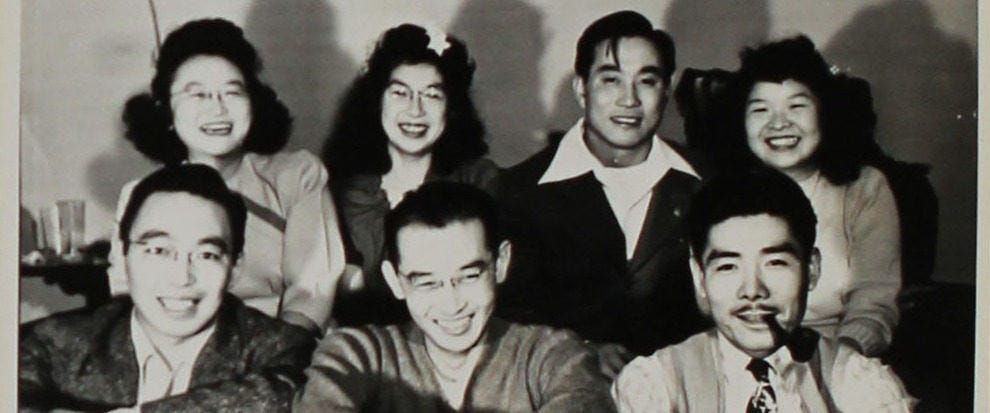
Indeed, these intelligence reports portrayed the second-generation Nisei as profoundly loyal, with the aforementioned Munson writing another report to FDR one week later that estimated “90 to 98 percent [of Nisei] are loyal to the United States,” and that “They are not Japanese in culture. They are foreigners to Japan.” These kinds of distinctions would ultimately matter very little, which became clear on February 19th, 1942, when FDR signed Executive Order 9066, which read, in part, as follows:
Now, therefore, by virtue of the authority vested in me as President of the United States, and Commander in Chief of the Army and Navy, I hereby authorize and direct the Secretary of War, and the Military Commanders whom he may from time to time designate, whenever he or any designated Commander deems such action necessary or desirable, to prescribe military areas in such places and of such extent as he or the appropriate Military Commander may determine, from which any or all persons may be excluded, and with respect to which, the right of any person to enter, remain in, or leave shall be subject to whatever restrictions the Secretary of War or the appropriate Military Commander may impose in his discretion.
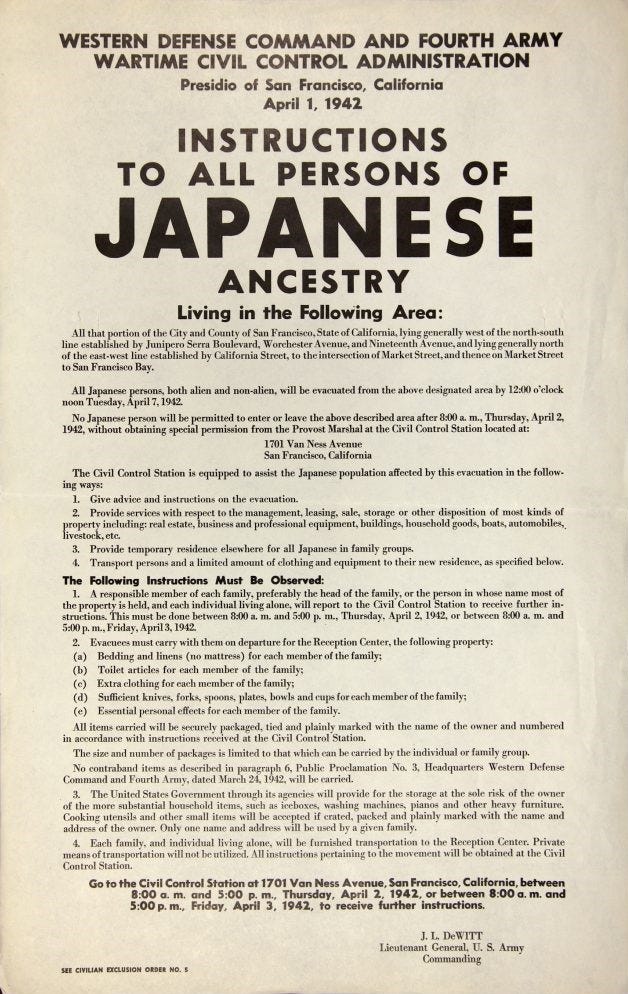
The day after this order was issued, the Secretary of War authorized the creation of Military Areas as part of the Western Defense Command under the command of Lieutenant General John DeWitt. In these areas, concentration camps would be set up. Who would populate these concentration camps had already been established by a Stanford lawyer and member of the Washington Army National Guard named Karl Bendetsen who sent a memo to Assistant Secretary of War John McCloy, titled “Alien Enemies on the West Coast.” The memo painted a picture of a Japanese American fifth column, implicating even the second generation Nisei, who, less than a year before, were being called 90-98% loyal to the United States. Indeed, as the memo stated:
A substantial majority of the Nisei bear allegiance to Japan, are well-controlled and disciplined by the enemy, and at the proper time will engage in organized sabotage, particularly should a raid along the Pacific Coast be attempted by the Japanese. […] This will require an evacuation and internment problem, of some considerable proportions.
This pre-9066 sentiment had not even been limited to internal memos circulating within the administration’s War Department. It made appearances in national media as well, under the byline of the incredibly influential Washington D.C., columnist Walter Lippman, who wrote a widely-circulated column, appearing in the Washington Post, the New York Herald Tribune, and literally hundreds of other newspapers across the nation. The February 13th, 1942, column read, in part, as follows:
The Pacific Coast is in imminent danger of a combined attack from within and without. […] It is a fact that there has been no important sabotage on the Pacific Coast. From what we know about Hawaii and about the fifth column in Europe, this is not, as some would like to think, a sign there is nothing to be feared. It is a sign that the blow is well-organized and that it is held back until it can be struck with maximum effect. […] There is the assumption that if the rights of a citizen are abridged anywhere they have been abridged everywhere. Nobody’s constitutional rights include the right to reside and do business on a battlefield.
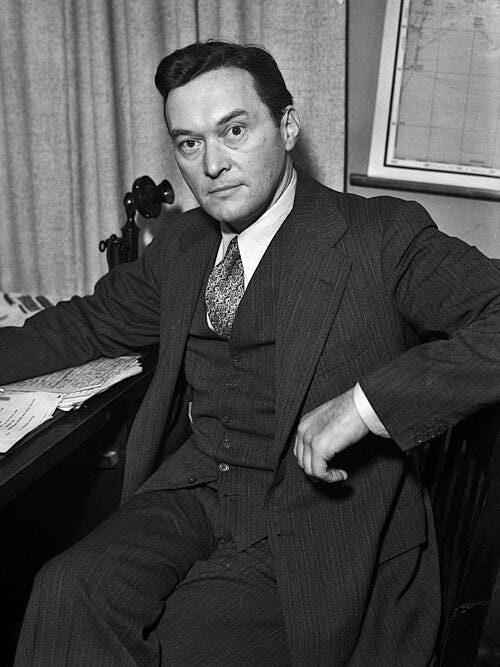
Lippman’s influence cannot be overestimated; as historian Richard Reeves writes about Lippman, he “was essentially writing to an audience of one: Franklin D. Roosevelt.” Acting more as a chorus to Lippman’s antagonizing column than as representatives of all their constituents, the Congressional representatives of California, Oregon, and Washington signed a letter to FDR that read, “We recommend the immediate evacuation of all persons of Japanese lineage, and all others, aliens and citizens alike, who presence shall be deemed dangerous or inimical to the defense of the United States from all strategic areas.” The pressure was clearly enough, because less than a week later, FDR signed Executive Order 9066 and handed the necessary authority over to the War Department, who quickly began setting up assembly centers, relocation centers, and internment camps, most of them dotting the American southwest and interior of the West Coast states.
To say Japanese Americans were wholly unprepared for the evacuations would be a mischaracterization. Many War Department representatives like John McCloy would travel to various Japanese American enclaves, particularly in big West Coast cities like San Francisco, to meet with community leaders and discuss the evacuation process. But to paint this as a more humane version of what the Third Reich had been doing to German Jewish citizens would be missing the point and be painting a distinction without much of a meaningful difference, at least in the years before Kristallnacht. Japanese Americans were aware of the looming day of their internment—of the literal stripping of their constitutional rights as citizens—and many acted accordingly.
That was the case with Hideo Murata, an Issei from Monterey County in California, as well as an American veteran of the First World War and recipient of “Honorary Citizen” status thanks to that service. After confirming with the Monterey County Sheriff (and long time friend) Alex Bordges that evacuations were happening, “Murata went to a hotel in Pismo Beach, paid for a room, and shot himself in the head. In his left hand, he clutched the [Honorary Citizen] testimonial from [the United States government,” to quote historian Richard Reeves’ account. This, tragically, would not be as uncommon as one might hope as evacuation day loomed and in the years that followed. As Reeves reminds us, “[Murata] was not the first or the last Japanese American suicide.”
Japanese Americans were quickly hit with travel restrictions and curfews that did not apply to anyone else as the evacuation plans began to take shape. They were given a chance to sell of whatever valuables they couldn’t carry, usually for a pittance so small it would be laughable if it wasn’t such an indignity. For example, in Klamath Falls, Oregon, the Kobayashi family—a relatively successful farming family with a barn, land, crops, livestock, equipment, and a home sold it all for $75, about $1,519 in 2026 money. In scenes mirroring necrophagous Germans absorbing looted and abandoned Jewish businesses across the Atlantic, non-Japanese Americans gobbled up abandoned Little Tokyo storefronts in Los Angeles and other West Coast cities for a song after their owners were evacuated by the National Guard.
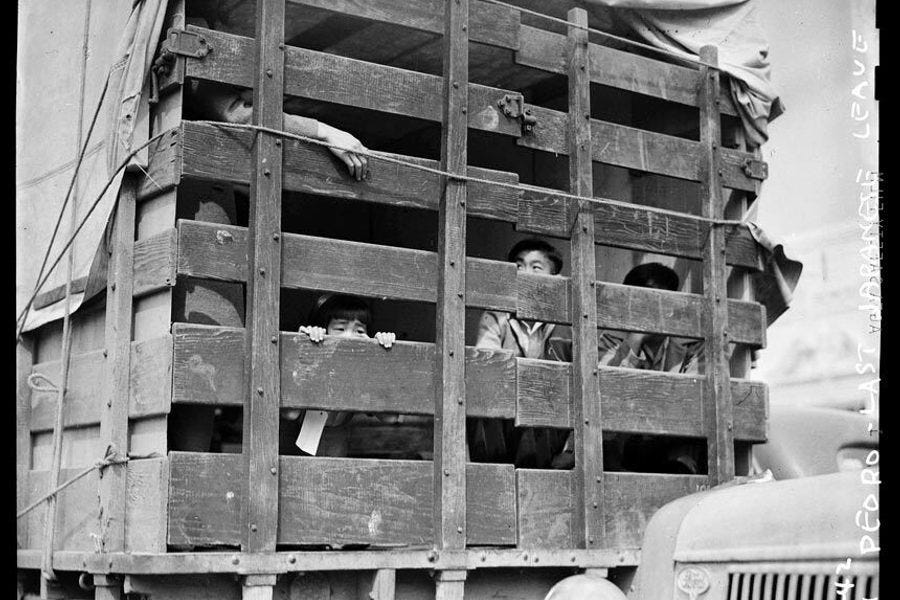
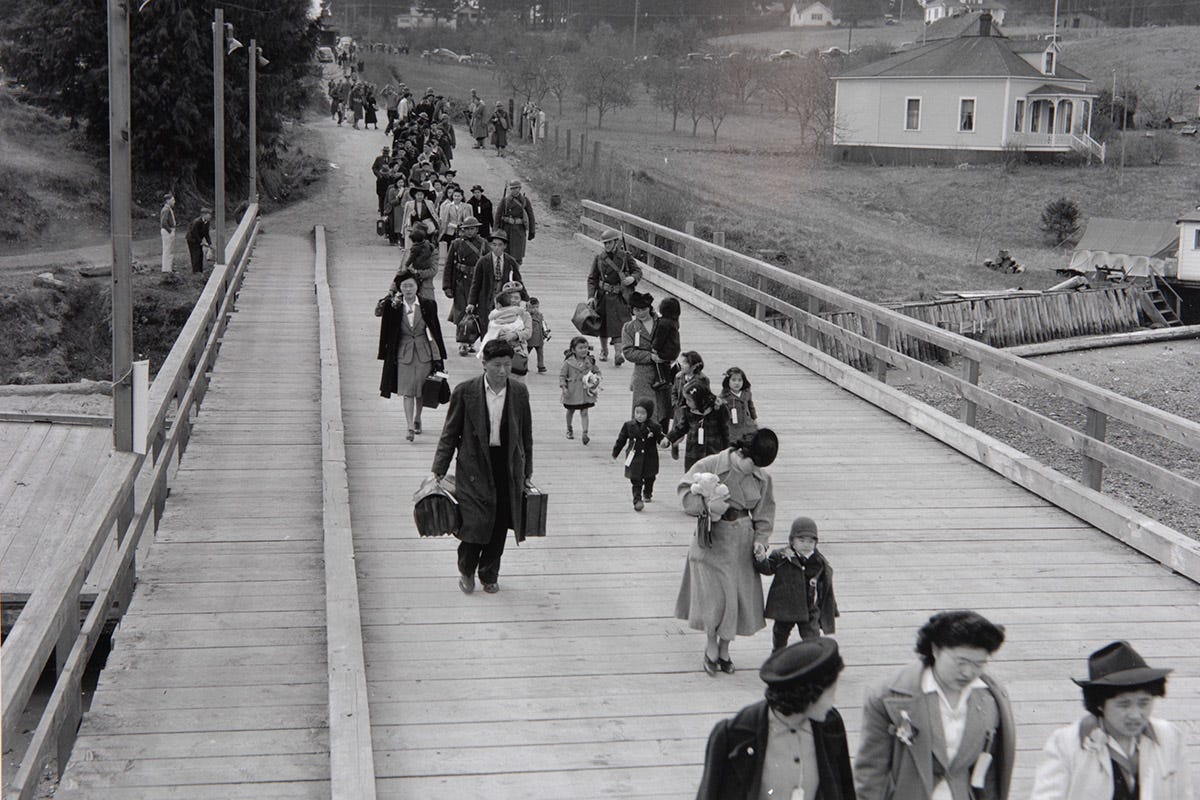
The tragic indignities of evacuation could be seen even more acutely with the evacuation of the Japanese American population of Bainbridge Island, near Seattle, Washington. They were to be transported by rail down to Manzanar, “a barren, wind-whipped ghost town 230 miles northeast of Los Angeles in the eastern foothills of the Sierras, on the road between tiny places called Independence and Lone Pine,” to quote Richard Reeves again. Despite the softened framing from the likes of the Seattle Times, it quickly became obvious that what was happening to all of these families lugging what little baggage they could carry. As Richard Reeves summarizes:
Thirteen of the marchers that day were seniors at Bainbridge High School, who had not been allowed to attend their senior ball the night before because of the 8:00pm curfew for all American Japanese. Many of the white residents of the island lined the ferry road, some of them crying and calling out to friends in the march. Some of the spectators were holding the dogs and cats of the evacuees, who were not allowed to carry pets. Many of the dogs had stopped eating when they were taken from their owners, and died within a week or two. […] There was no music and no crowd of white residents waving and crying when the families of Bainbridge arrived at Manzanar. There were construction workers, some of them Japanese volunteers, banging together 504 tar-paper barracks, each barrack divided into six units of sixteen by twenty feet. The camp was surrounded by barbed-wire fences and guard towers with machine guns pointed in toward thirty-six blocks of barracks.
Like all stories of internment, aspects of normalcy creeped in during the years the America’s Japanese population was kept behind barbed wire. However, normalcy is the way people cope with what is decidedly abnormal, or even intolerable. And it was clear, at nearly all times, that the Japanese American experience from 1942-1945, was anything but normal, in the sense that whatever had been normal for the internees was long gone. This is reflected in many of the diaries, letters, and recollections of those who were interned at camps like Manzanar, or Tule Lake, or Topaz, or assembly centers like Fresno, or Salinas, or Tanforan. This is seen in the account by Tanforan internee, Charles Kikuchi:
Mom is gradually taking things into her own hands. […] For 28 years she had been restricted in Vallejo, raising children and doing homework. […] Now she finds herself here with a lot of Japanese, and it has given her a great deal of pleasure to make all these new social contacts. Pop, on the other hand, rarely leaves the house and still retains his contempt for the majority of the Japanese residents. His attitude is intensified when he sees that Mom is gradually moving away from him. I have a suspicion she rather enjoys the whole thing. She dyed her hair today, and Pop made some comment that she shouldn’t try to act so young.
These changes might seem relatively minor, but it pays to remember that none of these changes would have occurred had Japanese Americans not been uprooted and put in these camps to begin with. Families throughout the camp system would fracture thanks to these circumstances, with particular fissures occurring between the Issei and Nisei. While such generational divisions between immigrants is perfectly normal, it got exacerbated by the camp system and the mindset into which it had put everyone. Kikuchi observed this, in that he saw Nisei more “taking things in stride” and “thinking about the future,” but it was not a firm rule. In fact, many of the Japanese Americans that defied evacuation orders were themselves Nisei, and were most aware of and offended by the indignity of internment. One of them, a Quaker student at the University of Washington named Gordon Hirabayashi, wrote the following in a letter from May of 1942:
This order for the mass evacuation of all persons of Japanese descent denies them the right to live. It forces thousands of energetic, law-abiding citizens to exist in a miserable psychological and horrible physical atmosphere. […] It kills the desire for a higher life. Hope for the future is exterminated.
There was plenty of reason for many Japanese Americans to feel such hopelessness, especially when the U.S. Supreme Court unanimously decided in 1943 that curfew and general restrictions on Japanese American movement were in fact constitutional, given the state of war. Not only was the wider American culture not particularly on their side, neither was the law that supposedly protected everyone equally and blindly. Hirabayashi devoted himself to his Christian principles that he had inherited from his parents—Christian converts from Japan, which was hardly any more common in the early 20th century than it was centuries earlier—but not all Japanese Americans felt that way or had such perspectives or principles toward which they could turn. “Life,” as Richard Reeves explains, “continued to be a struggle,” with circumstances in the camps sometimes taking “a tragic turn.” As Reeves continues:
There had been suicides and suicide attempts and more than a dozen Japanese men had been killed or wounded by soldiers guarding them in the relocation centers and in Justice Department camps and jails. On May 12, 1942, a man named Kanesaburo Oshima was killed by a sentry at Fort Sill, Oklahoma, a temporary center for the so-called dangerous aliens. The next day, Ichiro Shimoda, a forty-five-year-old gardener from Los Angeles who had served in the Japanese army as a young man and was arrested on the day Pearl Harbor was attacked, was badly wounded by another guard at Fort Sill. He was known to be mentally unstable and had twice attempted to kill himself by trying to bite off his own tongue. An FBI report dated May 18, 1942, said he was shot twice while trying to climb over a camp fence. On May 16, 1942, Hikoji Takeuchi was shot at Manzanar by a military police private named Edward Phillips. A WRA [War Relocation Authority] investigation report quoted his commanding officer, Lieutenant Buckner, as saying that guard service was so monotonous that MPs “welcomed a little excitement, such as shooting a Jap.”
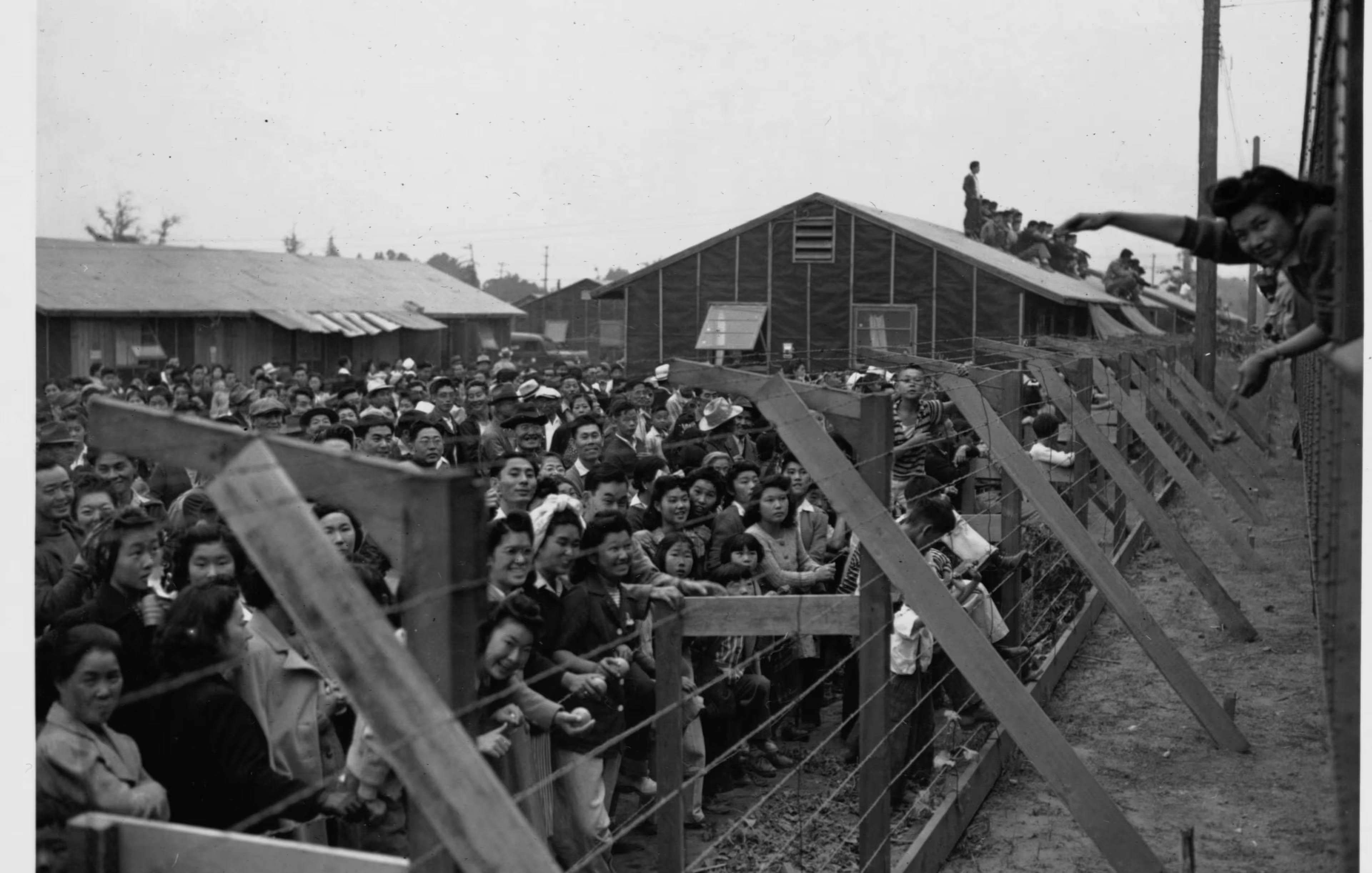
Legal and moral indignities had, clearly, turned into outright abuse and violent persecution by the authorities responsible for the now-hundreds of thousands of Japanese American internees. Abuse was by no means the norm across the board, but the circumstances had created a pervasive atmosphere of “frustration and fear,” in which the threat of violence became endemic to the internee experience.
As is often the case in concentration camps, the violence began to turn inward from the internees themselves. Sexual assault, while never reaching epidemic proportions, did still become more common than it otherwise would have. Even before internment occurred, there was an instance of a gang of thugs taking advantage of the situation, with “a woman [being] assaulted by men who forced their way into her home posing as FBI agents,” as reported by the Densho Japanese American Legacy Project. In describing the inward turn of the violence, the report continues that “within one month of the opening of Tanforan, three rapes and at least two attempted assaults” had occurred, with very little if any attempt to find the perpetrators occurring.
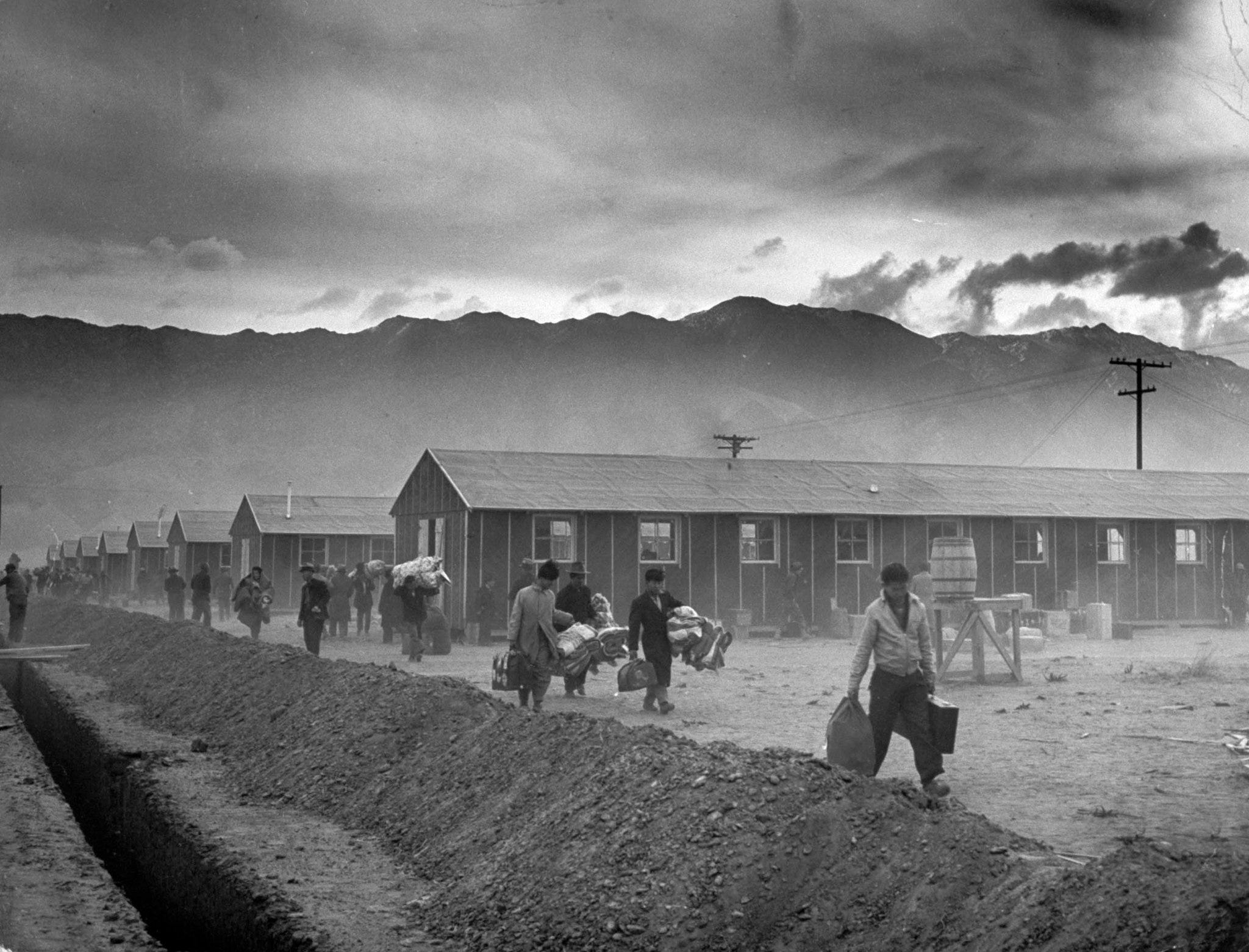
Internal discord and even violence became even more systemic as angry Kibei—that is, second generation Japanese Americans who had been at least partly educated in Japan before returning to the United States—formed anti-American gangs and, as Richard Reeves describes, “began to terrorize residents [of the camps] they considered spies or collaborators for the [Roosevelt] administration […] traveling in groups during the day, then harassing and beating the residents they did not like, usually at night.” This led to a community council member named Fred Tayama almost being beaten to death. Most of the time, camp administrators ignored these gangs and outbreaks of violence, “saying it was up to the Japanese to settle things among themselves.”
Obvious as it might seem, it must be stated that such circumstances were not particularly appreciated by the wider American public. Obviously, as described earlier, there was, by no means, a singularly delighted reaction to the evacuation and internment of Japanese Americans among the wider American public; many non-Japanese neighbors and friends expressed grief and outrage at seeing members of their community treated this way. However, the compassion Japanese Americans experienced from some of their neighbors and friends was by no means the norm. According to a poll conducted by the American Institute of Public Opinion in 1942, 93% of Americans supported the relocation of Japanese Issei while only 1% opposed it, and nearly two-thirds of Americans supported the internment of Nisei while only one quarter opposed it. To most Americans, any and all Japanese—Issei or Nisei or otherwise—were a liability in a time of war, especially one that had begun the way this one had for Americans.
With such broad public support of the measures made possible by Executive Order 9066, not much in the way of justification was required. However, justifications proliferated, as if many of those supporting—or enabling—the evacuations and internment realized how such policy looked, especially vis-à-vis the war with Nazi Germany, whose policies of internment were well-enough-known. Much of the justifications for the internment of Japanese Americans were either on-the-nose racism, or, more nefariously, reeking of post-hoc moralizing. In the case of the former, angry and threatening notes started getting shoved under the doors of Japanese-owned businesses, like that of the Tamaki family in San Francisco on the eve of evacuation, with the one addressed to them reading, “This is a warning. Get out. We don’t want you in our beautiful country. Go where your ancestors came from. Once a Jap, always one. Get out.”
Townsfolk in various places near the Manzanar camp even went on the record, with a local barber proclaiming that “We ought to take those yellow-tails right down to the edge of the Pacific and say to ’em, ‘Okay boys, over there’s Tokyo. Start walkin’.” More chillingly, a flight instructor in Inyo County proclaimed, “It’s a plain case of survival of the fittest. It’s either us or the god-damned Yellow-bellies! What are we waiting for? The Army needs target practice on those sons-of-bitches.” Shopkeepers in California concurred, putting up signs in their windows saying things like, “This restaurant poisons both rats and Japs,” “Open hunting season for Japs,” and, in the case of a barbershop, “Japs shaved: Not responsible for accidents.”
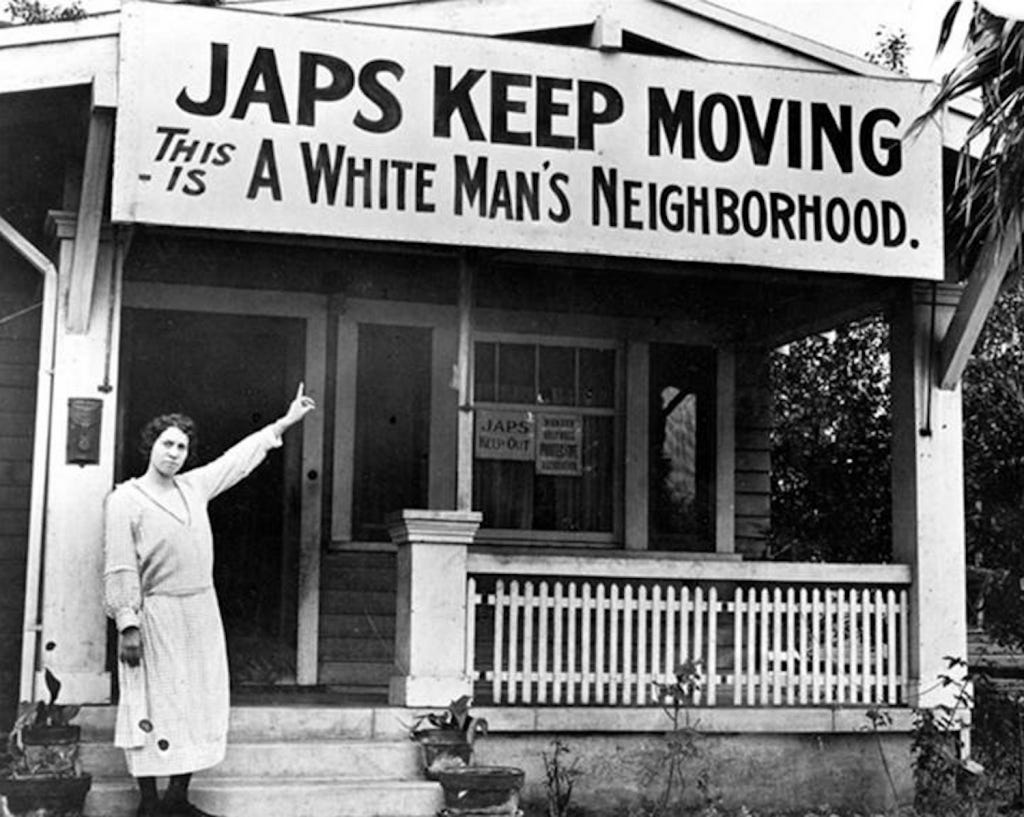
However, it was the previously mentioned post-hoc moralizing that strikes a particular chord when thinking about overseas events being used to justify at-home bigotry in the wake of the Pearl Harbor attacks. Many Americans were indeed aware of and horrified by the atrocities taking place in the Pacific, well before the attacks on Pearl Harbor. It was well-covered in the media and while there was not nearly the reach or technological capability possessed in the 1930s-1940s as there is today, plenty of what was occurring in China was reported by a number of American foreign correspondents.
As Iris Chang explained, the three main American journalists stationed in China during the Nanjing Massacre—Frank Durdin of the New York Times, Archibald Steele of the Chicago Daily News, and C. Yates McDaniel from the Associated Press—“made an enormous impact” in raising international awareness of the Empire’s crimes. They “[wrote] riveting stories that were splashed across the biggest and most prestigious newspapers in the United States,” and, like many international observers, even took part in trying to save as many Chinese civilians from the awful fate that had befallen so many. Even if they had not felt the moral pull to do the right thing in these instances, these men could not have forgotten what they had seen and experienced, and, they reasoned, neither would anyone else who read their copy. As Chang summarizes:
On December 15, most of the reporters left Nanjing for Shanghai to file their stories. Their last day in the city was grisly. On the way to the waterfront, the reporters literally had to drive over several feet of bodies under the Water Gate, where dogs were already starting to gnaw on the corpses. Later, as they waited for their ship to arrive, they saw the Japanese military line up one thousand Chinese men, force them to kneel in small groups, and shoot each of them in the back of the head. During the execution, some of the Japanese were laughing and smoking, as if they greatly enjoyed the entire spectacle.
Later, the AP’s McDaniel encountered another group of Chinese prisoners, one frantically pleading with him on hands and knees to save him from being murdered like everyone else. McDaniel remembered: “I could do nothing. My last remembrance of Nanking—dead Chinese, dead Chinese, dead Chinese.” These tragic sentiments were seen by millions, amplified further still by newsreel footage provided by Norman Alley and Eric Mayell of Fox Movietone titled “Butchery and Looting Reign in Nanking.” Japanese media tried to create PR spin, but the damage had been done, and American audiences were outraged at what they saw.
However, after the Pearl Harbor attacks, any chance of principled moral outrage on behalf of the Chinese suffering from the rapacious assault by the Japanese Empire gave way to full-on nativist paranoia and bigotry, and that Chinese suffering was reduced to mere post-hoc justification for the state-enforced expulsion and internment to come. The Japanese Empire’s continued expansion throughout southeast Asia, as well as the outbreak of war between Japan and the United States, did not help matters either. As Richard Reeves writes, “whatever goodwill there had been toward Issei and Nisei after Pearl Harbor was gone as news arrived daily of seemingly invincible and brutal Japanese armies running wild through the Philippines, Burma, Hong Kong, Malaya, and the Dutch East Indies,” leading to an atmosphere in which “tolerance of any kind was replaced by fear.”
While many were honest about their motives—such as columnist Henry McLemore, who wrote in both the Los Angeles Times and San Francisco Chronicle that “personally, I hate the Japanese and that goes for all of them”—layers of more “high-minded” justifications for distrust, hatred, and expulsion began to appear almost immediately after the Pearl Harbor attacks, most of which had nothing even to do with the war. “Crime and Poverty Go Hand in Hand with Asiatic Labor,” blared the Chronicle on December 10th, 1941, as well as “Japanese a Menace to American Women,” emphasizing supposedly systemic problems with the Japanese American population that went beyond base fear. The Seattle Times ran a story involving two Nisei businessmen being indicted for allegedly trying to sell three industrial-grade storage tanks to the Japanese forces occupying China, thus linking the supposed Japanese American fifth column to the imperial ambitions of Emperor Hirohito. William Randolph Hearst was at the forefront of this kind of framing that highlighted Japanese atrocities, and escalated it into an all-out campaign as the war continued, providing fodder for those looking for such high-minded rationale to justify the maltreatment of their countrymen. It became all the easier to create a demonic image at home, within Americans’ reach, once the war began in earnest in 1942.
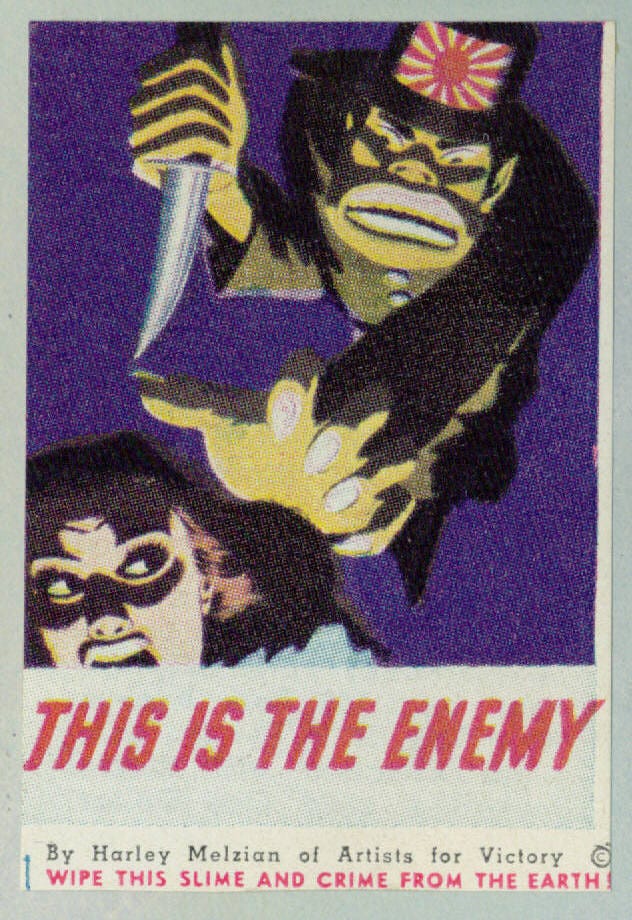
In the summer of 1942, the Japanese Army stormed the city of Nancheng and began a reign of terror nearly as horrific as the one that befell Nanjing five years earlier, and was followed up by a wave of experimental biological warfare conducted by the notorious Unit 731, who unleashed approximately 300 pounds of paratyphoid and anthrax germs onto the region after the army had destroyed the city. When the news broke in the spring of 1943, the New York Times would claim that “the Japanese have chosen how they want to represent themselves to the world. We shall take them at their own valuation, on their own showing. We shall not forget, and we shall see that a penalty is paid.” Similarly, the Los Angeles Times stated that “to say that these slayings were motivated by cowardice as well as savagery is to say the obvious. The Nippon war lords have thus proved themselves to be made of the basest metal.”
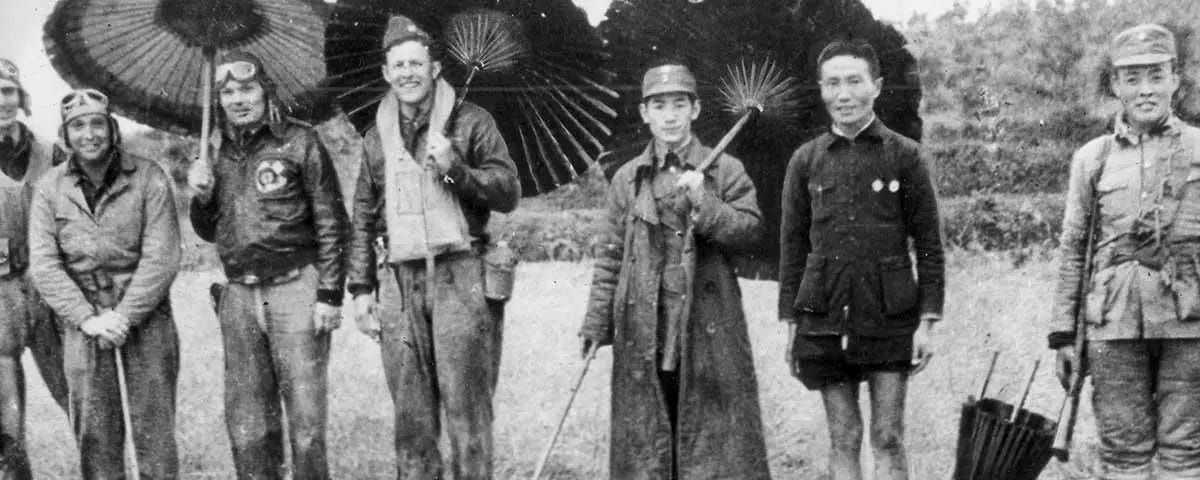
What neither of these publications admitted was that this operation had been conducted as a direct response to the United States’ own Doolittle Raid the year before, with the Japanese Army specifically targeting Nancheng’s citizens who had assisted the Doolittle raiders that had crashed in the Chinese countryside (just shy of seventy airmen in total). While it did nothing to justify the response made by the Japanese—which included torturing the Chinese civilians who had cared for the injured raiders and then later helped them escape—everyone involved in the raid’s planning, especially including Lieutenant Colonel James Doolittle himself was fully aware and even predicted that there would be a wave of destructive vengeance that would follow his own vengeance-driven raid on the Japanese capitol, as explained by historian James M. Scott. This darker aspect of the Nancheng massacre—the “Rape of Nancheng” as some came to call it—was only revealed by the wartime recollections of the American missionaries stationed there, with one of them, a Reverand Charles Meeus, writing the following:
Little did the Doolittle men realize, that those same little gifts which they gave their rescuers in grateful acknowledgement of their hospitality— parachutes, gloves, nickels, dimes, cigarette packages—would, a few weeks later, become the telltale evidence of their presence and lead to the torture and death of their friends!
In the United States, there was certainly growing understandable outrage as the fighting in the Pacific intensified, and as stories of the brutal treatment of American POWs, and the overall carnage of the fighting made their way home. But as we have already seen, the reality was that many Americans were already prepared to hate the Japanese as a whole, even if they were their own neighbors. That turn may have seemed sudden, as if Pearl Harbor alone had created it. But at least one person had seen the writing on the wall as early as 1932: the Rabbi Rudolph Coffee of Oakland. In an editorial for Jewish News of Northern California, Rabbi Coffee wrote the following about a sad-looking Japanese American gardener who had smiled at him as the rabbi complimented his work:
I have harbored a distressing thought. Can it be that the white man is letting his innermost feelings about Japanese atrocities in China react upon this innocent gardener? Unfortunately, some mass-minded individuals will link all Japanese in one groove, quite unconscious of the startling fact that a poor Jap gardener in the United States may be just as opposed to Japanese militarism as were the innocent Germans in our midst to the tactics of Deutschland’s Kaiser.
At this point, it would perhaps be too obvious to say that Rabbi Coffee’s remarks proved tragically prescient. But they were. Almost a decade before Pearl Harbor, he identified the logic that would later help justify the incarceration of Japanese Americans: the projection of anger at an empire abroad onto innocent people at home, many of whom had little or even nothing to do with the empire in question. The concentration camps were not the outcome of some cool-headed grasp of strategy or justice. They were the result of fear, racialized and displaced, made easier to manage by turning neighbors into symbols of a global enemy and the architects of their own misfortune; a misfortune that many Americans, as often appears to be the case, were all too happy to endure.
…
Stop me if you’ve heard this one: “if those urban blacks didn’t act like such thugs, then less people would be afraid of them.” Or, perhaps more pointedly to this comparison, “then more people would support causes like Black Lives Matter.”
It sounds pretty ugly, doesn’t it?
Let’s be blunt. The latter example is the same logic being employed by Ezra Klein when he says rising anti-Zionism is being caused by Israel’s actions, and the former is the same logic being employed by anyone blaming the increase in antisemitism in the Western world on Israel’s actions; both kinds of justifications are increasingly common. But more to the point of this entire essay, if it wasn’t yet obvious, is that it’s also the same logic people used 85 years ago when they justified the internment of hundreds of thousands of their own countrymen by citing the barbaric actions of an overseas empire—far more barbaric than anything Israel has done both in scale and character, for what it’s worth, shocking as the Gaza War has been in its violence and destruction.
The choices we make are always part of an ecosystem of incentives; no choice is an island, so to speak. But a choice is still a choice, especially when it is applied to groups of people and in general terms. Just because the proverbial elephant we all ride is governed by emotions and impulses does not suddenly make the conclusions that come from those emotions and impulses understandable, much less defensible. This is to selectively apply agency, the lifeblood of populism, discrimination, and eventually, crimes against humanity. It’s not speech or expression or “dangerous ideas” or anything like that; it’s the true belief that one has no control over one’s own hatreds, and that those you hate are in absolute control. This was the case with Japanese Americans, particularly after the Pearl Harbor attacks, and much of that could be reduced to typical race hatred. Considering that antisemitism is more of a skeleton key that purports to explain the ills of the human experience, rather than typical race hatred, the significance is even more profound. The discontent, the distrust, and the hatred all come first; the justifications come later.
After all, before a single American GI set foot in the South Pacific, much less was killed by a Japanese banzai charge, Americans needed very little encouragement to indulge in race hatred that allowed them to celebrate the internment of their own countrymen. There might have been fear of the carnage to come that would consume so many American families, and at least that can be understood with hindsight, but no such excuse can be made for the people who have made hating Israeli forces and the Israeli government for their alleged (and quite possibly real) crimes and then see their proxies in American Jews. Perhaps, god forbid, that will change. But so far, it has not changed, and American moral hand-wringing over Israel’s conflicts has done very little to show itself as anything other than a vulgar kabuki.
When I told her what I was writing in this essay, my partner Molly asked me who this essay is for. That is a fair question (and a good one especially if you’re writing from a place of frustration). I think it was mostly for me, as a way to vent, as essays like this often begin; as Andrew Fox recently wrote, “I am furious at the antisemitism pouring through the West, confident and shameless.” I am pretty furious, at both the antisemitism, but also the willful hypocrisy, double-standards, and historical illiteracy that, as always, seems to animate it. But if I was to pinpoint an audience that I believe needs to hear what I’m saying, I’ll suggest that it’s for anyone who has vaguely or even poorly-defined animus toward any group of people or even particular state. It doesn’t even have to be Israel, though that state and its people are certainly the most relevant ones here.
There is a shocking amount of outsourcing of animus today. Seemingly no one can just be honest about where they are coming from. It brings to mind the famous line from Hans Landa—yes, a fictional character—in Quentin Tarantino’s Inglorious Basterds when explaining why he finds Jews distasteful: “You don’t like them. You don’t know why you don’t like them, all you know is that you find them repulsive.” Many people engaging in such animus outsourcing do well to embrace their inner Hans Landa. Or, if one is to be perhaps less uncharitable (or at least use a real life example), be more like the managing secretary of Salinas Valley’s Grower-Shipper Association Austin Anson, who told the Saturday Evening Post in the wake of the Pearl Harbor attacks, “We’re charged with wanting to get rid of the Japanese for selfish reasons. We might as well be honest. We do. It’s a question of whether the white man lives on the Pacific Coast or the brown man.”
It is difficult to be so forthright with one’s own priorities and biases, and especially socially unacceptable bigotries; as we have seen, it was as difficult nearly a century ago as it is now, except for the rare exception like Austin Anson and others like him. No one wants to be seen as being hateful of anyone for any reason, and yet, here we are, always hating. So, then as now, we search for reasons bigger than ourselves to justify something so base, so human; thus, so truly and fundamentally small.
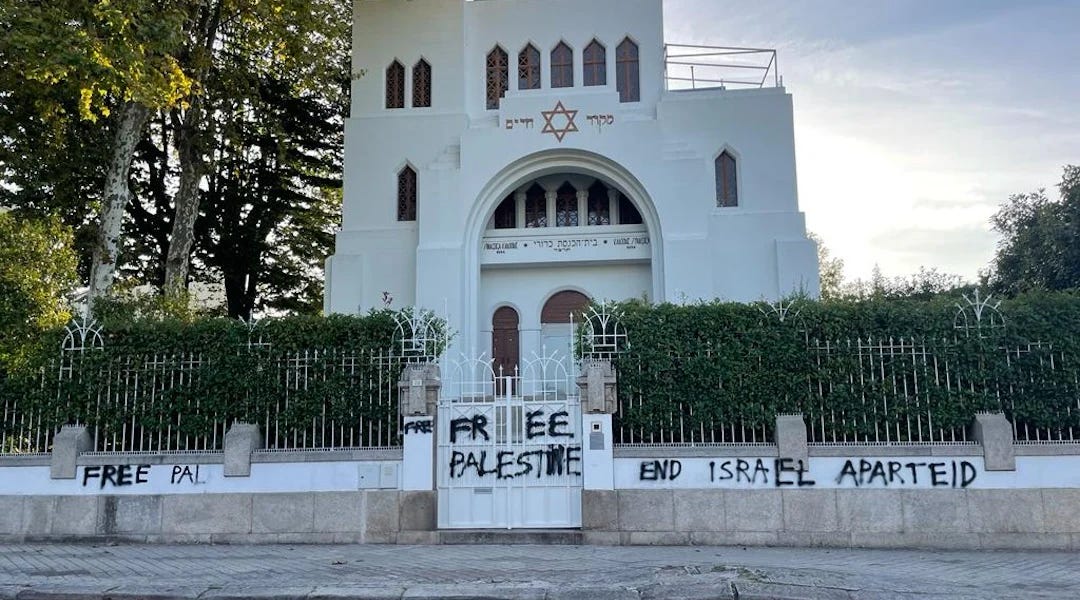
This has been an issue since October 8th, 2023, when protests, vandalism, and the like might have been understandable (if a bit tone deaf) if they had solely occurred outside of Israeli embassies. It would have (and did, when it occurred) sent the message that the Israeli government under Netanyahu was the problem. But then the protests, vandalism, et cetera (eventually including violence) quickly started appearing outside of Jewish community centers, Jewish synagogues, and Jewish gatherings. Whenever I have pointed out the self-evidently ghoulish vibe and underlying suggestions this created, inevitably I would be met with dismissive responses of “well, this is about Zionism.” To which I would say, and I say even louder now, “who the fuck are we kidding here?”1 If this were about “Zionism,” and the purveyors of Zionism, and not a lazy conflation of Jews with Zionism, why not target the most significant (and most problematic) promoters of that ideology; that is dispensationalist Evangelical churches? Not that I want to see such protests, vandalism, and threats of (or real) violence disrupting those people’s lives either, but should there not at least be some consistency on this question if we are not to assume there is some self-selected, conspiratorial, and obviously bigoted reasoning going on?
Of course not. And this kind of inconsistency has continued long enough—going on three years—without being meaningfully addressed. So a new script and moral license needed to be and has been provided by Ezra Klein and those like him, and one that sounds very familiar indeed. After all, if one can’t bring oneself to call a spade a spade, it can be extremely handy to have proxies to give you all the justification needed for remaining complicit or even acting as a participant in the newest incarnation of the world’s oldest hatred.
Even more to the point, how else would we characterize the reactions to the provocative cover from the Italian publication L’Espresso, which verged more on the Israeli soldier’s physiognomy rather than the substance (or possibly lack thereof) of the claim of “l’abuso” going on.
Unfortunately audience capture is becoming a bigger factor, and that is a worrying trend.
Alexander, it is always good to hear you on TFC