



Earlier this weekend, comic and supposed libertarian presidential hopeful Dave Smith (sorry Dave, I’m still skeptical) shared the following post and video on his Twitter account.


This video in particular struck as particularly galling. I don't know, maybe I'm late to the party, but my brain just got pretty rattled by this 50 second clip and what was said so plainly therein and what it says about America’s current leadership and the clear contempt for which it holds at least 70 million Americans. This isn’t to say that I am fully onboard with Dave Smith or those who echo his still-100%-correct sentiments, however (seriously: what else do you call dismissive fascista-branding by a literal representative of the State, if not hatred? Okay I’ll be charitable: if not contempt?). So I’m completely onboard with what he specifically said here; I’m not onboard with what it represents, as I’ll explain.
Now first, for context and so cards are on the table: I rarely, if ever, fully identify with any political ideology. As I see it, the values that I hold—some very radical—only seemingly conflict with one another to outsiders looking in because these values have been ascribed an ideological value—a political umbrella or tent, to use more common parlance—by others. I see no need for that kind of restriction and hence why I have no problem understanding the viewpoint of people who consider themselves “conservative Marxist” or a “libertarian socialist”, to use a couple examples. What I am, ultimately, is a pragmatist (who has a dose or three of unrealized idealism that inevitably makes me hate whoever is currently “the Establishment” and why any notions of replacement of said “the Establishment” are just as, if not more, evil than perpetuating the current one). And part of being pragmatic, therefore, means that there will never be a “side” with which I agree. The “sides” are the problem in and of themselves because, as is demonstrated here by this Pravda propagandist calling herself the “United States Press Secretary”, it makes it impossible to get things done that both of the sides want, sides that ostensibly are reflecting the will and interests of the people. And because we live in a time where there are only “sides” who are only, as per human nature, interested in themselves (but primarily through an ideological lens), it's no longer possible to look at things pragmatically—get things done that mostly everyone wants—when you see the other side as the enemy, especially when you're the ones in power. This isn't to give the Dave Smith’s or MAGA folks a free pass, by the way (even though Dave is indeed correct in his concise talking point): they are just as guilty of this. I mean what else are you supposed to do when you believe (however correctly or incorrectly, though, as I’ll explain, I think it’s correctly) that the administration and its supporters hate 70 million of you? Roll over and take it? I certainly wouldn't. Again, this is why Dave is correct, but also why what he’s revealing is where this kind of ugliness goes.
Now, we can argue about "who started it" all we want (well, you can; I honestly don’t care anymore and any attempt to try and tell me will result in silence or dismissiveness), but the point is that we are stuck in a feedback loop where each of the “sides” doesn't see other, actual people on the other “side.” They see anti-democratic fascists. They see degenerate genderless demons. They see elites who want to kill them for existing. They see podunk racists from the South that want to bring back Jim Crow and let white cops clear out black neighborhoods with impunity. They see a transgender Holocaust. They see evil pedophiles and cannibal Satanists. But that’s not really what they see. What they see, at their deepest, most ingrained level, is the lion stalking them through the high grass of the savanna tens of thousands of years ago.
And here's the real, profoundly disturbing problem at the root of this (which is, as always to my chagrin that no one ever takes seriously, psychological): the more they see that monster and the more they express their understandable fear of that monster, the more it becomes literally true. That's the feedback loop, as acted out here:
"Why can't they see what we're saying? They're going to destroy democracy."
"Destroy democracy? Have they lost their minds? They really do hate us. They think we're monsters!"
"They're so unhinged! It's making them act like fascists!"
"See? They're calling us fascists now."
"See! They're not even denying that they’re fascists!"
"We didn't even claim it! But clearly that's all we are to these people. We might as well embrace it."
And so on.
That feedback loop—the psychologically reactive tug of war between the politically engaged—is what we have become as a nation; not as a people, since the politically engaged is dwarfed by the hundreds of millions of normie Americans who don’t care and just want to be left alone. Just remember that not all Germans were Nazis and not all Russians were communists. But as a nation, which is an inherently political project? Yes. That is all we are as a nation.
(Another good analogy is the kids fighting on the playground and only focusing on whose fault it is when the teacher comes to break it up, but I felt like that was too obvious. And honestly, I, as a pragmatist, wish it were truly at that level, because simply calling someone a “doo-doo head” is far preferable to being accused of being a genocidal bigot or a pedophilic demon.)
…
So where does this go? Really ask yourself this: where does this go? And how will it make you feel when it goes there? As much as I’ve been enjoying Omar El-Akkad’s American War, I don't think “Civil War II” is in the cards, simply because we don't have a stable or consistent geographical distribution. That could certainly change, but it would require a few Great Migration-level population shifts toward particular locations based on ideological demographics, and the only place that seems to be making an effort to do that is New Hampshire’s Free State Project. There simply is no clear dividing line when it comes to territory, except in vague, ideologically-driven terms, such as “West Coast progressives” or “Texas GOP.” A repeat of 1861 conditions this ain’t.
(Before I continue, I should note that I will likely always stand by the notion that history doesn’t repeat itself or even rhyme; it’s just human nature—both informed by genetic predispositions and social trends and forces—at play, driving events forward. So when I speak of parallels here, do not mistake me for doing anything other than highlighting how the psychologically reactive dynamic I’ve been speaking about is what “rhymes”, not the events in question.)
So what is a more likely endgame to this reactive world in which we find ourselves? Where does this go? The likelihood of us coming out the other side with very few changes to what we currently recognize as our lives is quite low; unless some miraculous technology comes along that distracts everyone so much that no one will have anything they wish to complain about—in other words, unless the technology can supplant their self-interested search for meaning—I see the probability of that being next to nil. For example, even if the Avatar sequels that are on the way manage to capture the public imagination the way the first film did in 2009, there will always be someone who tries to plumb the “deeper meaning” and “problematize” either the film or the phenomenon or both and it will just become another facet in the culture war that exercises this psychologically reactive dynamic. Yes, I realize that I’m saying Avatar: The Way of Water could exacerbate the increasing political tensions that already exist in American culture…and yet, when you see Florida’s government targeting Disney for its—a private company’s—policies, you’ll likely realize that nothing is impossible anymore. Everything is an exercise in ideological posturing, which is always—always—the prelude for conflict escalation.
…
So as to not continuing to bury the lead, I’ll just throw out a term that history nerds and, well, the entirety of the British Isles, will know all too well: the Troubles. The Troubles (still the most British term for an ethnonationalist/religious conflict), for those who haven’t read up on them, was a period of time lasting for three decades—from 1968 all the way until 1998—between Irish Catholic Nationalists and British Protestant Unionists, resulting in multiple terrorist attacks and violent government suppression, with the most infamous incident being Bloody Sunday of 1972, in which 13 unarmed Irishmen were shot down by the British military while they were demonstrating against the internment of Irish revolutionaries. Bombings—committed by the Irish Republican Army (IRA) mostly in Northern Ireland, but also in Dublin and England proper—were a regular occurrence, especially throughout the 1970s and 1980s. Street battles between the IRA and British forces gained the status as proper battles as part of a war (called an “irregular war” or even “low level war” by some, but a war nonetheless). Ideologically-possessed hysteria was the norm with purity tests being foisted on anyone unlucky enough to be caught by gangs roaming the streets of Belfast; Christopher Hitchens himself recalled being accosted by some thugs wearing balaclavas who demanded to know whether he was a Catholic or a Protestant (smartly he told them he was an “atheist Jew” to which they hilariously paused and asked “Uhhh…Protestant atheist Jew or Catholic atheist Jew?”). The wounds and trauma are still there to this day, subtly bubbling beneath the surface; when Molly and I visited Ireland in 2013 and took an impromptu train trip to Belfast, the first thing our hotel concierge told us when recommending what we check out in the city was that we didn’t have to worry, historical sites weren’t “too political.” I didn’t press her on it, but I find it hard to believe she wouldn’t have told me if I asked what parts of the city we, as outsiders, shouldn’t go.
It is worth reiterating that the Troubles are by no means a 1:1 comparison with what is happening in the United States now; the root causes of the conflict stretch back centuries, with the Irish Civil War of 1922-1923 acting as a modern culmination of the conflict, with the Troubles more acting as a denouement to it all. The point is that while “civil war” in the American context conjures images of grays versus blues, shooting rifles at one another across battlefields, men having their limbs amputated with bone saws, and everyone else dying of dysentery, it’s likely never going to be like that again, at least not without, like I suggested above, time and geographical reorientation. Civil wars can indeed break out as traditional wars—we see that all over the world all the time. But the United States—and I’d argue the West more broadly, as can be seen by the Troubles—has become more decentralized in almost every way, including in how we conduct war. Decentralization is, I’ve come to believe, a good thing in many ways—namely for culture—and in some ways, decentralized warfare can be preferable to traditional warfare if all you’re looking at is casualty numbers. But what the Troubles—as well as the civil wars faced in former Yugoslavia, especially during the Second World War—show us is that decentralized warfare is far more chaotic and, in a lot of ways, far more likely to produce things like localized atrocities and draconian responses from the state.
A good example of draconian responses from the state—and the escalation that occurs afterward—brings us to the aforementioned Bloody Sunday Massacre of 1972. On January 30th of that year, in County Derry of Northern Ireland, a gathering of Catholic and Irish Nationalists gathered to protest what they called “fifty years of unionist misrule” and the introduction of internment without trial by the British government. County Derry had already been the site of demonstrations and even a fight between the nationalists and the unionists in 1969 called the Battle of Bogside. A massacre known as the Ballymurphy Massacre had already occurred back in 1971 in Belfast, where eleven civilians had been shot down by the Parachute Regiment, followed by the sniping of a British soldier by the IRA forces the next day. A 14-year-old girl had been murdered by the British forces one month later, followed by the killing of a 47-year-old mother of six in her own backyard. Tensions had been and remained high and mass protests were regular, especially in County Derry, and scuffles between authorities and protesters had often been brutal. The march protesting internment that occurred on January 30th was no exception.
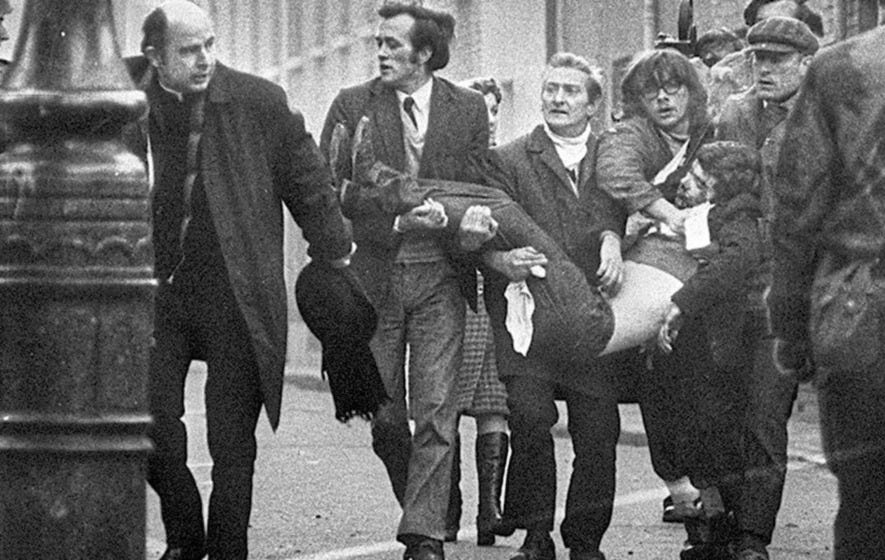
British paratroopers had been deployed to keep watch over the march—which had been deemed illegal by the President of Northern Ireland Brian Faulkner. There were an estimated 10,000-15,000 people in attendance and, for the most part, things were initially peaceful. But when the procession encountered the barricades set up by the military, stones began pelting the troopers, who responded in kind with rubber bullets and CS gas. But the stones kept flying at soldiers whenever they were seen and it didn’t take long before live ammunition started peppering the crowds. Many of those shot were determined to be completely unarmed and not even part of the mob throwing stones. Many were shot at a barricade, some even while they were attempting to help the others who had already been hit—namely 19-year-old William Nash, whose would-be saviors—John Young and Michael McDaid, 17 and 20 years old, respectively—were both shot in the face.
When it was all over, 13 people lay dead, with a 14th dying a month later of his wounds.
It wasn’t the first and it wouldn’t be the last time there would be incidents like this during the Troubles and despite there being several inquiries in the years to come and even a murder investigation, Bloody Sunday became an inflection point in the long-strained relationship between the British Crown and Ireland. Now that the state had shown its true face, the IRA’s gloves came off. 18 British paratroopers were ambushed and murdered in 1979. A lord was assassinated shortly thereafter. Bombings continued all the way into the 1990s, culminating with the 1998 Omagh bombing, which killed 29 people and injuring over 300, despite the Northern Ireland peace process’ ceasefire being in place for four years by then. The Good Friday Agreement had been signed only four months earlier but it wouldn’t be effective until December 2nd, 1999. Members of the Irish paramilitary group responsible for the bombing, the Real IRA, were getting charged as recently as 2014. To say that this conflict is still fresh in the public’s minds is an understatement.
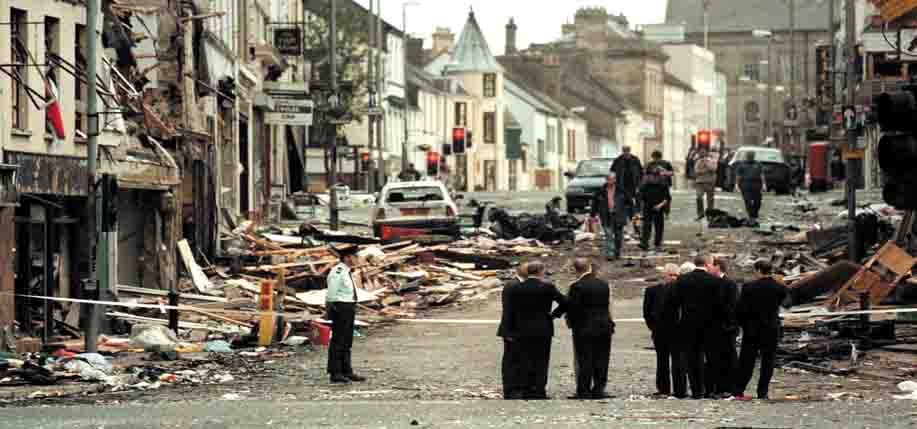
We can entertain euphemisms like “low-level war” or “irregular war” all we want. But if we’re being honest and looking at how things have changed since the 19th century, a sectarian war doesn’t require massive battlefields. And with that sober reality in mind, can you really see something like this not happening in the United States in the coming decades? I’ll let your biases inform your imagination on what that will look like.
…
But why not examine the more extreme manifestations of decentralized warfare and where that ultimately leads? Why don’t we go to the extreme logical conclusion of such an eventuality? Well on one hand, it’s good to avoid invoking extremes too much lest you be accused of hyperbole or hysteria. But on the other, invoking the extremes of the human condition—as our historical podcaster Grand Puba Dan Carlin is wont to do—provides us with a nice barometer for how far things can truly go.
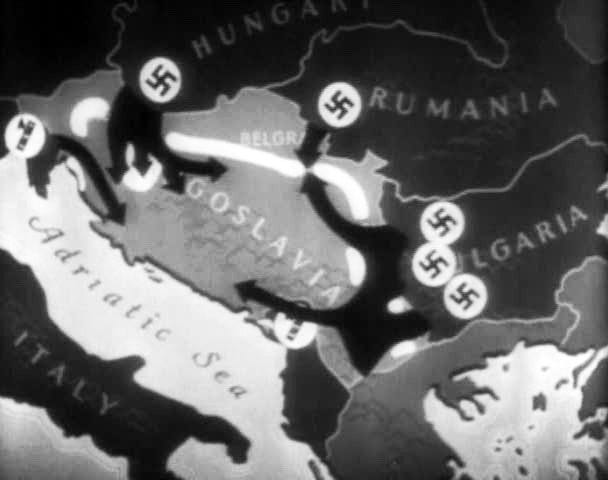
In 1941, the Nazis invaded the still-young Kingdom of Yugoslavia, an arguably doomed, centralized monarchist project that, interestingly enough, would only be resurrected successfully by Josip Broz Tito when he created the Socialist Republic of Yugoslavia in 1945. In doing so, they completely dissolved any barriers put to paper in the multi-ethnic, multi-religious, multi-linguistic territory and created their own, choosing to back the Croatian Catholic nationalists and Muslims headed by Ante Pavelić, the Ustashe. The Ustashe were arguably the most savage, brutal manifestation of European fascism seen; what they didn’t match in the Nazis’ scale, they more than made up for with a zeal for cruelty and a thirst for blood. Their victims included 30,000 Croatian Jews, but their primary ire was directed at the Croatian and Bosnian Serbs who primarily identified as Eastern Orthodox Christians. Through sadistic torture that usually involved farming and forestry implements, they ultimately killed somewhere between 350,000 and 400,000 ethnic Serbs during the course of the war. They were so brutal that even the occupying and allied Nazis were disgusted by their behavior.
Meanwhile, two other groups were fighting with the Ustashe and their Nazi allies: the Serbian nationalist and royalist faction led by Draža Mihailović who (despite allying with the Ustashe at one point during the war, but that’s another story) were backed by the Western powers, namely Great Britain, and the Communist partisans led by the aforementioned Tito, backed, of course, by Stalin’s Soviet Union. Putting aside the complication that ultimately arose thanks to the meddling by the SS that resulted in the creation of the primarily Bosnian Muslim units within their ranks, what essentially had been created was a three-sided war within the territory formerly known (and to be known again) as Yugoslavia. The powers at play were all centralized, to be sure, but external circumstances—namely, the imperialistic ambitions by Adolf Hitler—had led them to be that way.
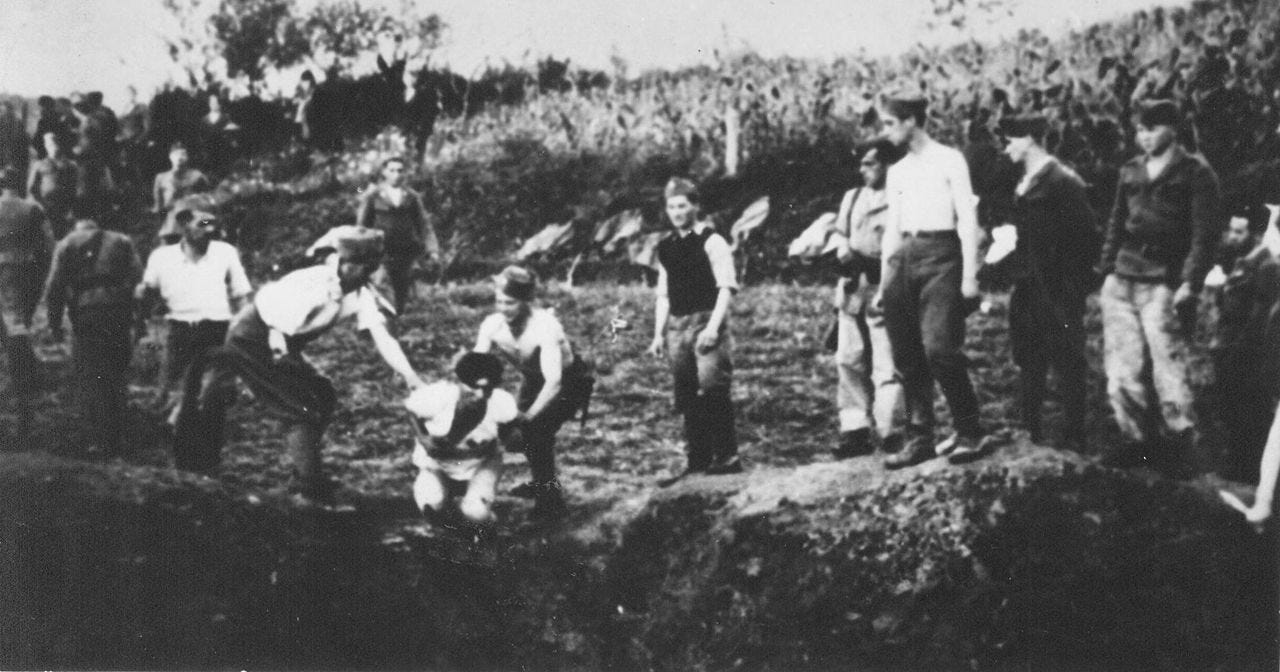
The Kingdom of Yugoslavia, despite being relatively stable, was by no means a guarantee, as I alluded to before. The tensions that the Nazis exploited hadn’t simply gone away. Yugoslavia, like Afghanistan, was a graveyard of empires—namely the Austro-Hungarian and the Ottoman Empires. The people of this region had not only survived the First World War, but they were fresh off of a series of conflicts known as the Balkan Wars from 1912-1913, during which they threw off the Ottoman yoke, though not without acts of terror and ethnic cleansing, with clear dividing lines appearing that only seemed to be determined by religious faith and language. “Yugoslavia”, as it would come to be known, had only been held together by empires—empires that exploited the natural divisions that existed within their borders by using techniques of divide and rule. When the things that keep citizens separate from finding a common identity are as fundamental as religion—deeply-held belief, in other words—or even language, it is not hard to keep these citizens distrustful of one another when these things don’t match. And when the one thing that holds the multi-ethnic, multi-religious, multi-linguistic state together at the seams—an empire or a kingdom—comes apart, nothing will bind those people together again except by force or a very skilled dictator (one like Tito). The various groups of Yugoslavia—the Serbs, the Croats, the Muslims—had no incentive to come together under one shared and unified identity when none of them ever believed or, more importantly for our parallels here today, had started to disbelieve that such an identity even existed.
To continue to drive home these parallels, the United States of America, it could (and perhaps, nah, really should) be said, is also a graveyard of empires: of the British, the Dutch, the French, and the Spanish. And despite how united these states are in name, there is very little evidence to suggest that anything unites us other than a shared appreciation of the freedoms we enjoy, the comforts we can appreciate, and, ultimately, a desire to remove those freedoms for those we consider enemies. And our greatest enemies, it must be said (and as we’ve seen from the video with which I began this whole essay), are now thought and declared to come from within. But let’s be sober-minded and clear-eyed here: are we on the cusp of a brutal, savage, three-sided war, facilitated by an invading, fascistic force that doesn’t speak our language?
No…just not yet.
If you go back and trace the through-line I’ve made here, you likely (I hope, at least, if I’m ever to be considered a halfway decent storyteller) see how a distressed, atomized nation can go from one end of the spectrum—a profoundly psychologically reactive populace engaging in sociopolitical culture wars that escalate toward draconian state crackdowns and, eventually, persistent-if-sporadic and extremely violent sectarian conflict—to the other—this conflict destabilizing the entire territory and society enough so that it becomes a foregone conclusion that a greater power could (only if it so chose, of course) step in and exploit those long-standing divisions and hatreds, only for it to all spiral completely out of control.
The United States, the master of the 20th century proxy war that turned weakened countries into its geopolitical playthings, could well really, truly reap what it has been sowing since it first set foot in the Philippines in 1899 and, thanks to its ever-increasing internal contradictions and weaknesses, become the site of the next series of proxy wars between major powers that only see our continued, unified-if-only-on-paper existence as a hindrance to their ultimate aims. We’re not exactly lacking in monumental amounts of natural resources that the emerging great powers of the world would love to have at no cost apart from that of a war (expensive, but always a sunk cost). As we know from our own geopolitical behavior over the last 130 years or so, natural resources we don’t have to produce ourselves look real sweet and unless you’re an American exceptionalist, it’s legitimately insane to believe the rest of the human race doesn’t operate that way too.
…
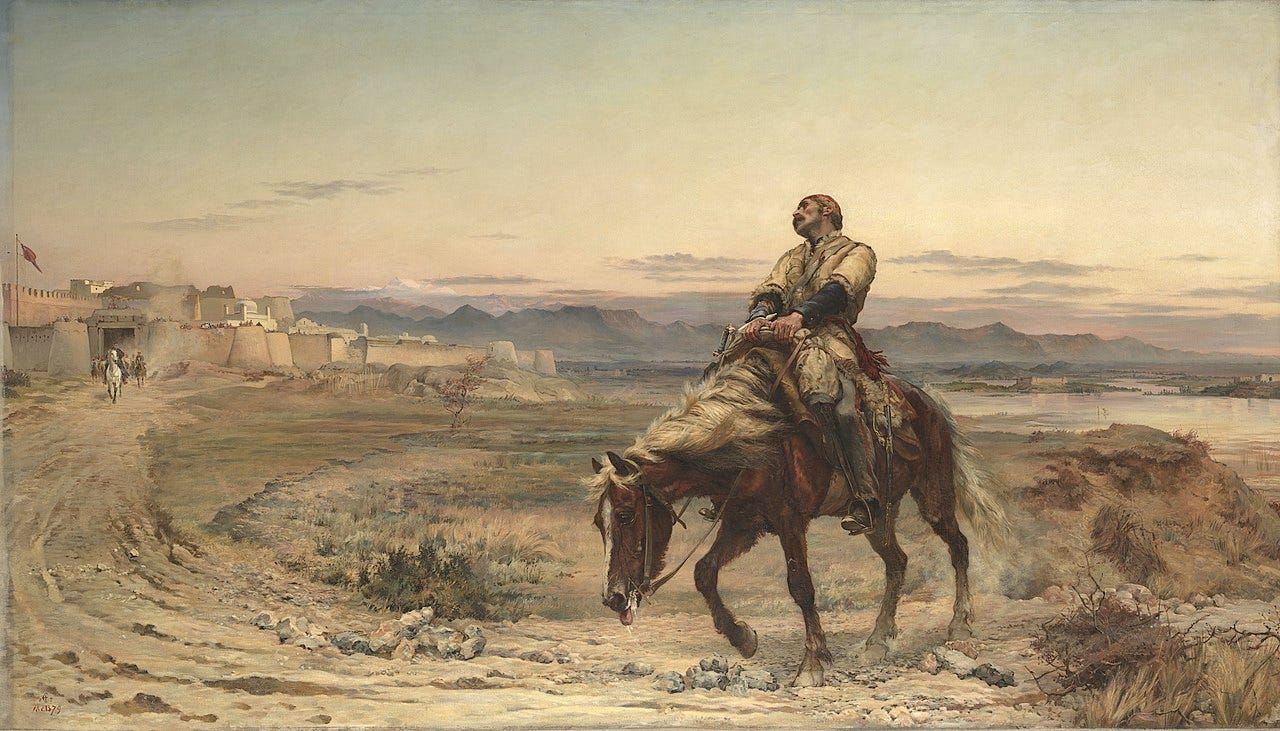
There are two things that come to mind when I think about the logical conclusion of the thread our sociopolitical culture seems to be following. The first is that notion I described earlier that is usually applied to Afghanistan but that could also easily be applied to Yugoslavia and, no I did not stutter before when I said this, the United States: that of the graveyard of empires. There’s a painting from 1879 called “Remnants of an Army” by Elizabeth Thompson, also known as Lady Butler, depicting a British assistant surgeon named William Brydon, who was involved in the 1842 retreat from Kabul, also known as the Elphinstone’s Army Massacre, where over 16,000 British soldiers and civilians perished at the hands of the Afghan forces who, under the direction of Wazir Akbar Khan, were determined to force the occupying British Empire out of their lands. This disaster—considered to be the worst in British military history apart from the Fall of Singapore to the Japanese in World War II—is encapsulated in this painting by Lady Butler, but so is the notion of this “graveyard of empires”; it’s so tethered to not just the event that sparked the creation of that term, but also so tethered to that notion that it’s the main image for the Wikipedia entry on the “graveyard of empires” sobriquet. A graveyard of empires is still a graveyard of empires, no matter how great or terrible it looks in the aftermath.
And then, after thinking about and looking at that amazing painting, I try to think about what all of this looks like well after we’re all dead; well after our children and grandchildren, and maybe even great-grandchildren are all dead. In my mind’s eye, I see a hitch-hiker, trying to get from one end of, say, Kansas, to the other. He’s been moving through North America, gradually, never really stopping, just trying to find a place where he can settle, if only for longer than a few days. Apart from a pup-tent, the clothes on his back, and the canned food he brings in case of emergencies, he only keeps books about the history of the United States with him, reading them the way an Italian reads about Rome or the way a Brit reads about King Arthur or the way a Chinese person reads about Shi Huangdi unifying China. When someone finally picks him up in their electric (or hey, let’s be optimistic, fusion core-powered!) car and asks him where he’s from, maybe what he’s seen. The hitch-hiker tells the driver what he’s seen, but my imagination is limited enough that the scenario kind of stops there. But we don’t really need to know what the hitch-hiker told the driver to understand the essence of what he likely conveyed. All we need to do is remember the words of Percy Shelley:
I met a traveler from an antique land,
Who said—“Two vast and trunkless legs of stone
Stand in the desert. . . . Near them, on the sand,
Half sunk a shattered visage lies, whose frown,
And wrinkled lip, and sneer of cold command,
Tell that its sculptor well those passions read
Which yet survive, stamped on these lifeless things,
The hand that mocked them, and the heart that fed;
And on the pedestal, these words appear:
My name is Ozymandias, King of Kings;
Look on my Works, ye Mighty, and despair!
Nothing beside remains. Round the decay
Of that colossal Wreck, boundless and bare
The lone and level sands stretch far away.”
Tom Nichols in the Atlantic
President Joe Biden has been getting a lot of static for referring to the ideology of Donald Trump and his followers as “semi-fascism.” It isn’t surprising that right-wing pundits, such as the Fox News contributor Mollie Hemingway, are practically having to take out loans to buy extra strings of pearls to clutch. But even John Avlon at CNN and Matt Lewis at The Daily Beast are trying to warn Biden off from insulting millions of voters.
It’s risky politics for the president to use words like semi-fascism, much as it was a needless fumble back in 2016 for Hillary Clinton to call people “deplorables.” For the rest of us, even to consider the word fascism feels like failure. It is a Rubicon we fear to cross, because it makes our fellow Americans into our civic enemies and implies that there is no road back for them, or for us.
We cannot, however, let our understandable fear of words such as fascism scare us out of talking about the reality staring us in the face. The GOP itself might not meet the full definition of a “fascist” party—not yet, anyway—but it’s not a normal party, and its base is not an ordinary political movement. It is, instead, a melding of the remnants of a once-great party with an authoritarian, violent, seditionist personality cult bent on capturing and exercising power solely to benefit its own members and punish its imagined enemies among other Americans.
Is that fascism? For most people, it’s close enough. A would-be strongman and a party of followers enveloped in racism, seized with nostalgia for an imagined glorious past, and drunk on mindless blood-and-soil nationalism all stinks of fascism. There’s a reason, however, that I still counsel against rushing toward the F-word: Things are poised to get worse, and we need to know what to watch for.
Fascism is more than a romance with a forceful right-wing leader. (And let’s remember: Trump is not a “strongman” in any way—he is one of the weakest and most cowardly men ever to serve as president.) A fascist takeover relies on a disciplined and organized mass party led by dedicated people who, once they gain the levers of government, will zero in on destroying the mechanisms—laws, courts, competing parties—that could dislodge them from power.
Violent, tiki-torch-wielding nincompoops are dangerous, but a rabble is not a disciplined party. Ivy League Republicans stumbling around and losing to Democrats in a 50–50 Senate are not the iron ladies and men of steel who can build a fascist state. Faux intellectuals such as Steve Bannon blathering about Leninism are not capable of inspiring the masses. And real fascist street fighters do not start blubbering and shedding tears when they’re arrested. (To paraphrase Jimmy Dugan, there’s no crying in fascism.)
This is why it’s a mistake to assume that every group of howling weirdos wearing “Trump 2024” capes and carrying bear spray is composed of “fascists.” Some of these people are deluded, some are bored, and some are just idiots. If we build them into something more, we’re not only missing the chance to pull some of those people back into American democracy; we’re going to fail to spot the real fascists hiding among them. Glaring drivers jacked up on Fox News and talk radio flying “Fuck Joe Biden” flags on their cars aren’t fascists; they’re the raw material of fascism, the battering rams that actual fascists—cleverer and nimbler than the hapless overgrown adolescents who will end up in front of a judge—will use to knock down our institutions by goading them into violence.
This might seem like a distinction without a difference. And I suppose, like so many people, I am prone to “normalcy bias”—a kind of innate denial that life could ever change dramatically. For those of us who remember the Cold War, it is a special humiliation to think that we defeated the Soviet Union only to find Americans in Budapest cheering on the likes of Viktor Orbán.
But something has changed in American life. Trumpism, which has captured the base of the Republican Party, is authoritarian, antidemocratic, anti-constitutional, and anti-American. For now, Trump and the GOP activists are capable only of igniting scramble-brained jacqueries. But Trump’s most faithful followers are headed for fascism, and they will use the GOP as the vehicle to get there unless the rest of us remain true to a pro-democracy coalition.
It is also important not to be overly distracted by Trump himself. We are in a prefascist interlude, but Trump himself is too incompetent, too lazy and selfish, to lead an actual fascist movement. But avoiding the word won’t prevent it from happening. What should really scare us is realizing that smarter and tougher American fascist leaders are out there, waiting. Trump has paved the way for them by corroding the guardrails of the American system, normalizing the kinds of rhetoric and attacks on opponents used by actual fascists, and convincing ordinary American voters that mass violence is an alternative to the ballot box.
We can prove him wrong and stop this threat in its tracks. But time is growing short.