


On the one hand, I’m writing this to prove to myself that I can produce a steadier stream of content for the influx of new readers. On the other, I feel like opening up a little to help explain to you all fine people just why I care so much about this thing we call history.
You see, longtime listeners of History Impossible and friends of mine know that I was diagnosed with Generalized Anxiety Disorder about 10 years ago (though it would be naïve of me to think I didn’t have the affliction at a younger age, even before I irradiated my brain with drugs throughout my early-to-mid 20s). This disorder, like all psychological disorders, can manifest in myriad ways. For some, it’s fixated on specific worries—“Am I sick? What if I have cancer?”—and for others (like yours truly) it’s much more broad-swath—“I’m getting older and there is no point to anything and I’m a fraud and I’m worthless and no one will ever actually like me.” (Perhaps ironically, when you’re afflicted with the latter type, you’re encouraged by your cognitive behavioral therapist, as I was, to distill these broad worries down into specific things, which almost always results in the realization that those things are completely silly and detached from reality).
If we want to further distill the existential subtype of anxiety, as I like to call it, I think we can see a pattern of a fixation on time. While of course I can only speak for myself, I know that many who suffer from manifestations of more existential anxiety do seem to have a fixation on the passage of time. This can be whether it manifests as a fear of time passing so quickly (e.g. getting older) or a fear of something you did in the past. While I feel confident enough to say that I have, thanks to therapy, largely grown past the latter—the fear of having done something wrong in the past—I still feel the hints of the former—broadly speaking, the fear of the future. This is where my interest in history comes in.
You see, history, despite our interpretations of it always changing, is a fixed thing. It can’t change any more than we can stop gravity or claim that two plus two make five. Pathological anxiety looks at un-fixed things—instability, in other words—the way my dog Freyja looks at a piece of chicken. As soon as something feels uncertain or unstable, your brain decides to smirk and remind you, “hey, this is terrifying isn’t it?” with the most shit-eating grin imaginable. Basically, I imagine my brain has the troll face when it tries to do this to me.

You can likely see where I’m going with this: history being fixed means it’s something that someone like me can latch onto when he’s feeling uncertain about the future. Perhaps not in such a way that makes me feel better about more individualized, personal things, but when facing more existential, broad-swath things (like, say, a global pandemic), looking to the past helped immensely. And being as obsessed as I am with psychology—for reasons that may seem even more obvious now—it has given me a way to look at past events through what I hope is a unique lens (and not just unique because all perspectives are unique). Hence why I believe, as I’ve covered, if we look at the past as being made up of behavioral effects, then we have ourselves some pretty stable footing, including for looking at the future.
Now as I also covered in that previously-linked essay, I don’t believe the future can be predicted (and come to think of it, I have to wonder if the people who claimed—and claim—to be able to see the future are all suffering from or know someone suffering from the existential subtype of pathological anxiety…). But I do think human beings are only capable of a limited number of behaviors (barring true madness, of course), creating a limited number of types of events; hence, why some of us seem to see things operating in cycles. I’m of course speaking on the grandest of scales here because obviously when you boil down to the individual life, you’re always going to see myriad variations. But on the scale of societies and civilizations? There’s a reason we can see ourselves in the stories of the past as far back as ancient Greece or ancient China; hell, there’s a reason we can see ourselves in the behavior of chimpanzees. And to be clear, it’s not just because of how historians (and podcasters) frame things this way, so we should probably toss out the post-modern argument of us creating meaning (as fun as that kind of argument can indeed be).
But there’s another, more counter-intuitive reason history “does it for me,” in the context of my own existential subtype of pathological anxiety. And that is because history is fucking terrifying.
Now of course, there is probably more positive (or even neutral) than negative in the world’s history, but that is simply per capita in the context of, well, “all time.” When things in history go bad, they really go bad, as readers and listeners of me and all of my comrades and friends in this historical podcasting space likely know. If you’ll indulge me, I want to obliquely draw the comparison to a book I used when putting together the over-six-hour episode I did on the Spanish flu and its effects in postwar Weimar Germany. That book is Meltdown: What Plane Crashes, Oil Spills, and Dumb Business Decisions Can Teach Us About How to Succeed at Work and at Home, written by Chris Clearfield and Andras Tilcsik. In that book, they do indeed look at all of those things listed in the title—and more—and explain that as we’ve advanced technologically, our systems become more robust, while also becoming—by necessity—more tightly-coupled. A tightly-coupled system is, statistically, the safest kind of system in existence. And yet, because the system is so tightly-coupled, it means that if anything goes wrong, it’s going to go really wrong.
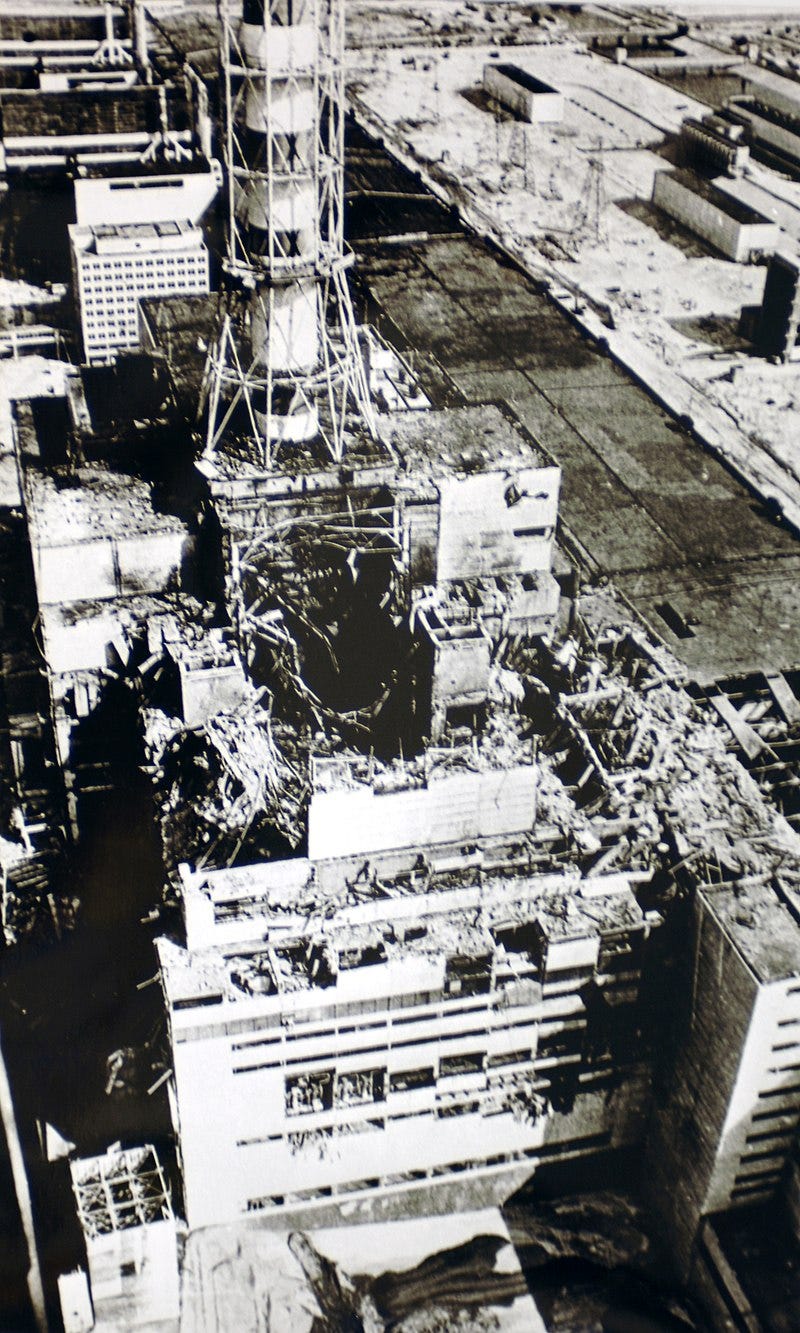
Airplanes are a good example of this—hence why people’s fear of flying is, I guess “cured,” by referencing how rare plane crashes are compared to fatal car crashes; I guess some people feel better knowing that they’re more likely to die horribly during a daily activity than during the miracle of human flight, but I digress—but I think my favorite example (because, you know, history) is a nuclear power plant; namely Chernobyl. I won’t get into the nitty-gritty details of the incident or even its causes (I mean, do you want me to try and explain large positive void coefficients of reactivity, the design of control rods, and Soviet corruption?). I recommend listening to my friend Kristaps Andrejsons’ Eastern Border podcasts on the subject, and watching the amazing HBO series while you’re at it, if you want to get into the details and the human drama. The point is, the nuclear disaster at Chernobyl was only possible thanks to a confluence of very tiny factors (tiny only in isolation), that then, in turn, led to the worst nuclear catastrophe since the dropping of the bombs on Hiroshima and Nagasaki.
To explain, we just need to look at some of the factors in isolation. Take, for example, the fact that the plant’s operators didn’t fully understand safety aspects of the plant. This by itself could definitely cause problems, but only with the other factors present could things go as wrong as they did. These factors, including the overall design of the plant not adhering to proper safety standards, the overall design of the aforementioned control rods, the use of solid graphite to slow the neutrons and thus produce runaway energy, or even just the “general lack of safety culture in nuclear matters at the national level as well as locally,” as put by the International Nuclear Safety Advisory Group in their 1992 report, are all similar: in isolation, they’re not good by any means and can cause problems, but together? That’s the last thing a nuclear power plant should have to experience. To summarize, Chernobyl, like all nuclear power plants, was a very tightly-coupled system, so when the “correct” factors coalesced within its walls, the disaster was going to be catastrophic, rather than simply an annoyance or relatively minor accident.
So where does history come in? Well, as I hypothesized in my aforementioned pandemic episode, there is no more tightly-coupled system than a society or civilization. And this reflects in how history works, like I was suggesting above. Again, in the grandest of scales, things are normal most of the time; chill, low-key. But then something goes wrong, and because society is our most tightly-coupled system of all, it goes very wrong. Things may have gotten bad thanks to COVID-19 and Russia’s imperialist adventures in Ukraine, but please trust me when I say this: they can very easily and very broadly become much, much worse, as long as the “correct” factors enter the picture at the right time. Again, the probability of massive, cascading catastrophe is always low, but just know that if (or when) a catastrophe happens, it’s going to be huge thanks to just how tightly coupled our civilization is.
And so, this is why, as I say, history is terrifying. Because, thanks to its fixed and certain nature, it gives us a window into just how bad things can get in the unfixed and uncertain future. And yet, as counter-intuitive as this all might sound, that can provide a measure comfort to this twisted little anxiety-riddled beast whose work you’re reading (and listening to) right now. Because as terrifying as the past truly is, it’s got nothing on the terror that comes from our unseen, unknown, uncaring future.
I might slightly disagree that "society" in general is a very tightly coupled system. Our (maybe your) version of society (urban society) is tightly coupled, but is also made up of super-intelligent, autonomous parts, ie humans. Those parts should be capable of self-sufficiency and resilience if there is a potentially catastrophic chain of events set in motion. But that resilience at an individual level, and by extension regional or global level is likely at an all-time low compared to even a century ago. There is no good reason for this, save the seemingly irresistible pull of cities on people that could otherwise spread out on the land and reassume responsibility for their own sustenance, including shelter and social life. Our society is tightly coupled due to most of us falling for the globalist lie that somehow cukes from Mexico will keep rolling up the highway come hell or high water. Our reliance on such systems has a compounding effect on the negative outcomes from something like a novel virus working its way through our population.
This is not me trying to puff out my chest and act like a tough guy, but I believe the hysterical reaction of many people to adverse events (looking at you COVID-19) is very much a function of lack of familiarity with high-risk situations, and the subsequent inability to assess, mitigate and power through these events. My reaction to COVID 19 was, "ok, danger lurks, how do we carry on without the hysterics?". You do not run from something without assessing why you are running. This is literally true for almost all the jobs I've done, where it may be a falling tree, or a chance encounter with a bear that you need to assess. Save for some loggers, commercial fisherman, military types or other high-risk occupations, most people these days just aren't mentally equipped for a proper fight-or-flight assessment, especially at any sort of speed. Watching people melt down over something well before the dangers were understood would have been funny to me were it not almost society-wide. I actually feel very sorry for people whose parents and society haven't helped better prepare them for the potential hazards of life.
Having said all that, I still believe that although our current iterations of civilization are ostensibly rightly coupled, we as humans have more than enough individual intelligence to work through, or around almost any calamity. If we were, on average, better equipped with the skills of risk assessment and resilience there would be very little other than a meteor strike that would cause us much of a sweat.
One of the treatments for my anxiety and depression (or whatever this shit is inside my head) is to lean into and seek out challenging or "dangerous" work and pastimes. The realization that many hazards are big ol' nothing burgers is the antidote to your fears.
I like this a lot. Although it ends on a dark note. 🤖👺😑