


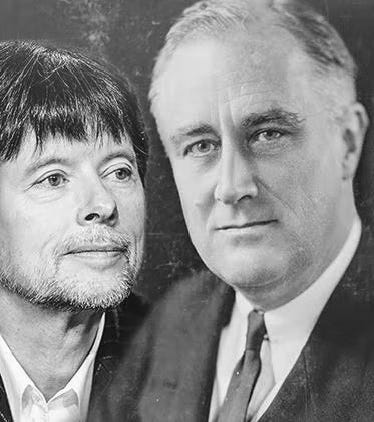
We all have a point of view. I’ve made it abundantly clear that I have my own, and it’s always welcome when someone presenting history admits specifically what their point of view is or will be. The great (and I say that without irony, hence my short temper on this one) Ken Burns himself did indeed announce this past summer that his then-upcoming miniseries The U.S. and the Holocaust was aiming to dispel the “myth” that President Franklin Delano Roosevelt abandoned the Jews while he was president. And that is fair enough: Ken Burns is Ken Burns, first of all, but honestly, there’s nothing wrong with presenting history via your point of view—this is why I equally support the 1619 Project’s right to exist alongside, say, Niall Ferguson’s right to suggest that the British Empire might have been more of a net positive than a net negative on the world. The same goes for the famous (or infamous) characterizations made about America in Howard Zinn’s The People’s History of the United States. I’d even extend the same charity to David Irving and his Holocaust “skepticism” if he only had admitted from the outset that he was an abject anti-Semite with a certain bone to pick, but we can’t have nice things, can we?
However, when you do this, you are taking a risk, as I and many other historical podcasters and content creators likely know, you are prefacing your work in a way that invites criticism. And to be clear, this is a very good and principled thing to do—I see this, as my pal and comrade CJ Killmer of the Dangerous History Podcast likes to put it, as engaging in “honest history.” However: when you invite this scrutiny upon yourself, you better make sure that you have your ducks in order. Because when an amateur like me can—without even digging into the sources until after watching the series—see right through your omissions and even outright distortions of the long-available facts that don’t support your goal of quite literally white-washing FDR’s legacy viz the Holocaust, then you done f’ed up. And when you’re Ken Burns, that’s even more unbecoming than any of us engaging in this historical content creation game in which we find ourselves.

…
Allow me to get some throat clearing out of the way first: I have nothing against Ken Burns or even what I’ve called his “super milquetoast American worldview”. And in fact, despite that and what I’m about to say here, I still consider him to be the greatest historical documentarian of all time. His miniseries on the Vietnam War (my personal favorite), WWII, the Old West, the Dust Bowl, Prohibition, Mark Twain, jazz music, baseball, and of course, his oft-cited (and hilariously parodied) Civil War series are all in my personal canon of inspirational content. They are, dare I say it, works of true art. The way they bring to life every facet of the story they set out to tell—whether through well-acted audio readings or interviews with people who were actually there—essentially has created the baseline with which all historical podcasters produce content, whether we are aware of it or not. While it goes without saying that we owe the likes of Dan Carlin and Mike Duncan for creating this genre, we REALLY OWE Ken Burns.
And that, ladies and gentlemen (brothers and sisters, comrades and friends) is why The U.S. and the Holocaust is so disappointing and even, in some ways, distressing to me.
On the one hand, it’s possible to see where Ken Burns was coming from when working on this miniseries. While he’s largely seen as a positive force in American politics, especially by those old enough to remember his presidency, FDR does get a fair bit of thrashing when it comes to the “Holocaust question” (as well as, it should be noted, the “Executive Order 9066 question”) from pretty much all sides of the debate. And the question of whether or not this is a fair thing to do is what preoccupies Burns with his newest miniseries. However, having gone in with the stated mission of rehabilitating FDR’s image with regards to this question, we can see that he’s more motivated by debunking the thrashing FDR receives than examining all of the evidence that’s available that both supports and refutes such claims. In other words, it’s pretty clear that based on the information Burns does provide that he’s going to come off as a blatant apologist at best and a dishonest propagandist at worst.
In many ways, the writing has been on the wall since at least 2014 for how willing Burns was to distort the historical record in order to place FDR onto his vaunted pedestal. It was in September of that year that Burns released The Roosevelts: An Intimate History. While at the time it was largely seen as another seemingly august piece of work from PBS’ preeminent historical documentarian, closer examination of the work tells a different story. While the series was covering the reaction within the FDR White House to the appalling proto-Holocaust event that’s come to be known as Kristallnacht (in which 100 Jewish people were murdered and 30,000 were tossed into concentration camps), it made sure to highlight FDR’s response as “forceful and impressive,” as described by Rafael Medoff in his exposé in Tablet. It was the case that FDR, while extending the visitors’ visas of 15,000 Germans already in the United States, made no effort to take in more refugees (a theme continuously excused and dishonestly explained away by Burns in his newer docuseries). It was also the case that this bullishness on the part of the president regarding refugees was what ultimately led to the infamous “Voyage of the Damned Incident” with the MS St. Louis, after which almost one third of the Jewish refugees onboard the ship denied entry into the United States were murdered in the Holocaust.
In the Tablet piece, Medoff highlights many other examples of Burns’ obfuscation in the 2014 docuseries, including a refusal to back the Wagner-Rogers Bill, which was designed to bring in 20,000 German Jewish children as refugees, as well as an unwillingness to reference Hitler and Germany when his Secretary for the Interior addressed the events of Kristallnacht in a CBS radio broadcast. In wondering what we can make of this circa 2014, there wasn’t much in the way of answer except that it suggested a mere blindspot on the part of Burns. But when 2022 rolled around and The U.S. and the Holocaust was released in September of that same year, we’d get our answer as clear as day. Because, if anything, the 2022 docuseries seemed to made less about informing the American public about just how complicit their entire nation—especially including its beloved president—arguably was in the most infamous genocide in world history, and more about saying “Oh, you handful of critics didn’t like my softball characterization of FDR back in 2014? Hold my beer.”
There is a persistent theme that plays throughout the three-part series Ken Burns has given us: that when it comes to America’s tepid response to the Holocaust, it definitely wasn’t Franklin Delano Roosevelt’s fault. This is tricky to criticize because if one leans into blaming FDR too much, one risks overshadowing the real, actual perpetrators of the Holocaust, i.e. the National Socialists of Germany and their toadies. However, an inverse of that risk is created when you use the tactic Ken Burns seems to have thought was best: when you go out of your way, repeatedly, to blame everyone but FDR for how the Holocaust turned out vis-a-vis American inaction, it starts to raise a few questions even for the cursory fan of history. Burns’ chosen method can be easily boiled down to these two characterizations:
When a specific policy that could have saved Jews from Hitler’s clutches doesn’t go through or work, it’s the fault of the rampantly antisemitic State Department.
When the failure of a policy can more credibly and directly be blamed on FDR’s inaction, it’s the fault of a rampantly racist and morally backward American public.
It is worth noting that these claims are not invented out of whole cloth. There is plenty of evidence cited by Burns that does indeed carry some very unpleasant truths. FDR’s State Department—particularly under the influence of known anti-Semite Assistant Secretary Breckenridge Long—was indeed responsible for several heinous policies that resulted in untold thousands of Jews and other refugees trying to escape Europe being unable to enter the United States and thus being killed by the Nazis. These decisions/policies included Long lying to a Congressional committee in 1943 about the work the State Department had been doing on the part of refugees, something that had already been kept at a minimum since the 1920s. And it is indeed true that many—if not most—Americans not only didn’t initially reject Nazism wholesale but also didn’t like the idea of allowing refugees—Jewish or otherwise—into the United States, especially during the worst years of the Great Depression. And yet, what of President Roosevelt? According to Burns, FDR—who the Atlantic appropriately wrote is “treat[ed]…with kid gloves” in their review of the series—was doing all he could to help the refugees whose plight apparently only he and “the good guys” (deemed so, of course, by Burns and no one else except historians who agree with him) cared, while the rest of the country and government were apparently salivating over the spilling of Jewish blood. As the Atlantic piece by Dara Horn—who, despite writing sympathetically of the series, mercifully doesn’t let Burns and his team off the hook on this problem—also puts it, “The film’s refusal to judge the commander in chief plays into a larger political pattern: offering generosity only toward those we admire.” So this raises the question: per the central question regarding the relationship between the United States and the Holocaust, what is there to admire about President Roosevelt? As it turns out, next to nothing.
…
That FDR was, broadly speaking, a racist, there is little doubt—in the 1920s, he wrote for the Macon Daily Telegraph that “Japanese immigrants are not capable of assimilation into the American population.…[a]nyone who has traveled in the Far East knows that the mingling of Asiatic blood with European or American blood produces, in nine cases out of ten, the most unfortunate results.” This links more directly to his callous (and one might even go so far as to say criminal) treatment of Japanese Americans in the wake of the bombing of Pearl Harbor, who, as many reading likely know, were thrown into literal concentration camps, not unlike the early, pre-death factory camps operated by the Nazis within Germany’s borders. But more specifically to the point of this analysis is the question regarding his feelings about Jews. Perhaps unsurprisingly, they didn’t deviate much from the norms established by his class or ideology (i.e. late 19th and early 20th century progressivism).
Also in the 1920s, FDR had attempted to “spread the Jews thin” on a local level in Meriwether County in Georgia and at Hyde Park in New York state, “on the basis of adding four or five Jewish families at each place.” Claiming that “the local population would have no objection if there were no more than that,” FDR clearly puts his worldview on display: that the fewer concentrations of Jews there are, the better off everyone is. He even expanded this view, according to a diary entry by Vice President Henry Wallace, to a global scale during his 1943 meeting with Winston Churchill to discuss the “Jewish question.” Whether or not concentrations of Jews “create” anti-Semitic feelings among the majority of a population is irrelevant when you consider the implications of “spreading the Jews thin”: effectively eliminating any notion, now and forever, of a “Jewish community.” Of course, this is not even the same league as what the Nazis were doing (or really what any other “Great Power” was doing in the late 19th century). But the essence of this desire to “solve the Jewish question” is always the same: that the world would be better off without the Jews and any suspicion, persecution, or violence they experience, they bring upon themselves.
Some may think that FDR’s views on how to help the Jews were simply misguided, out-of-touch attempts at “mercy.” This would wash, if not for the fact that there are multitudes of documentation regarding his private remarks about the Jews, including during his presidential terms while he was handling the refugee crisis from Europe. Before he was president, and was a member of Harvard University’s board of directors, he engaged in what, frankly, is almost too familiar to us in the 21st century: racial quotas. During the 1920s while serving the board, FDR instituted a quota system that was specifically aimed at limiting the number of Jewish students enrolled. Flash forward to his presidency, he was known to privately refer to the repeated pleas of Jewish refugees from Europe as “Jewish wailing” and “sob stuff.” Once when meeting with the famous (or infamous; your mileage may vary) Rabbi Stephen Wise in 1938, who notified FDR of the threats of Jewish expulsions from Poland, FDR explained the threat away by saying that the Poles’ feelings were understandable because “the Jewish grain dealer and the Jewish shoe dealer and the Jewish shopkeeper [were] controlling the Polish economy.” He was even known to say that the Nazis’ feelings on the Jews were “understandable” as late as 1943, when millions of Jews had already been massacred and many world leaders—including FDR—were aware of what was happening. Even Eleanor Roosevelt—who Burns never wastes any time to praise—had her own thoughts on the Jews, once referring to Supreme Court Justice Felix Frankfurter as “an interesting little man but very Jew,” and once writing in her diary after attending a party held by Jewish banker Bernard Baruch that, “The Jew party was appalling. I never wish to hear money, jewels, and sables mentioned again.”
Based on both historical and anecdotal evidence available, there is no question (or should be no question) that Franklin Roosevelt was an anti-Semite; perhaps no more of an anti-Semite than the average man of his age and class of that time period, but an anti-Semite nonetheless. And while it is certainly counterproductive to judge someone’s personal feelings and prejudices with the same social standards of the present, in the case of FDR, there were, literally, millions of lives imminently on the line, something about which he could have, as Liam Neeson playing Oskar Schindler famously said, “done more.” A debate on Thomas Jefferson’ or Abraham Lincoln’s overtly racist behavior or secret racist convictions (respectively) this is not. We must therefore try and figure out how much that personal anti-Semitism fueled his action (or inaction) with regards to the Holocaust is. This is ultimately, of course, more debatable, in the sense that one cannot read the mind of a man who has been dead for nearly 80 years (let alone one who is alive today). But we can certainly try.
…
One of the major pieces of evidence presented by Burns of FDR’s magnanimity toward the Jews is his calling of a conference Evian-les-Bains, France in 1938 to discuss what to do about the Jewish refugee crisis created by the Nazis’ persecutions. During this conference, delegates from 32 countries convened. Suspiciously absent wasn’t FDR—this wasn’t Yalta, after all—but rather was any representative of his government. Instead, he sent, as a “special envoy,” a friend of his who worked in business. As it would turn out, this conference was, among other things including a colossal waste of time (apart from the Dominican Republic being the only country to accept refugees; 5,000 out of the 100,000 spaces offered, as it would turn out), a way for the United States and other nations to promote themselves as nations sympathetic to the plight of Europe’s Jews, but whose hands were simply tied. As the previously-cited Atlantic article concerning The U.S. and the Holocaust puts it, “The Évian Conference was carte blanche to kill” also pointing out that the Nazis “couldn’t have asked for a clearer announcement that the world did not care what happened to the Jews.” While one might be tempted to think that FDR was naive enough to think that Hitler wouldn’t dare read the conference that way, it’s pretty striking that he didn’t even bother to send a representative from his own government to make it clear he was serious.
This is yet another aspect of FDR’s presidency given a free pass by Ken Burns, who more than once claims that FDR’s decision-making regarding the Jews in the 1930s was to avoid provoking a response by Hitler. And indeed, only four months after the Evian-les-Bains conference, Kristallnacht occurred. While the Nazis had their excuses for Kristallnacht—namely the assassination of Ernst vom Rath by Herschel Grynszpan—it had been made perfectly clear by the delegates at Evian-les-Bains that they couldn’t be bothered to help the Jews. In addition, as we’ve already seen with Burns’ 2014 series, Burns again tries to suggest that after Kristallnacht occurred, FDR’s response was forceful and impressive. While highlighting things that suggest such a response, Burns omits those that contradict it. For example, there is no mention of FDR “pressing Wise to neuter [a] planned American Jewish plebiscite [to fight anti-Semitism],” as put by Rafael Medoff in his book on the subject, The Jews Should Keep Quiet. There is also no mention of Eleanor Roosevelt saying after Kristallnacht that “I think it is important in this country that the Jews as Jews remain unaggressive and stress the fact they are Americans first and above everything else.”
Then there is the question of Jewish immigration itself. According to Burns, many countries of the world were indeed largely indifferent to the horrors facing Europe’s Jewish population; however, they were all worse than the United States, specifically because of the actions taken by FDR. Beginning in the mid-1930s, the United States was only letting in a couple thousand German citizens here and there—around 3,500 in 1934, contrasted with Great Britain admitting 50,000 to its territories, mostly in Palestine (which, given the history there during this period, is a whole mess of moral complexity, something covered by me in the first half of the Muslim Nazis series, and much better by Darryl Cooper in his MartyrMade podcast’s Fear and Loathing in the New Jerusalem series, and not worth trying to untangle here). This is indeed pointed out by Burns, but he also claims that between 1939-1941, the United States accepted “more refugees than any sovereign nation,” something objectively untrue when compared to Nazi Germany’s still-on-paper-allies, the Soviet Union. While hardly a paragon for human rights, the USSR took on an estimated 300,000 Jewish refugees during that same period, as well as continued efforts to evacuate Jewish civilians during the Soviet retreat during the onslaught of Operation Barbarossa. The trends of less refugees being admitted by the United States than by other Allied and Allied-adjacent countries continued until the end of the war. As Rafael Medoff writes, “[I]s it really impressive if the president of a country claiming to represent high ideals of humanitarianism was slightly more generous in admitting refugees than, say, the military juntas ruling in South America? Is that the moral standard by which we as Americans judge our country and our leaders?”
Much of these issues, as mentioned earlier, are pinned by Burns on two things over which FDR supposedly had no control: the State Department and the American public. FDR’s State Department in general, and the anti-Semite Breckenridge Long in particular are the main targets of the former, as mentioned earlier. However, what Burns also manages to leave out of his narrative is the fact that, despite FDR’s values being allegedly (according to Burns) incompatible with those of Long regarding the plight of the Jews, that FDR made no moves to remove and replace Long and other nefarious figures in the State Department. Many of the historians quoted and cited by Burns repeatedly make the point that FDR wasn’t able to effect the kind of change necessary to change immigration policy—and indeed, the president doesn’t have the right to tell Congress what to do, and the Congress of that time has a lot to answer for—but many of the policies that were implemented outside of Congress were implemented by figures like Breckinridge Long. And, it should be noted, Long wasn’t immune from being removed from his position. Because, thanks to the precedent being set by the Supreme Court in 1926 in Myers v. The United States, FDR—who became president in 1932—did indeed have the right to dismiss members of the Cabinet at any time without any sort of approval from the Senate. Undemocratic as this might be, is anyone—Burns or otherwise—willing, especially in hindsight, to say that FDR couldn’t (or shouldn’t) have put the squeeze on his Secretary of State Cordell Hull after it was clear where his assistant secretary’s priorities were? Even if this was merely a case of incompetence—rather than simple apathy, willful negligence, or even outright malice—this isn’t something that can simply be explained away. Which Ken Burns was all to happy to do, and repeatedly, throughout his newest series.
The other thing over which FDR supposedly had no control according to Burns—the American public—is slightly less of something that is objectively incorrect and more of a moral argument, but nevertheless is a valid one to make. Throughout The U.S. and the Holocaust, the American public’s attitudes—e.g. the 90% disapproval of the Nazis’ treatment of the Jews contrasted with the 70% disapproval of letting Jewish refugees be given safe harbor in the United States—are given as a major reason for why nothing could be done. By providing this much criticism of the American public as a whole, while at the same time providing so many excuses for FDR, the entire argument smacks of, quite frankly, incredible, out-of-touch elitism, especially with regard to how persuasion works.
By many metrics, FDR’s approval rating fluctuated throughout the 1930s, but his highest disapproval never peaked above 46% (something that can’t be claimed by our two most recent presidents, it should be noted); in addition, his famous Fireside Chats, while sitting at an average of 18% listenership during peacetime, reached an average of 58% during the war—that’s of all radio listeners. The point of bringing up these two metrics in conjunction with one another is to illustrate just how much influence FDR actually had over much of the American people. If one takes the fact that nine out of ten Americans disapproved of what the Nazis were doing to the Jews, and in the same breath claims that FDR—a man as popular as he usually was—couldn’t do anything to move the needle even slightly on the question of granting refugee status to these people, then it’s going to come across as, frankly, the kind of joke a toddler would make.
…
Where Ken Burns’ series manages to succeed—and given its multitudes of failings, that is certainly saying something—is in its willingness to air differing points of view regarding the “bombing of Auschwitz” question. In 1944, Rudolf Vrba and Alfred Wetzler, inmates at Auschwitz-Birkenau, managed what was often impossible and escaped captivity. They managed to reach Slovakia and reported on what had been going on in the camp, with their report—in which they recommended bombing the complex—circulating through many worldwide Jewish organizations dedicated to appealing Allied governments for assistance. The report made its way to the United States, and while it still isn’t clear that it ever was presented to FDR himself, the decision against bombing the killing factory was made.
Many historians—namely some of those interviewed by Burns for The U.S. and the Holocaust—claim that it simply wasn’t feasible for the Allies to divert resources to conduct such a raid, especially in the most intense phases of the Holocaust, during which 90% of Europe’s Jews were outside of the range of American bombers. And while certainly an arguably valid claim in the context of 1942-1943, the morality of such a claim starts to teeter on shaky ground, especially as 1944 and 1945 enter the picture. Were most of the Jews who were going to be killed already dead? Almost certainly. And yet, is one willing to keep things purely numerical when one has to countenance the fact that 800 Jewish children were gassed in a single day in October of 1944? What about the over 434,000 Hungarian Jews that didn’t pass through those gates until 1944? It’s not an argument I’d like to make, especially if it was in the interest of defending a president who most certainly hated Jews.
However, thanks to the inclusion of scholars like Deborah Lipstadt—who knows a thing or two about Holocaust disinformation—the best monkey wrench that can be thrown into an ethical discussion—that is, moral complexity—is added to the third part of this series, where she makes the case that, whether or not it was possible to bomb Auschwitz, it should have been done. Would a bombing raid have resulted in both casualties on the part of the bombers and, crucially from the perspective of an ethical debate, the inmates at Auschwitz? Almost certainly. And yet the amount of lives saved had this been done even in 1944 would not have been insignificant.
The question of whether or not it was possible is moot, however, because, as it turned out, it was. Again, thankfully, the series does highlight the fact that there were bombing runs being conducted close to Auschwitz—namely in Upper Silesia, within 20 miles of the complex and sometimes as close as five miles. And in the end, the question of efficacy, feels as if it is left largely open. Regardless of how one feels on this question—and I can say that I tend to fall into the David S. Wyman camp—one can appreciate that the debate is allowed to happen in the first place. And while this is certainly the case during one portion of The U.S. and the Holocaust, the same, as we’ve now seen, cannot be said for the rest of it.
…
What can be said about a hero, perhaps idol, who lets you down? In a way, it simply paints them as a human being, something that is always going to happen in life. It first happens with your parents, and then, indeed, it happens with your idols. This is why there’s that old saying about “never meeting your idols.” I’ve never met Ken Burns and I doubt I ever will; Ken Burns—who has said that he “loves” FDR—has obviously never and even more obviously will never meet FDR. And yet, clearly, I am capable of doing what Burns is not—recognizing that one of my idols has some pretty fatal, moral flaws in his work and worldview. That he has said he “loves” FDR “the way you love complicated people in your own life,” and that “it’s not without judgment and disappointment,” just makes the omissions he made from this newest series of his feel all the more glaringly obvious and therefore deliberate.
This can suggest a lot of things. It can suggest that Burns, like Isabel Wilkerson did in her famous 2020 book Caste where she very conspicuously omitted FDR’s friendship with the famous eugenicist and Hitler pen pal Madison Grant in favor of highlighting Grant’s Republican friendships, wishes to paint a very ideological picture in which any information inconvenient to that picture is omitted for the sake of stability and consistency. It could be that Burns, a Baby Boomer, is simply insecure about the world wrought by his generation and yearns for the “Greatness” status imparted by cultural historians on his own parents’ generation, as well as the one of FDR. They saved the world, after all. And what have the Boomers done? Oh right…
However, I think what has happened with Ken Burns in the case of this docuseries is something that all fans of historical figures have to sometimes face. In the case of Burns, I think he was unable to face the truth that, as Jared Sorhaindo wrote, “in the end, the only other people who cared about [the Jews’] existence, and with single-minded ferocity, were the relentless murderers empowered with the means to destroy them.” And thanks to his self-professed love of FDR, when (or even if) that reality dawned on him, he was emotionally incapable of admitting it to the rest of us. Instead, he decides—as made clear by the docuseries’ final minutes—to, as Jonathan S. Tobin puts it, “trace a link between the political villains of the past and the people his audience despises right now.” This could well be basic, milquetoast ideological blinders, but for someone of Burns’ skill and intellect combined with his open admission of crying while editing the sequences of his Roosevelts docuseries when all of the figures covered in the series died—somehow, as he perplexingly claims, not making him “sentimental and nostalgic”—it strikes me as more of an emotional defense mechanism against the dark truth that human beings, even great and talented ones, can have truly vile moral compasses. And, more importantly, a defense mechanism against the fact that Franklin Delano Roosevelt was no exception to this.
Historian Lucy S. Dawidowicz once wrote that “Americans have […] preferred to address themselves to the eternal verities, the large questions of good and evil.” Dawidowicz had her own understandable issues with casting anyone apart from the Nazis as villains in the story of the Holocaust, and likely wouldn’t have agreed with much I’ve written here. But later in her work, when she describes Americans watching the trial of Adolf Eichmann in 1960 as “blaming themselves for harboring racist prejudices and for being sinful creatures” and “inton[ing] as one: ‘We are all guilty,’” all I can really see is a solemn faced Ken Burns nodding along, clutching his portrait of FDR to his chest like a Bible—perhaps weeping, perhaps not—showing how little he actually understands the irony of the scene.