



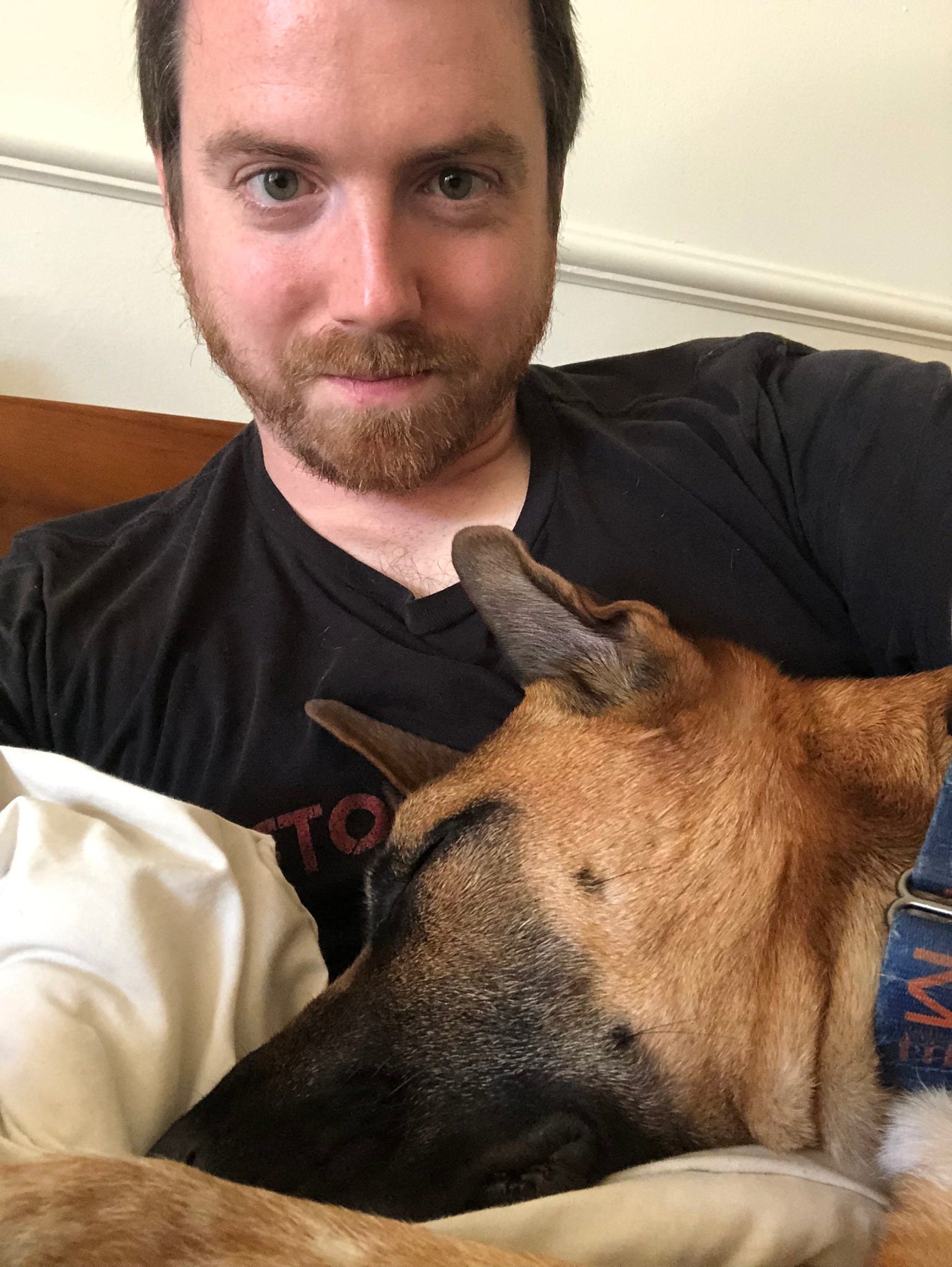
As friends, family, and people following me on social media likely have seen by now, we lost one of our family dogs, Lincoln, in a tragic accident last week. To say devastated doesn’t begin to describe the feelings that have been swirling around my house. While the raw pain has deadened—at least deadened enough for me to try and write this, so please forgive the stream of consciousness vibe—I still find myself seeing his ghost roam our back yard and feeling his absence every time we leash up our other dog Freyja for a walk and I can feel my throat tighten. It’s been harder to deal with than I expected, especially since this isn’t the first time I’ve unexpectedly lost a beloved pet (though it is the first time I’ve lost a dog, and the first time I’ve lost one so soon after it’s entered my life). It’s also not the first time I’ve experienced death. In fact, this has gotten me thinking about how much death has played into my own life, as well as its role in my main interest; that is, history.
Death has come in many forms in my experience, starting from a relatively young age. More tangentially, I have memories of losing a family friend and fellow church member to AIDS in the mid-1990s, to knowing family members of classmates and friends becoming victims of gang violence. More closely, my surviving grandparents both died within about five years of each other during my young adulthood. I also experienced a traditional Chinese funeral when Molly and I visited Changsha in 2012 and her uncle coincidentally suffered an aneurysm and became brain-dead, which would be my first and last impression of him. In the span of one year—in 2008 when I was 22—two friends of mine died under very different, but in some ways equally horrifying circumstances. One, Jeff, became consumed by a mysterious neurological condition that gradually shut down his bodily functions until there was nothing left. The other, Joe (a guy I’d actually known since childhood), would become the victim of a murder, possibly a random gang initiation killing, in which he was stabbed in the throat as he left a music show in the Cedar-Riverside neighborhood of Minneapolis. I would hear of other deaths thanks to social media, where many profiles on Facebook or Instagram lived (and in some cases, still live) on as digital mausoleums with people sending annual birthday wishes like placing small bundles of roses on a grave.
I mention all these deaths to which I’ve been privy because the first important thing that I have to remind myself is that unlike a lot of things in life, death never becomes easier. You don’t become a “pro” at dealing with the tragedy of death. I suspect that if anyone does become truly numb to the experience, there’s something else going on; whether it’s just psychopathy or simply a cognitive defense mechanism, I can only guess. Losing a loved one, or even just a friend and one to whom you’re not even necessarily that close, rips something open inside you, like a frayed seam in some old clothes. It’s why many people, especially in the later stages of life, will say that it never gets easier after someone dies. It might remind us that we only have so much time left, but I don’t think that’s necessarily what grief is either, though I wouldn’t rule it out as playing a part.
This is one of those things that I’m sure I’ll always change my mind about, but as best I can explain it, I believe grief is simply the knowledge that what we had—or, more tragically, what we didn’t get to have—is over. It’s never coming back. What you had, or were going to have, stopped and has ceased to exist. All of your plans are over. Everything that was part of what you had, or were going to have, with this loved one has lost its immediate, present value, and becomes something with a vague past value. It’s what El Jefe meant in the Cormac McCarthy-penned underrated masterpiece The Counselor when he said, “When it comes to grief, the normal rules of exchange do not apply because grief transcends value. A man would give entire nations to lift grief off his heart. And yet, you cannot buy anything with grief, because grief is worthless.” Grief is something that feeds on our sense of the past and tries to make it part of the present because grief cannot exist without the past. That is why so often grief becomes a present state of pain, especially when left unattended.
I once wrote that the future isn’t so terrifying when the past is terrifying enough. I stand by this, especially thanks to this most recent reminder of death’s persistent presence (and certainly not the last). I don’t think it’s unreasonable to suggest that history is a chain of pain and grievance. While I don’t go for the Buddhistic idea that life is suffering, I think that the ancient wisdom found within the Buddha’s words does provide us with some deep insight. “If a man speak or act with a good thought, happiness follows him like a shadow that never leaves him,” the Buddha said. Notice he said nothing about good deeds; all he spoke of was good thoughts, and good thoughts in the moment. The recognition of motive and the importance of the present are some of the more powerful parts of Buddhism, as I see it. Because living in the now and with good thoughts is indeed the best we, as a species, can hope for with any certainty. The promise of life after death is impossible to really make, and the recognition that, as I said, human history is a chain of pain and grievance—suffering—both powerfully reveal to us what matters most: now. Today. And grief, for all its transcendent value, seeks to tell us otherwise. This is why I choose to tell myself that there is a way out, and one that not only honors memory, but appreciates—with gratitude—what the present holds.
I was happy to see that my good friend Daniele Bolelli recently was able to appreciate the humanity and the profound art of what I consider to be the greatest video game of all time, Red Dead Redemption II. There is a point near the end of the main story in which the main character, Arthur Morgan, essentially confesses his fears and deep-seated nihilism to Mother Superior Calderón, a nun so graceful and perfect that I don’t think it’s unreasonable to suspect that she represents a kind of angel. Indeed, if you’ve played the game “honorably” (i.e. not killing random people, not being a total dick to everyone you talk to, not being cruel to wildlife), only then is it Calderón you speak to (you speak to the deeply-flawed and sad Reverend Swanson if you’ve been “dishonorable”, a man of pure id and arguably a nuanced representation of someone tempted by Lucifer). Regardless of my analysis of this game (and I could indeed go on), the exchange between Morgan and Calderón strikes a deeply important chord and one with which I was already starting to resonate a number of weeks before Lincoln’s death, and that has only gained strength with the tragedy and his memory. It is worth watching so I’ve also included it below (and SPOILER WARNING if you’ve somehow not yet played through this masterpiece and want to experience it yourself):
There is, of course, some absolutely heart-wrenching acting from Roger Clark, Arthur’s performer, especially when he finally relents and admits forthrightly how afraid he is of the great beyond, that needs to be appreciated here; it gives me a catch in the throat every time because it is so deeply real and, well, human. But in keeping with my sense that Mother Superior Calderón is a genuine angel—Arthur’s angel, perhaps—she tells him that “life is full of pain, but there is also love and beauty.” And perhaps intentionally on the part of the writers, perhaps not, she echoes the Buddha, saying “Take a gamble that love exists and do a loving act.” This plays more directly into the narrative of the game, but it’s those words that have stuck with me over these last few weeks; how they relate to what is in front of us and what is behind us. Like I keep saying: I think it is without question that history, in essence, is a chain of suffering. No living creature—especially humans—transcends or avoids suffering. As Mother Superior Calderón admits, life is full of pain. But also as she says, life is full of love and beauty. And more to the point, I also think it’s clear that life is about joy. As I see it, because the past is built on pain, the present should be built on that love, and beauty, and joy.
If there was anything that Lincoln gave me—gave my family—it was love, and beauty, and joy. And that’s why it hurts so much that he’s gone; that’s what my grief—what the past—is always trying to tell me. But the present tells me is that the love, and beauty, and joy Lincoln gave me and my family will never be gone as long as we remember it for what it was and is in the present. And forgetting that is, to put it bluntly, out of the question.
beautiful!
This makes my heart ache. In a good way. It is a loving act.