


Do you believe “Jane Doe’s” accusation of the seven Chi Phi fraternity brothers at Cornell University of drugging and gang-raping her?
That is the question central to this ongoing fracas that has animated the English-speaking world’s commentariat class (particularly the New York Times, for some reason). Strip away everything—contradictory statements made by Jane Doe, controversial legal standards, questionable witch hunt analogies, extremely cringe social media posts from would-be femme-vigilantes, and a dose of gross misogyny here and there—and that is the only question that really matters to most people in this newest proxy war for the eternal Battle of the Sexes. It’s also the hardest and easiest question to answer, at least for me. On the one hand, I have no idea. I have my suspicions, and assumptions, and biases, just like everyone else, but the truth is I can’t possibly know and neither can anyone else outside of the situation involved. And yet, I do believe Jane Doe, in the sense that I believe she believes her own characterization of the events in question, just as I believe that the seven accused believe their characterization of the events in question.
I’m not going to relitigate the story itself, mostly because there are enough commentaries out there that would likely do a better job than me, and also because I don’t want to turn History Impossible into a disturbing variation of a sordid erotica Subreddit discussing consent-blurring group sex. I will say that it is obvious that people are using their imaginations fueled by pop cultural reference points to paint a picture of what happened, and it seems to fall into two camps. On the one hand, you have people imagining the most notorious scene from Hubert Selby Jr.’s Last Exit to Brooklyn, in which the character Tralala is brutally raped by a cavalcade of sailors and ne’er-do-wells on a dirty mattress in a vacant lot. On the other, you have people thinking about scenes they swear they’ve never watched involving infamous porn star Bonnie Blue. Having read the available details on the case (and it doesn’t take long to do so), it’s clear to me that the truth lies between these two interpretations, and mileage should only vary on what part of that spectrum the truth lies.
The contemporaneous commentary should begin and end there, as far as I’m concerned, at least until the claims see their day in court, as they should given their severity. But this case, like so many before it, is riven with fuzzy, often contradictory details that will likely never see the light of day, and will not even matter if they do at least to those watching everything unfold. This is a function of how we absorb scandal as a society, but more importantly—and disturbingly—it is a function of how rape or even “just” accused rape has always been handled and perceived by societies, from today and well into antiquity. The point is, unless someone actively admits to committing a crime—whether rape or perjury—or there is other irrefutable evidence one way or another, there is never going to be a clear answer for anyone because there are usually only two people who know what is true and what is false (and even then, that can be shaky, thanks to the fallibility of memory), and both of those people have every reason to believe and state their version of the events in question.
Surprising as it might sound, it really has always been this way, and our forebears recognized this, usually with more sophistication than is often given credit. It is often the case, for example, that in centuries past, the word of a woman was never taken seriously, but that was less of a function of active hostility toward a woman’s word and more of a function of uncertainty and the consequences for such accusations. In that sense, nothing has changed. While women of lesser economic or social means or at the brunt of an invading army could not reassure themselves of this, it’s important to remember that no one of lesser means or at the brunt of an invading force could reassure themselves of anything we would recognize as basic human rights today. However imperfectly, we absolutely must remember that this expectation of rights and decency has massively expanded in the past several centuries in ways unthinkable to the vast majority of humans who have ever lived.
So when an accusation of something unthinkable—that is, rape, considered the “crime of crimes” by medieval chroniclers—was made against someone of means and status by someone of means and status, we are provided a window into how such accusations were handled in times long forgotten. And as unbelievable as it might sound, it is not significantly different than how such accusations are approached today, both for better and for worse. The best way for us to understand this is to look at a story from medieval France, where a knight and a squire faced off against one another in a battle to the death over the accusations made by a woman, where the truth of the matter could only be settled by God’s judgment.
…

In the spring of 1386, the knight Sir Jean de Carrouges knelt before the seventeen-year-old King of France, Charles VI and appealed to him for justice, the only kind that could be approved by the young King. Speaking loudly so the gathered crowd of clerics, nobles, courtiers, and the men-at-arms could all hear his accusation, Carrouges proclaimed:
Most excellent and sovereign lord, I do hereby charge that during the third week of this January past, one Jacques Le Gris, squire, did feloniously and carnally know my wife, the Lady Marguerite de Carrouges, against her will, in the place known as Capomesnil. And I stand ready to prove this charge by my body against his and to render him either dead or vanquished at an appointed time.
I can imagine that with this accusation, there was a moment of deathly silence through the Salle de Conseil. Jean de Carrouges was a well-known knight, by then 50 years old and dedicated servant of the realm, and the accused, Jacques Le Gris was a well-known squire to the Count Pierre d'Alençon. Most present, the King included, likely also know that the knight and the squire had a long history, having started as comrades and friends and slowly becoming adversaries and eventually even enemies. Their animosity had supposedly cooled two years before, with the two men seemingly reconciling, but now, quite literally, the gloves were off.
After the accused Le Gris arrived in Paris to answer the Parlement’s summons—having, against his lawyer’s wishes, forgone his “benefit of clergy,” which protected educated and clerically-connected men like Le Gris from kingly jurisdiction—the King and Parlement bore witness to Carrouges’ official challenge, with the knight throwing down his gage of battle as official declaration in the even more vaunted halls of the Palais de Justice. Le Gris, arguably just as prideful as his accuser, denied the charge that he had raped Carrouges’ wife, the beautiful Lady Marguerite, and picked up the gage, and accepted the challenge. All that was left was for the Parlement to conduct its official inquiry into the matter and issue its approval or disapproval of the requested trial by combat between the two men. This inquiry would result in multiple versions of the same conflicting stories told by both men, one speaking on behalf of his wife and the other speaking on behalf of himself.
The inquiry took place over the course of several months, during the sweltering summer of 1386. Studying this era of history can be difficult for want of surviving documentation, and the inquiry’s oral testimonies and transcripts no longer exist, but the French Parlement’s official records still do, including a summary of the inquiry that has since been translated from the original Latin and used as the centerpiece for Eric Jager’s monumental account of the Carrouges-Le Gris affair, The Last Duel: A True Story of Crime, Scandal, and Trial By Combat in Medieval France (and popularized by its 2021 adaptation directed by Ridley Scott). As Jager explains, this document “runs to nearly ten densely written folio-sized pages in faded brown ink” and “includes the knight’s itemized charges against the squire, based on his wife’s sworn testimony, followed by the squire’s lengthy and formidable defense.”
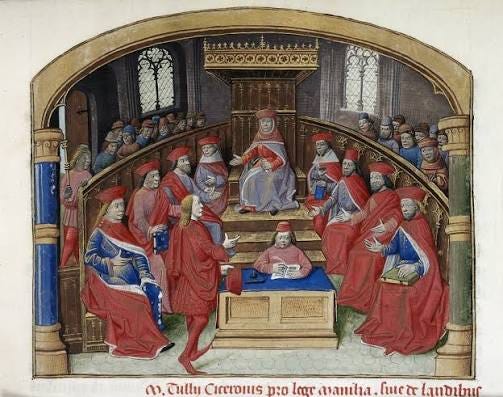
Carrouges’—and by extension, Lady Marguerite’s—testimony was recorded first, with the knight claiming that upon meeting the Lady at a gathering the year before the attack, Le Gris, “a notorious libertine,” became completely infatuated with her and decided to “add her to his long line of conquests,” in Jager’s words. Carrouges’ overall claim actually extends beyond the central charge of rape, with him claiming that Le Gris had “foully committ[ed] rape, adultery, treachery, incest, and perjury” (with the incest charge relating to Le Gris’ status as godfather Carrouges’ first, then-deceased son). Marguerite’s testimony to her husband, communicated to Parlement, was deeply disturbing. According to her, while her husband was away in Paris and her mother-in-law Nicoles de Carrouges was running an errand twelve miles away from her chateau where Marguerite was staying, Jacques Le Gris and his companion Adam Louvel came to the house.
Gaining entry under false pretenses, Le Gris proclaimed his love for the lady, “more than any other,” and added, “Everything I have is yours.” Marguerite claimed that she told the squire how inappropriate this was, and he changed tactics, forcing her to sit on a bench with him where he promised to help her husband with his money troubles, essentially asking her to prostitute herself for such a benefit. When this failed to move Marguerite, she claimed that Le Gris’ tone instantly changed. “You will go upstairs with me whether you want to or not,” he said coldly. Marguerite claimed his companion Louvel then barred the door and she began to shout, “Haro! Aidez-moi! Haro!” imploring anyone to come help her, though no one came, and she was dragged upstairs and into a nearby bedroom by the two men. While Louvel stood guard outside the door, Le Gris attempted to pin Marguerite to the bed, but she claimed her struggles were too much for him. That was when Le Gris called for Louvel to come help him, and both men managed to tie Marguerite to the bed. That did not stop her from screaming, so, as Jager describes it, “the squire took his leather cap and roughly stuffed it into her mouth to silence her,” and then, according to Carrouges’ testimony, Le Gris “had his desire of her against her will.”
In answer to these claims, Le Gris had mounted a frank, but sweeping defense: the crime had never occurred, since he was nowhere near the scene of the alleged crime that day. According to the squire, he had, in Jager’s words, “seen or spoken with Marguerite on only two occasions—the present litigation before the Parlement of Paris, and the social gathering, ‘at least two years ago,’ at the home of Jean Crespin,” the location where Carrouges and Le Gris had buried the hatchet with regard to their previous quarrels. Contradicting Carrouges’ and Marguerite’s testimony, Le Gris claimed that the six-hour window during which Marguerite was alone in her mother-in-law’s chateau, he had been at Argentan with two friends all morning—the time of the alleged attack—and well into the evening. He also claimed to have several other witnesses who would attest to his presence at Argentan throughout the course of the day. Therefore, he could not have been where Carrouges and his wife claimed he had been the morning of her alleged attack.
Having claimed complete innocence of even knowing or seeing Marguerite, it fell upon Le Gris to provide an alternate explanation for her accusation against him. To accomplish this, he was notably blunt: not only had Marguerite made a false claim against him, but she had made a false claim altogether. According to Le Gris, when the Lady Nicole de Carrouges returned from her errand, she found Marguerite “happy and mirthful, showing no sign of any displeasure.” In other words, as Jager puts it, “the implication is obvious: does this sound like a woman who just a few hours before had been brutally attacked and raped?” This claim was based on previously-obtained testimony from Nicole de Carrouges and it does indeed call Marguerite’s alleged state of mind into question, but it’s important to note that Le Gris’ interpretation was, by design, vital for proving his alleged innocence of the crime.
But if she had not been attacked at all, why would Marguerite have made this accusation? According to Le Gris, it boiled down to his on-again-off-again feud with her husband, Jean de Carrouges, and his notorious deficiencies as a knight and, more importantly, as a husband. As Jager explains, Le Gris claimed that “while married to his first wife, Jeanne de Tilly, [Carrouges] fell into an ‘insane jealousy,’ forcing her to lead such an austere life that she died an early death.” Damningly, Le Gris also claimed that “Carrouges tried to get his first wife to say that Le Gris had slept with her—‘which the said wife, wise and good, refused to do, since it was not in any way true.’” Thus, this newest accusation by Carrouges was, in essence, “part of a long pattern of lies and enmity” against Le Gris. Carrouges’ alleged poor character extended to his current wife, who was, according to Le Gris, beaten by Carrouges shortly after his return from his trip to Paris. Following this attack, Carrouges supposedly “forced Marguerite falsely to accuse the squire of having raped her,” despite his wife supposedly never making this charge before. As Jager concludes:
This last clause [claiming Marguerite never made the claims in the first place] was crucial, since it reduced the knight’s entire set of charges to a vicious falsehood coerced out of his wife in a fit of rage to avenge himself on the innocent squire. It also painted a new picture of Marguerite, with fresh bruises from her husband’s fists, now forced to collaborate in a further violence to herself, a violence to her mind and soul, by falsely accusing the squire of a heinous crime.
Jean de Carrouges was given a chance to respond, and he vehemently denied many of the squire’s charges and claims, particularly those regarding his allegedly abusive nature with women in his life, but also the attacks against his wife’s noble character. His counter-claims to Le Gris’ testimony rested upon a very fair point: why would Carrouges lie about such a vile crime when he, in requesting a trial by combat, put his “soul, body, wealth, and honor,” as well as that of his wife’s, at stake? More to the point, Carrouges argued, his wife was “chaste and honest,” using Le Gris’ own words to describe her, and had brought incredible scrutiny upon herself in making this claim, and she had maintained this claim “firmly and constantly, without any change or variation,” despite the scrutiny and risk to herself. This is also a fair point since, it must be noted, if the duel went forward and Carrouges fell in battle, Marguerite would also be rendered guilty in the eyes of God, and as punishment, be burned at the stake as a heretic.
With the respective cases made, all that was left to determine was if this proposed trial by combat would move forward. This rested on the findings of Parlement’s inquiry, which proceeded throughout the rest of the summer, during which new pieces of evidence were uncovered, some of which supposedly damaged Carrouges’ and Marguerite’s testimony. These included a set of letters that, unfortunately, have not survived and can’t be fully scrutinized, but whose existence is confirmed by a courier’s expense receipts and the statement made by the bailiff of Caen, Guillaume de Mauvinet, who ordered the letters delivered to Paris. Mauvinet also told the courier to report “by word of mouth certain other secret things not to be committed to writing,” which also remain lost to history. However, as Jager explains, “these new letters and reports seem to have been a further attempt to damage the knight’s case by discrediting Marguerite’s testimony.” While this should of course be taken with a grain of salt, it also demonstrates that at the time there were circumstances that cast uncertainty over who was telling the truth in the case.
In addition, Le Gris’ alleged co-accomplice Adam Louvel was summoned to face questioning, was arrested, and “put to the question,” that is tortured, as part of his interrogation. An interesting, if morbid, facet of this development is that torture was becoming more common in medieval France as part of the judicial process, while duels were becoming less common. We don’t know the specifics of the kind of torture Louvel endured, Jager explains that “standard techniques included the strappado, where the victim’s hands were tied behind his back with a rope by which he was winched off the ground and then suddenly dropped, as well as the rack, ‘fire applied to the soles of the feet,’ prolonged sleep deprivation, immersion in cold water, and water forced down the throat to the point of suffocation.” Despite enduring such torture, Louvel never confessed anything that differed from the accounts offered by Le Gris, casting further doubt on Carrouges and his wife.
Despite these newfound discoveries, the fact remained: no one truly knew what happened on the day in question except the person who made the accusation and the person being accused. Because of this, the solution was clear: the duel would proceed. After all, when the truth could not be ascertained one way or another based on the available evidence, only God remained as a reliable witness. His favor, Parlement (and much of France) believed, would be granted to the man who spoke true and that would have to suffice. As one of the priests presiding over the duel would say, the outcome of the trial would determine “the damnation of the one who is in the wrong, in both soul and body, as a result of the great oaths they have sworn, whence they will be judged by the sentence of God.”
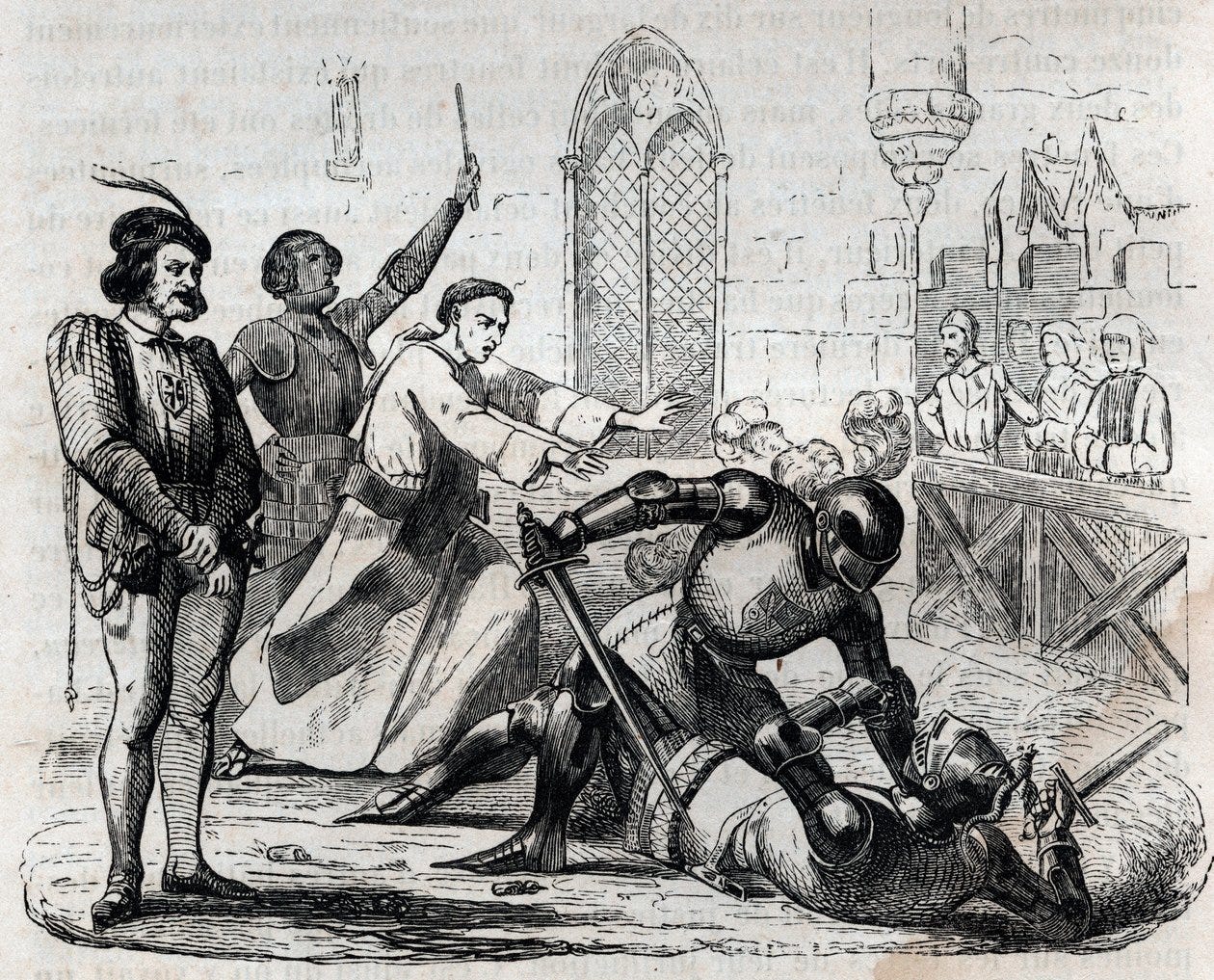
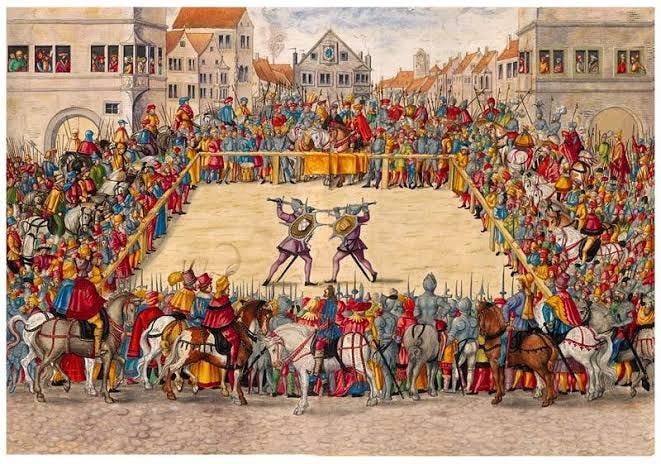
When the day of the duel came at the end of 1386, both combatants—now both knights, with Le Gris being granted equal standing with Carrouges—took their oaths referenced by the priest, as did Marguerite, who was shackled to her own viewing platform for the length of the duel itself, which could well have lasted several days. This was not to be. The knights began by charging one another on horseback, pointing sharpened lances at one another; a deadlier version of the kind of duel you see as a contemporary Renaissance Faire. Neither knight speared the other, but both of their horses were killed when the knights switched to axes and began hacking at one another. They eventually switched to short swords and faced each other on foot. Carrouges was wounded in the thigh and began bleeding profusely, leading the hushed crowd (who were forbidden from cheering or making any kind of audible reaction at this solemn event) to likely believe the battle was going in Le Gris’ favor.
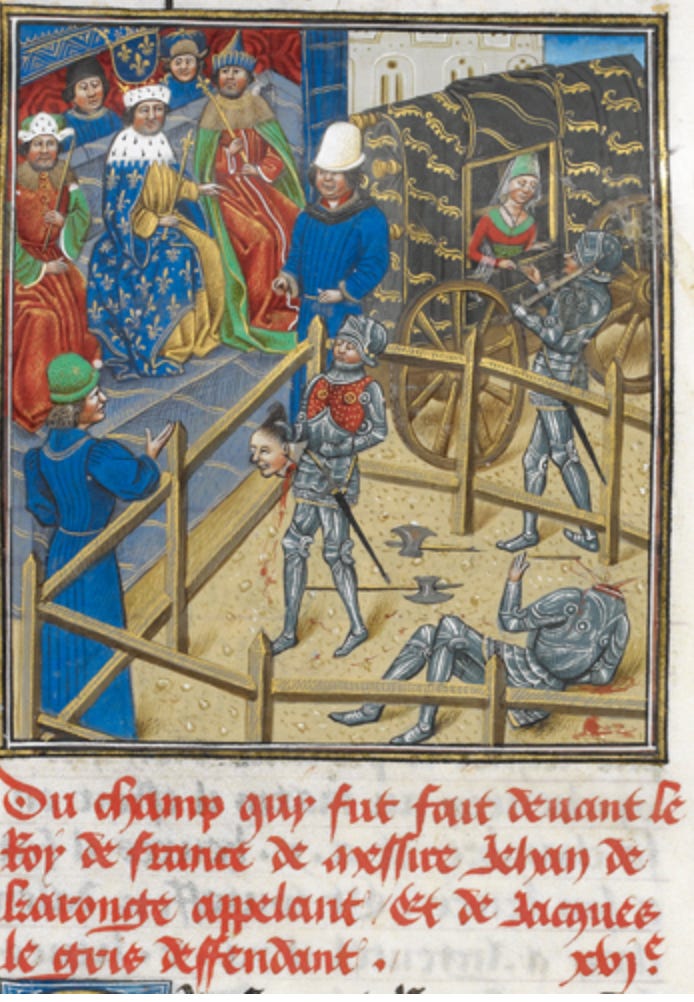
But Carrouges suddenly gained the upper hand, grabbing Le Gris by his helmet and forcing him to the ground. The important thing to remember about medieval combat is that both men were carrying over sixty pounds of metal, in which it was difficult to move, especially when laid out on the ground, as Le Gris now was. Straddling Le Gris, Carrouges began attempting to pry open Le Gris’ helmet visor, both so he could access the weak point of Le Gris’ throat and, likely, so he could look his opponent in the eye. As he did this, history records that Carrouges began shouting on repeat, “Confess! Confess your crime!” Eventually breaking the lock on Le Gris’ helmet, Carrouges finally could see his enemy, and screamed again, this time with a dagger to Le Gris’ throat: “Confess!”
What happened next is nothing short of remarkable. A dagger at his throat, ready to pierce his flesh any second, Le Gris had a chance to finally admit what Carrouges had been alleging, perhaps saving himself from such a grisly fate. And yet, as the dagger’s tip dug into his flesh, he shouted with all his might, so the gathered onlookers and Carrouges alike could hear: “In the name of God, and on the peril and damnation of my soul, I am innocent of the crime!” Barely missing a beat, Carrouges shouted back: “Then be you damned!” And with that, as Eric Jager describes it:
Carrouges put the point of his dagger to the squire’s underjaw, while bracing the helmet with his free hand, and with all of his remaining strength drove the sharp thin blade into the exposed white flesh, sinking the weapon into his enemy’s throat up to the hilt. A spasm shook the squire’s body, and blood spurted from the wound. Le Gris’ eyes fluttered rapidly open and shut, and his throat gurgled with his final choking breaths. His body shuddered again under the knight, and then his limbs relaxed and he lay still. Carrouges remained astride his enemy for another minute or two, until he was sure Le Gris was dead. Then he got slowly to his feet, leaving the dagger stuck in the lifeless body stretched out on the blood-soaked sand.
Weak with exhaustion and loss of blood, Carrouges loosened his visor and turned to look at his wife. Marguerite now clung to the rail [of her viewing platform], wiping away her tears. As the crowd quietly watched, the couple exchanged a very long look, both seeming to gain strength as they locked eyes. Turning around to face the royal stand, Carrouges bowed to the king. Then, nodding to each side, he acknowledged the huge crowd, who gaped in awe at the bloody scene before them. The knight, hoarse with thirst and hunger, then titled back his head and shouted into the air as loudly as he could:
“Ai-je fait mon devoir?” (Have I done my duty?)
Ten thousand voices—silent since the beginning of the duel, on pain of the severest penalties—now answered as one:
“Oui! Oui!”
Le Gris was dead, and with his death, God’s judgment had been rendered. He was thus guilty of the crime with which he had been accused, and Marguerite had spoken true.
And yet, doubts lingered in everyone’s minds, including Le Gris’ own lawyer, Jean Le Coq, whose surviving diary sheds light on both his favorable impression of Marguerite de Carrouges’ consistency in her testimony as well as his doubts about his own client. In a particularly relevant entry of his diary, Le Coq wrote that Le Gris “told me that when he heard the news that Carrouges intended to prosecute him in this matter, he immediately went to a priest to make confession.” This in and of itself proves nothing one way or the other, but as Jager writes, “both combatants in the duel would have [had] ample time to confess their sins before they met in battle,” and yet “Le Gris apparently took no chances with his immortal soul.” However, this flies in the face of Le Gris’ final protest of innocence—when his life was literally hanging in the balance—as well as Le Coq’s observation “that many knights swore they saw him with the Count of Alencon throughout the entire day in question.”
But the matter had been settled, and Carrouges and his wife would continue to live their lives, handsomely compensated by the king, and have three children, who would be known forever as the progeny of the victor of France’s last trial by combat. Carrouges maintained his and his wife’s honor, and was celebrated for it for the rest of his days, until he died while participating in the Last Crusade to the Holy Land in 1396. While the trial by combat cemented his and his wife’s word during their lifetimes, later chroniclers and historians, including Enlightenment thinkers like Voltaire, would cast doubt on Marguerite’s story. Decades after the event, there were unsubstantiated stories about an escaped felon being the true criminal and Marguerite had either somehow mistaken him for Le Gris or, like Le Gris himself had claimed, had been coerced by Carrouges into accusing his rival. This claim would be repeated throughout the centuries, even into the 20th century, with little in the way of evidence being provided.
Nevertheless, the story of the Carrouges-Le Gris affair has been defined by conflicting interpretations for over six centuries. Despite defending his client, Le Gris’ lawyer Le Coq neatly summed up the reality of the case better than anyone else, revealing that the medieval mind was perhaps more complex than we often give it credit, when he wrote in his diary that “No one really knew the truth of the matter.”
…
All that can indeed be said is that no one really knew what had happened between the squire and Marguerite de Carrouges, if anything happened at all. We certainly don’t know today, but it is clear from the historical record, no one back then knew either. As is often the case in stories of rape and other forms of sexual assault today, the people of the time were aware that, typically, the only people who truly knew what happened in the case of rape were the alleged victim and alleged perpetrator. This was, the medieval mind reasoned, why God’s judgment needed to enter the picture. Leaving these matters up to God, archaic as it sounds, actually demonstrates a sophisticated understanding of the fallibility of witness testimony and perils of self-preserving instincts by both parties involved in a rape case. The accuser has every reason to make their case as strongly as they do, and the accused has every reason to deny the accusation with unlimited vociferousness.
There is a misconception about medieval life that crimes such as rape were not taken seriously because women were not considered, well, people. Rape victims were sometimes forced to marry their rapists and spousal rape wasn’t even a concept, so it is understandable that one might imagine the Middle Ages as a time “where rape was rampant and scarcely considered a crime,” to use Eric Jager’s words. It’s also certainly true that wives were considered a form of property—more a representation of family and property, but property nonetheless—but this patriarchal instinct actually forced the issue to be taken just as seriously, if not moreso, than it is taken even today. As Jager explains:
Medieval law codes and actual trial records show that rape was considered a felony and a capital offense. The law in France […] usually followed Roman practice, according to which rape—defined as forcible sexual intercourse outside of wedlock—was punishable by death. Philip de Beaumanoir, a 13th century authority on French law, states that the punishment for rape is the same as that for murder or treason—namely, “to be dragged through the streets and hanged.” And even in wartime, leaders often tried to restrain their men, as when the English soldiers who captured Caen in 1346 were ordered on pain of death not to harm any of the town’s women, although many troops disregarded this warning.
Rape, a capital crime, was therefore not just taken seriously, but so was the accusation of it. After all, the accused’s life was literally on the line when it occurred. Therefore, the approach to proving or disproving accusations was as meticulous as one could expect, with the only meaningful differences between the process today and then being the technology available, as well as legal and social standards. With the same kind of seriousness, then, came the same kind of shortcomings, which again, often boiled down to the fact that oftentimes only two people knew the truth of the matter, as seen in the case of the Carrouges-Le Gris affair. Hence, the invocation of God’s judgment being the final word; literally or figuratively—however one decides to interpret the concept of divine judgment—it truly was the only source of unbiased truth outside of the accuser’ and accused’s universe.
Of course, in the 21st century, we don’t have the option of invoking God’s judgment anymore, and we are probably better for it as far as legal standards go. We also don’t require female accusers to make their accusation via their husbands, fathers, or male guardians. However, we can’t pretend that we are much better at omniscience than the god our medieval forebears worshiped. We also can’t pretend that even with different social and legal standards than those of our forebears that we are meaningfully more enlightened than them. That rape was a heinous crime—again, considered the “crime of crimes”—was just as recognized then as it is now, and men were not the only ones to say so. While few medieval women had the opportunity to speak for themselves publicly the way they do today, that was typically the case for everyone outside of the educated clergy, not just the women. And when women did speak on the subject, they did so unequivocally. Christine de Pisan, a French court writer, explained in her 1405 tract The City of Ladies that women “take absolutely no pleasure in being raped. Indeed, rape is the greatest possible sorrow for them.” [Emphasis added].
While a case can be made that rape was punished less often in the medieval era than it is today, this was thanks less to ingrained misogyny (or what we often hear called “The Patriarchy” or “rape culture”) and more thanks to a lack of political clout or social standing. These limitations applied to all victims of all crimes, especially if the alleged perpetrator had the social standing and political clout that their alleged victims lacked. The requirement of a male proxy to make an accusation is certainly retrograde by today’s standards, but as we saw with the Carrouges-Le Gris affair, a raped noblewoman was seen as an affront to her husband as much as it was an affront to herself, meaning the incentive to make the accusation was no less apparent than it otherwise would be.
One might be tempted to say that these kinds of limitations, particularly surrounding social standing and political clout, remain the case today, and anecdotally, I suppose one could make that case. But the fact remains that rape is prosecuted and leads to conviction far more often today than ever before, with the United States Sentencing Commission reporting that in 2024 alone, 1,430 convictions for sexual abuse were handed down. As a proportion of accusations, that number remains small, probably far too small, but that speaks more to standards of evidence, which, for a crime like rape, are high for a reason and must account for the uncertainty that plagues sexual abuse cases. Sadly, it must be said that the tragic trade-off that comes with sufficiently high legal standards is that across time, to use Jager’s words, “rape was a serious crime for which the law provided heavy penalties, [but] in practice it often went unpunished, unprosecuted, and even unreported.”
This suggests an unresolvable (or at least difficult-to-solve) paradox: either rape is a crime worthy of the severest punishment and thus deserves a higher standard of evidence, or it shouldn’t be considered so serious and thus allow for lower standards. I make no case one way or the other. But I do maintain that, if we examine the historical record, there is a continuity in our understanding of such a perversely intimate crime: rarely is anyone is ever going to fully know the truth of the matter apart from the people allegedly involved. The Cornell case, like the Carrouges-Le Gris case, rests upon the sworn testimony of two parties who both have every reason to convince everyone (including themselves) that their version is the truth. The Ridley Scott adaptation of The Last Duel, despite some of its issues, adds a very sophisticated angle thanks to the superb script by Ben Affleck, Matt Damon, and Nicole Holofcener, in which the perception of the main characters matters more than just their claims.
In their version, Jacques Le Gris flatly denies the crime, but admits privately that he did sleep with Marguerite, but that it was consensual, and calling her refusals part of a flirtatious game that all women are expected to play when sleeping with a man outside of wedlock. There is no evidence that the real Le Gris ever admitted or believed this, but by adding this detail, Affleck, Damon, and Holofcener added a plausible explanation for why Le Gris protested his innocence of a crime until the bitter end. This does nothing to exonerate him from the alleged crime if he was in fact guilty of it, but it reveals yet another angle for why allegations of sexual assault can be so fraught. If one party perceives the behavior of the other one way, and the other party perceives it another, but both agree that something—in this case, sex—happened, then in effect, neither and both parties can and often do come off as dishonest and, in effect, self-serving. At that point, to use one of my favorite phrases, mileage simply varies on the imaginations and biases of those observing the drama from afar.
This helps explain, to my mind, why so many—both in 21st century America and 14th century France—become so emotionally invested in these stories. The uncertainty of others’ motives and perceptions, and the brutal fact that none of us actually know the truth of the matter, forces us to simply rely on what we do know, which often only comes from our own experiences and again, imaginations, and the evidence that often results from investigations into these alleged crimes will only support our own conclusions derived from these things. When we so deeply personalize an alleged crime that has nothing directly to do with us, being reminded that we will never know what truly happened is always going to feel like an affront of the highest order, whether we believe the Jane Doe of the story, or the man or men she has accused of committing a truly heinous crime.
I don’t personally believe in God. But when it comes to sordid stories involving Ivy League frat house gang-bangs or alleged assaults in the Middle Ages, I do believe that if there is only one party that will ever truly know what happened in those rooms and most others where such crimes are allegedly committed, it is God. How we, in our quasi-secular age, can reconcile that with our desire for certainty in the name of justice is anyone’s guess.