


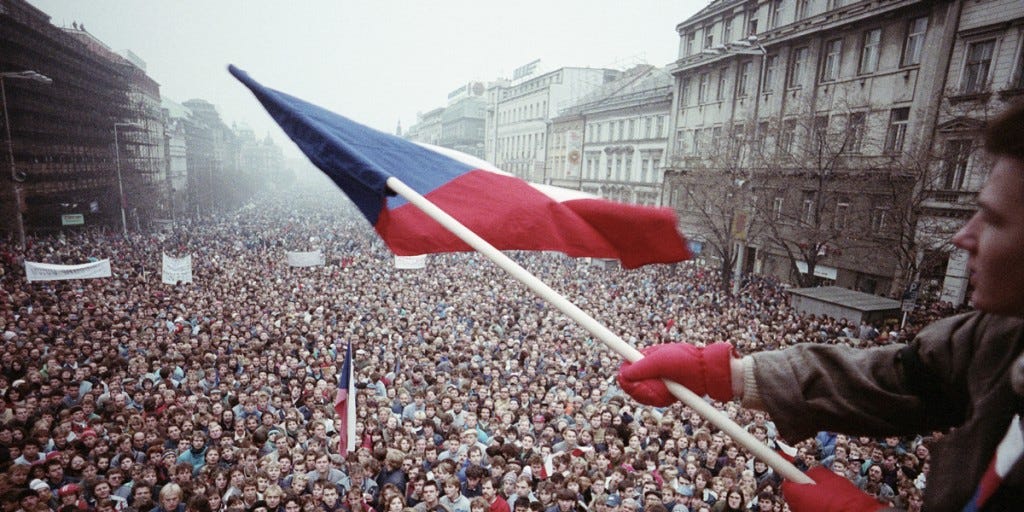
“The times are better now because we have freedom. You can say what you want, and you won’t end up in prison. There’s no harassing people, no thought control, no spying. And the standard of living is higher, too. Just think about all the possibilities our kids have. People still grumble a lot, but they’ve never been so well off as they are now, never. Only there are bad things in politics: prices are rising, we’re having a hard time with unemployment, and everybody will tell you that there’s a lot of injustice. And it’ll get worse: there’ll be millionaires and paupers. Most people here don’t like it.”
—Konrád Niesner, born 1941, electrician
“I just say—every period brings along good things as well as bad. You can’t say it’s all black; some things are always white. […] It was all wonderful back then in 1989, during the Velvet Revolution. People shouting ‘Havel for President,’ you know, we all went crazy. […] At that moment, we were all a bit nuts, like intoxicated because we suddenly saw life could be great. And we couldn’t imagine what would come after fifteen or twenty years of freedom—that it could be in some ways even worse than before and that some of us would be living on a shoestring. But I said to myself back then, I’ll become a great fireman. Everything will be fine. Yeah, and so five years later, I was looking for another job. So every period is difficult in its own way. That’s why I’m not saying life is grey—it’s got colors, including black and white.
—X. J., born 1962, fireman
…
One may assume that revolutions come about via violence as a matter of course. The philosopher Rene Girard theorized that a community can unite around the violent expulsion of a scapegoat—that is, an oppressor—but always framed such an expulsion in violent terms. As Girard writes, “any community that has fallen prey to violence or has been stricken by some overwhelming catastrophe hurls itself blindly into the search for a scapegoat. Its members instinctively seek an immediate and violent cure for the onslaught of unbearable violence and strive desperately to convince themselves that all their ills are the fault of a lone individual who can be easily disposed of.”1 This formulation applies to many revolutions across European history, from the French Revolution in 1789, to the revolutions of 1848, to the Bolshevik Revolution of 1917, as well as the decolonialist revolutions all over the world throughout the mid-twentieth century, in places as far flung as Vietnam and Algeria. However, in 1989, there were a cluster of anti-communist revolutions across central and eastern Europe that, with the exception of the violence that broke out in Romania, largely bucked the trend observed by Girard and others.
At the symbolic center of this cluster, thanks largely to the name it came to be known by, was Czechoslovakia’s Velvet Revolution, a largely non-violent affair (at least on the part of the protesters) that, in the words of historian James Krapfl, “was an inversion of [the] process” described by Girard in which there would normally be “unanimous exclusion, whereby the community unites in violence against something”; in the inverted case of Czechoslovakia in November of 1989, “it was the police attacking the marchers that cemented the unity of the latter party.”2 Whether or not revolutions require violence in order to qualify as revolutions was largely irrelevant in the case of Czechoslovakia (as well as the wider liberation of central and eastern Europe) in 1989; what was noteworthy, to many watching at the time and many historians analyzing the Velvet Revolution well into the twenty-first century, was and is the rapid and large scale transformation of a society once thought to have completely succumbed to the darkness of totalitarianism, all done without a single shot being fired against the authorities in whose interest it was to stop such a revolution from occurring in the first place.
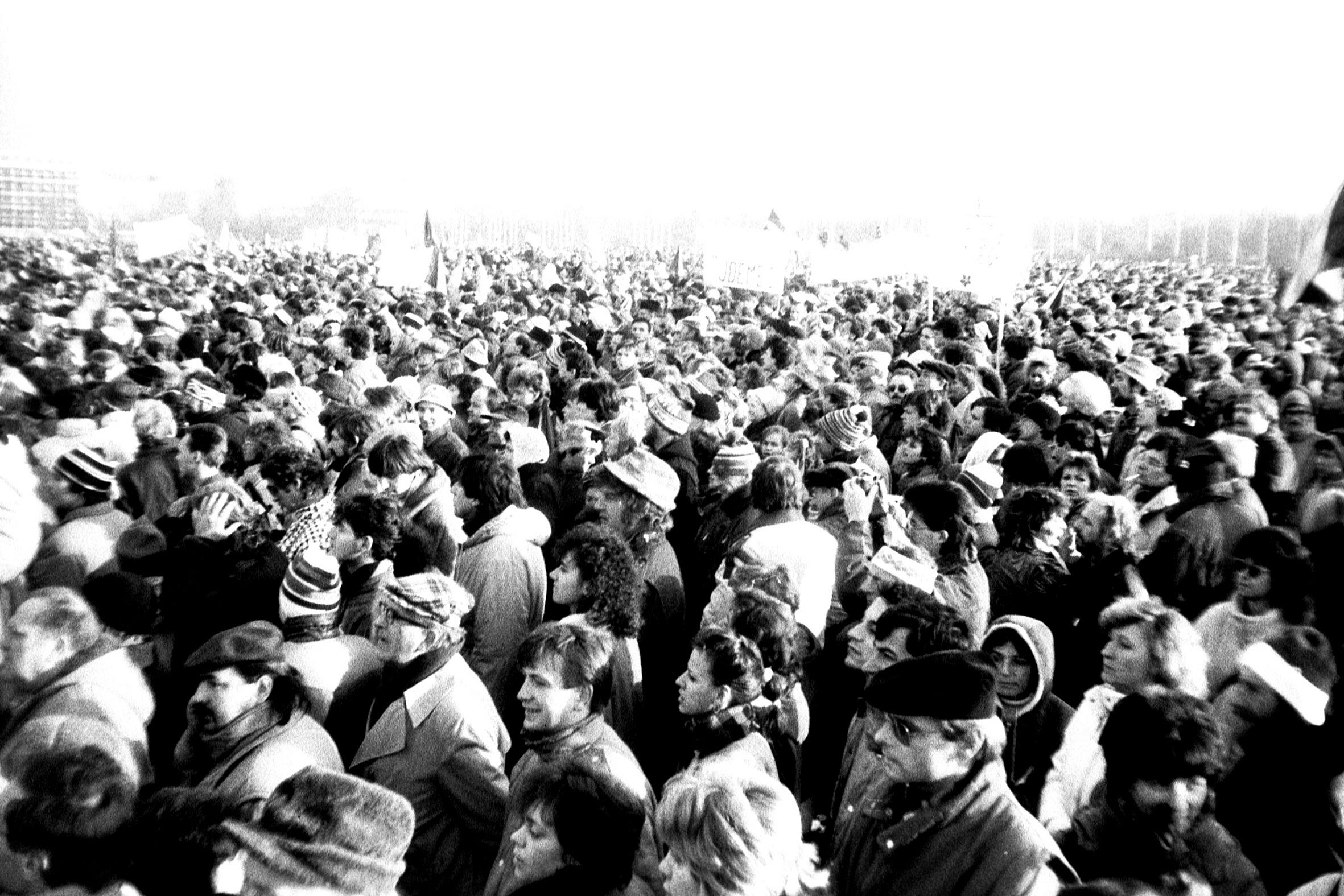
The Velvet Revolution unfolded relatively peacefully as the Soviet Union began its disintegration. This stood in stark contrast to the violence that characterized the Warsaw Pact’s crushing of the Prague Spring only twenty years earlier, which resulted in over 130 civilians being killed, and subsequent violent demonstrations, such as the self-immolation of Jan Palach. In many ways, one of the best symbols of the Revolution’s character was the election of famed dissident and playwright Václav Havel to the presidency, emphasizing cultural achievements rather than military ones, as is often the case in revolutions. It even helped symbolize what many optimistic observers of the time, including Francis Fukuyama, felt when they began to see the future as one solely dominated by open, democratic societies. Because of the self-evidently historic nature of the Velvet Revolution, the historiographic process began almost immediately after the establishment of the newly independent Czechoslovak state, though it would be difficult to truly classify the initial works dedicated to the Velvet Revolution as truly historical, given the immediacy of the events in question.
This changed over time, of course, and ultimately, demonstrated something striking: how the historiographic process typically works in real time. Whereas many, if not most, histriographies are relatively removed from the events that they cover, the historiography of the Velvet Revolution in Czechoslovakia was held prisoner by the present, forcing innovations, responses, and complications to occur much faster, with the scale of approach expanding and contracting much faster than is typical. While there is no iron law of the histriographic process, the Velvet Revolution’s historiography appears to follow a similar trajectory seen in much longer time-scales, beginning with a focus on the most visible, major figures of revolution—the Great Men of History, so to speak—followed by a broadening of the historical context to include larger transnational forces and contexts—the Trends and Forces—and then, finally, a shift back towards history from below, in which the concerns and experiences of everyday people were centered, made possible with the use of the growing field of oral history. This makes the historiography of the Velvet Revolution significant, serving as a proverbial Petri dish that indicates how events are chronicled in their immediate aftermath and how they transition into the realm of history.
The first works that covered the events of the Velvet Revolution and their aftermath focused almost solely on immediate documentation, preservation of data, and interviews with participants and observers. This was best characterized by the book, The Velvet Revolution: Czechoslovakia, 1988-1991, co-written by Bernard Wheaton and Zdenek Kavan. Kavan, a participant in the revolution himself, provides his own firsthand accounts but they used many other sources, including “local and regional newspapers” from regions across the country, interviews “with members of the theatrical community (especially at the Vinohrady Theater) who were personally involved in the revolution from the very outset,” and finally, “original documents gathered at the [Václav] Špála Gallery, one of the nerve centers of the revolution.”3 This approach to sourcing allows Kavan and Wheaton to create early analytical frameworks that provide the standard early narrative of the revolution and in a sense lay the groundwork for future analysis. By working with these sources, Wheaton and Kavan come to the conclusion that 1989 was a tipping point for the crises created by the normalization process that began in 1969 after the Prague Spring was crushed, made most apparent by the public’s “mood of disillusionment and retreat into the private sphere,” also known as “inner emigration.”4
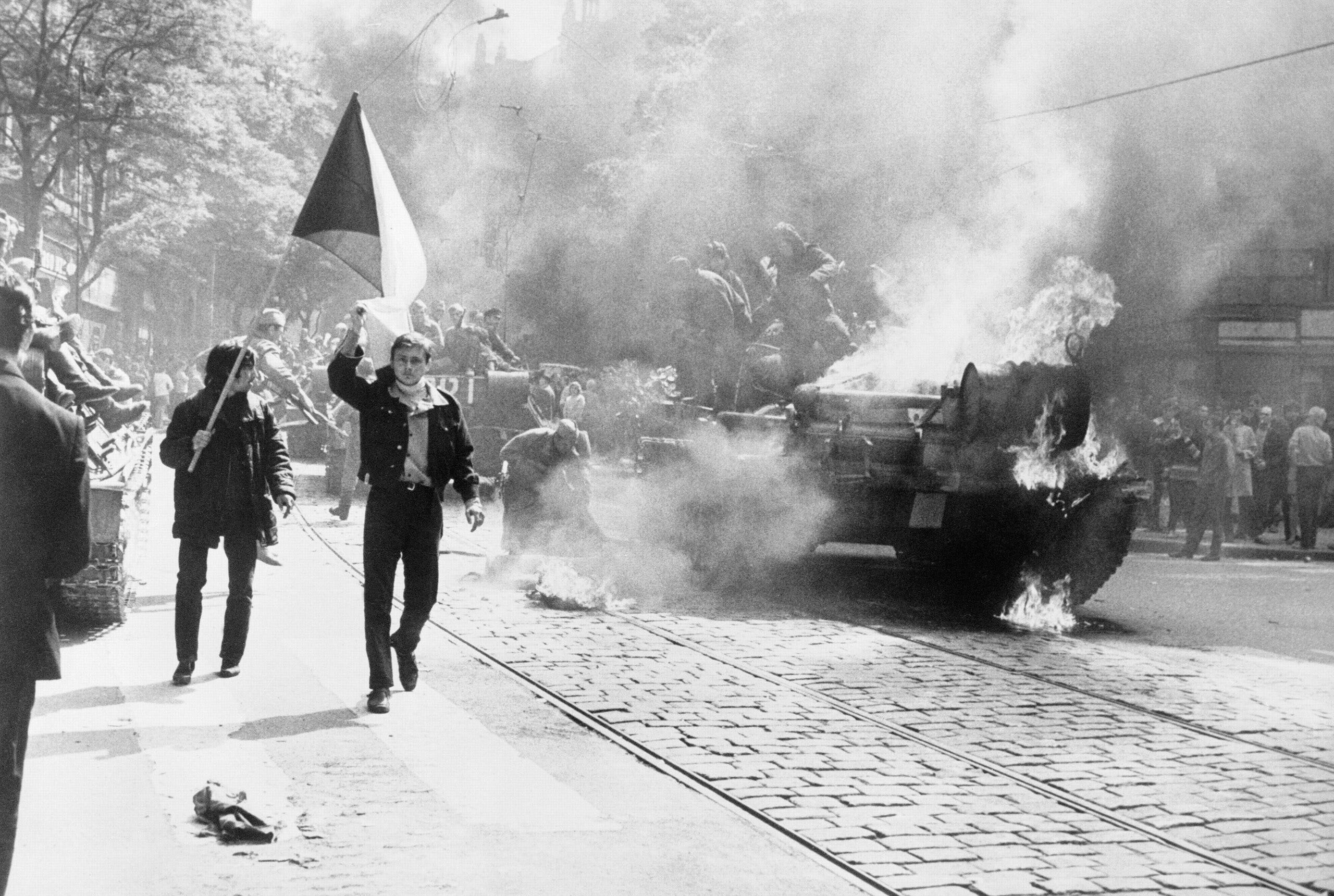
The static conformity that this created, the authors argue, was merely on the surface; there was plenty of dissent to be found, particularly with those who signed the famous Charter 77, and with whom that document resonated. This involved “a broad coalition including reform Communists, Social Democrats, liberals, and conservative Catholics who, though quite disparate politically, all agreed on [the question of human rights] and on the need for an ethical basis to politics.”5 Despite the Chartists’ relative isolation from one another, Wheaton and Kavan make it clear that “the significance of Charter 77 lay […] in the personal example of the courage of its individual members, who withstood everything thrown at them.”6 Out of this milieu came the significant figures of the Velvet Revolution, particularly Václav Havel, as well as others, who all play the most significant role in Wheaton and Kavan’s narrative. The authors certainly pay the appropriate lip service to the systemic forces at work, particularly when it comes to the backlash to normalization, “the growth of public criticism, economic difficulties, and the changes in Eastern Europe,” and the government’s inability to to ignore “one area of popular concern—namely, ecology,” with pollution standing tall among the public’s concerns.7
However, individual actors stand taller in the narrative, particularly those at the symbolic head of the revolution, like Havel, and the symbolic head of the toppled Stalinist regime, like disgraced general secretary of the Communist Party of Czechoslovakia, Miloš Jakeš or politicians like Miroslav Štěpán. There are sweeping descriptions of the demonstrations that occurred in late 1989, but Wheaton and Kavan often return to the people in charge, describing at one point the Central Committee as having “torn itself into pieces in the search for a solution at an all-night meeting,” and ultimately “acceded to the wishes of the public, and Štěpán and all the villains of the normalization disappeared from the Central Committee.”8 From there, the story shifts to Havel and the new government’s attempts at establishing democratic structures after their takeover in 1990, as well as the question of which economic path needed to be followed for Czechoslovakia to catch up to the rest of Europe.
The other limitation that emerges from Wheaton and Kavan’s recency comes more from hindsight but is nonetheless significant, in that the break-up of Czechoslovakia—the Velvet Divorce, as some called it—had not yet occurred, though they were indeed aware of “the national question” in terms of the dissent it was creating as of 1992 and that it was “noticeable […] that the nationalist rhetoric used in particular by the Slovaks had acquired its own momentum,” and that “the situation facing Czechoslovakia […] today is unprecedented.”9 While one cannot expect the authors to predict the future with any reasonable accuracy, such concerns would be addressed by later scholarship, like Robin H.E. Shepherd’s 2000 work, Czechoslovakia: The Velvet Revolution and Beyond. Shepherd extends the arguments presented by Wheaton and Kavan by examining the role of Slovak nationalism more directly, but he also historicizes the Velvet Revolution by directly addressing any challenge to the notion that the Velvet Revolution was, in fact, a revolution. In fact, he opens his work by stating plainly that “the events in Czechoslovakia and elsewhere in eastern Europe in late 1989 were genuinely revolutionary in character,” thanks largely to the transfer of power to the powerless, the rapid transition to a different economic and social model, and the persistence of some old elites.10 By doing this, he both makes it clear that the Velvet Revolution was not something to be consigned to the dustbin of history, but also that revolutions in general can and should be understood in a broader context.
Shepherd accomplishes this by focusing on what Wheaton and Kavan were unable to do: by looking at “the most obvious change,” which is that “the constituent nations have split into two separate and independent states,” creating a relatively unique challenges of “reforging the national identities of two relatively small European countries and projecting them to a foreign audience still reeling from the world historical changes associated with the fall of the Soviet Union.”11 Many pages are spent looking at the systemic forces at work, especially in the economic context following the Velvet Revolution, as well as the “institutional and structural explanations for the [Czech-Slovak] split” as well as “the developing national consciousness which eventually made federation unviable.”12 And yet, the temptation to reduce complex events to the behavior and machinations of individuals is difficult for Shepherd to resist, with him dedicating an entire chapter to Havel and his interpretation of Czechoslovakia’s communist past and speeches as a vital hinge point for the entire narrative, as well as spending a large amount of time discussing the Slovak presidency of Vladimír Mečiar when discussing the path Slovakia took after the divorce.
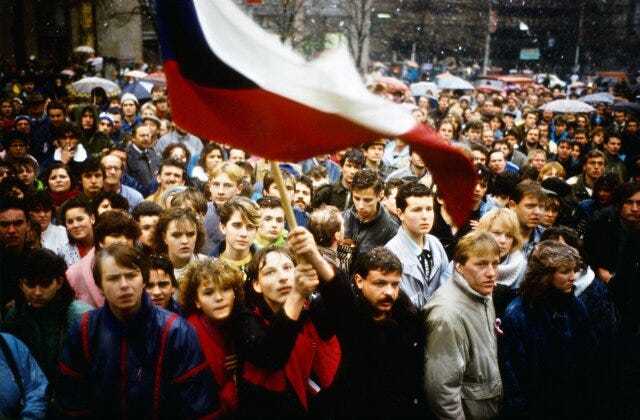
Shepherd makes it clear that in order to understand the Czech people’s growing frustration with Havel’s 1989-era anti-politics and thus the politics of the Velvet Revolution with hindsight—as history, so to speak—then one needs to “go back to Havel’s dissident past, trace some important elements of his thinking, and relate them to developments in the 1990s.”13 Similarly, Slovak nationalism, and thus the Velvet Divorce, is understood as an extension of the politics and governance of Mečiar, which supposedly reflected a delayed realization of “living in an independent state with the real prospect of rule by a fully democratic government.”14 This is not to say that these figures do not matter to the development of a free Czechoslovakia, or to two independent, democratic nations; they absolutely do, and Shepherd’s commentary does reflect larger forces than men such as Havel and Mečiar, particularly in the economic realm, but his focus does at times overrate these men’s roles.
This is, arguably, a symptom of attempting to historicize something as relatively recent as the Velvet Revolution and its after-effects, as of the time of the book’s publication in 2000. Equally suggestive of this difficulty is Shepherd’s commentary on the then-contemporary issue of the Czech Republic’ and Slovakia’s potential joining of the European Union, something that would not happen for another four years as of the book’s publication. With so much systemic uncertainty in the present and on the horizon, it is perhaps inevitable that a historian would focus on the so-called Great Men of this particular history. It was therefore perhaps inevitable that larger trends and forces that surrounded the Velvet Revolution—and other revolutions around central and eastern Europe—would begin to take center stage in the scholarship, particularly regarding the question of state breakdown and cultural shifts across borders.
The second era of scholarship that focused on the Velvet Revolution lasted from the early 2000s to the early 2010s, and it sought to contextualize its place in the wider events that were taking place across central and eastern Europe at the time; there was little in the way of centering the Czechoslovak experience and more in the way of treating it as a significant puzzle piece that helped create a coherent picture of the end of the Cold War and collapse of the Soviet Union. This could first be seen most pointedly in Padraic Kenney’s A Carnival of Revolution: Central Europe 1989, published in 2002, in which Kenney saw the Velvet Revolution as part of a much broader cultural trend that nigh-simultaneously swept the countries of the Eastern Bloc, and less to do with the particularities of the Czechoslovakian experience.
Kenney did not dismiss the particular cultural experiences of all the countries completely, and indeed placed some focus on them—including the experiences of Solidarity in Poland, Hungary’s Catholic dissidents, and Ukraine’s nationalist movements—but he places them all in the wider context of a carnival. According to Kenney, these movements “[broke] down borders of all kinds,” and “[forced] a suspension of the usual rules of society, issuing a challenge to the existing order, and reversing social and political hierarchies,” mostly by “[disregarding] the fear that held so many others back” and “[breaking] the rules of politics”; this perspective thus allows historians to look at the Velvet Revolution and the 1989 revolutions like it in a new way: “from the perspective of grassroots social movements.”15
While Kenney acknowledges significant historical actors like Mikhail Gorbachev and their decisions like perestroika and glasnost, he is careful to note that such figures’ decisions do not fully explain what happened in central and eastern Europe. It was indeed the social movements across the entire region, often operating in tandem, using various methods including samizdat, the antipolitics of the much-analyzed (and soon-to-be-challenged) concept of “civil society,” church resistance, counter-cultural forces such as punk rock music groups, and nationalist organizations. Much of this is revealed by Kenney’s own experiences and interviews with participants in these social movements, thus employing an element of oral history that would come to dominate the Velvet Revolution’s historiography in the years to come. However, this was all part of his project of characterizing the Velvet Revolution and other revolutions of 1989 as part of a broader shift away from the politics of the Cold War and Soviet communism.
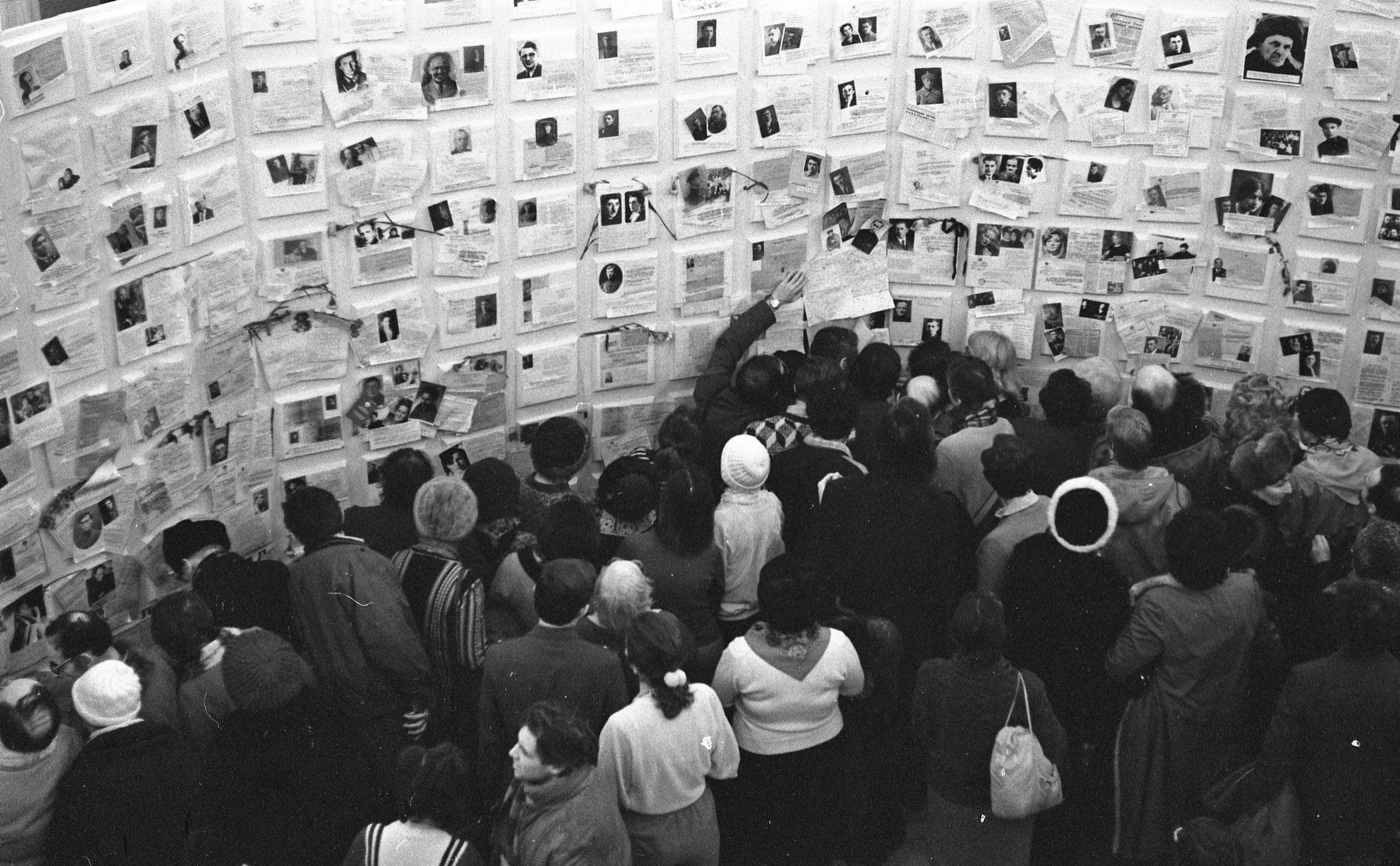
Similar to both Wheaton and Kavan as well as Shepherd, Kenney spends some time explaining how normalization helped lay the groundwork for the titanic shifts of the late 1980s, but quickly moves to the loci of social resistance that also existed and persisted until that time. His broader focus that also includes the nationalist groups in the Eastern Bloc—particularly, but not exclusively in Ukraine—is unique compared to the previous scholarship but where he departs most is the due he pays to the role of churches and the counter-culture. As Kenney writes, “if there was any hope at all, it came from churches” since “the churches of Central Europe were the only official institutions with any independence from the regimes,” since it provided a fundamental and powerful center of community.16 This was experienced in several central and eastern European countries, including Poland and Hungary, but more particularly for our purposes in Slovakia.
While the Slovak churches were, of course, closely monitored by the communist regimes and their hierarchies were carefully vetted, Kenney points out that by the mid-1980s, “the underground faith exploded into view at a ceremony at Velehrad,” celebrating the 1,100th anniversary of the death of St. Methodius, the man who introduced Christianity to the Slovaks, the celebration of which Kenney compares to the return of Pope John Paul II to Poland in 1979.17 The significance of this event to the growing confidence of Slovaks and their willingness—often times greater willingness than their Czech counterparts—to join in the efforts of the Velvet Revolution, Kenney argues, cannot be understated. Neither can the role of groups like the Independent Peace Association, a “loose alliance of musicians, pacifists, and more or less frustrated youth,” or the demonization by the communist regime of the hippies who came out to mourn the killing of John Lennon.18
Stories like these make up the bulk of Kenney’s work, which culminates in sixteen vignettes, which Kenney refers to as “a revolution in sixteen scenes” that occur all over the map of central and eastern Europe, but are all brought together into a greater whole that is made clear in the final scene, which centers on the Velvet Revolution itself, but that Kenney contextualizes within a broader framework of five different factors: “the formation of student self-government, the arrival of waves of East German refugees, and new examples of regime arrogance,” as well as “the festival of Czech culture in Wrocław and, just days before the Opletal anniversary, a large ecological demonstration in Teplice, in northern Bohemia.”19 The international framework provided here speaks for itself.
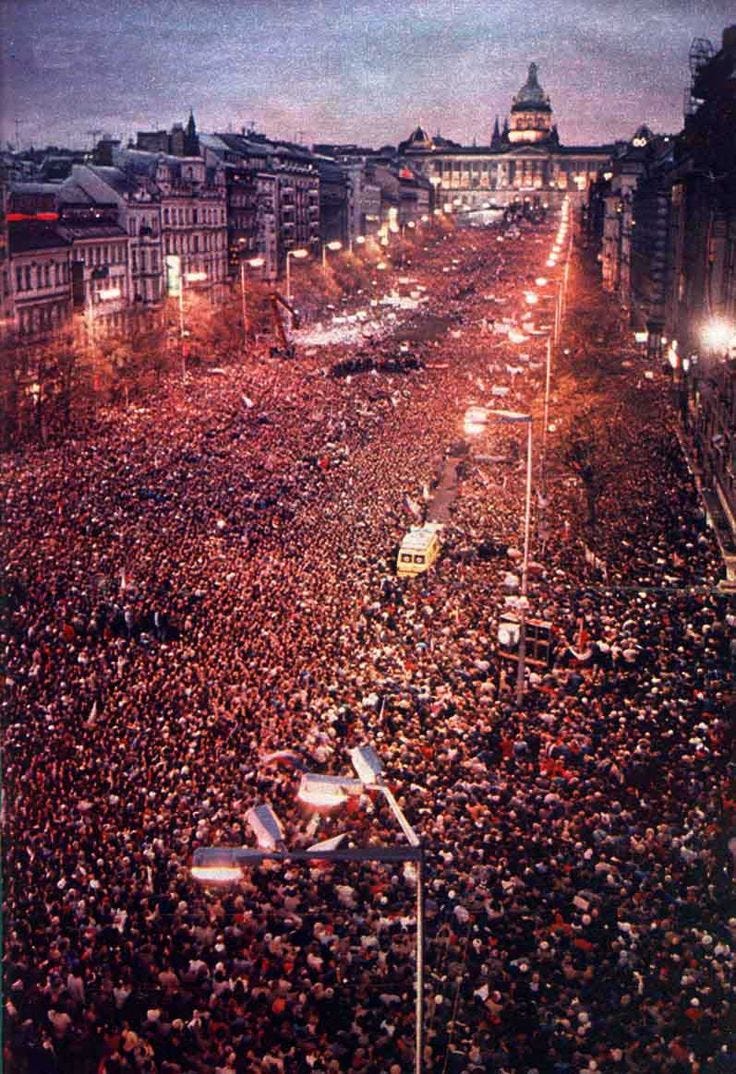
Kenney’s contribution thus went beyond even widening the cast of characters in these different social movements, and made it clear that they needed each other, creating a transnational network that made them all the stronger in their efforts to create their civil society. This could be seen most pointedly with what Kenney calls “Polish-Czechoslovak Solidarity,” which “destroyed the isolation of the Czech opposition,” after the border between the two states was loosened by the efforts of both Ukrainian and Polish activists, as well as sympathetic border guards.20 Thus, while placing it within a larger international framework, Kenney still acknowledged the significance of the intellectuals’ “civil society” concept as being, at least in part, central to the success of the Velvet Revolution. The scholarship that came next not only called that significance into question, but promoted a completely different angle that challenged the power of dissident movements: the angle of state breakdown.
Some scholars had previously questioned the impact of state breakdown, such as John K. Glenn, who has stated that such an approach “has been limited by studies of single movements against the state,” and that instead that the “democratic outcome” of the Velvet Revolution “was the result of successful mobilization for a general strike by the civic movements that linked their demands for gradual, legal change on behalf of the nation with striking theater networks, which served as an organizational basis for a general strike.”21 In other words, the Velvet Revolution’s ultimate outcomes was the triumph of the civil society. Previous to Glenn, Shepherd had actually discussed the concept of a civil society in his own work, describing it as “the core issue of post-communist political transformation,” at least for some, and that it involves “the intermediary institutions which fall between the apparatus of state power and the individual,” acting as a vital conduit for dissidence, however problematic that term may have been to dissidents like Havel.22
However, in 2009, the Sovietologist Stephen Kotkin, along with his contributor Jan T. Gross, dismissed this popular notion entirely in their book Uncivil Society: 1989 and the Implosion of the Communist Establishment. Kotkin’s central argument was that “in 1989, ‘civil society’ could not have shattered Soviet-style socialism for the simple reason that civil society in Eastern Europe did not then actually exist.”23 There was, in fact, no way “to self-organize” and “have recourse to state institutions to defend associationism, civil liberties, and private property,” and thus, Czechoslovak citizens lived in an uncivil society.24 That is, until they did not; when the peaceful revolutions broke out across central and eastern Europe, this was because of collapsing state legitimacy and, thus, power in the Soviet metropole as well as in their satellite state apparatuses. Functionally speaking, Kotkin’s argument almost entirely dismisses the significance of figures like Havel and other figureheads of the Velvet Revolution, writing that “recourse to the concept of ‘civil society’ in fact exaggerated the role of intellectuals (at the expense of workers, churches, and the world economy),” with his parenthetical placing an even finer point on broader trends and forces that, in Kotkin’s view at least, allowed the Velvet Revolution and others to happen in the first place.25
It is fitting that Kotkin singles out Poland, Romania, and East Germany for his analysis, while also claiming that they represent similar circumstances in all countries affected by the disintegration of communism in central and eastern Europe in 1989, since they most strongly support his conclusions that state breakdown was at the center of these changes. Counter the claims made by Kenney, he writes that “the social-movement analogies to Poland’s mesmerizing Solidarity have been profoundly misleading, falsely generalizing a successful strategy in one special case to others,” suggesting that the gatherings of protesters in Wenceslas Square as well as the general strike had no inspiration or leadership by dissidents like Havel.26 The dream of a civil society, Kotkin argues, was merely that: a dream. And indeed, the fact that authorities saw it that way allowed the dream to at least appear that it had become a reality, especially when it became clear that “the near-complete absence of outlets or safety valves for basic popular grievance” had “made elementary conflict into an existential threat.”27
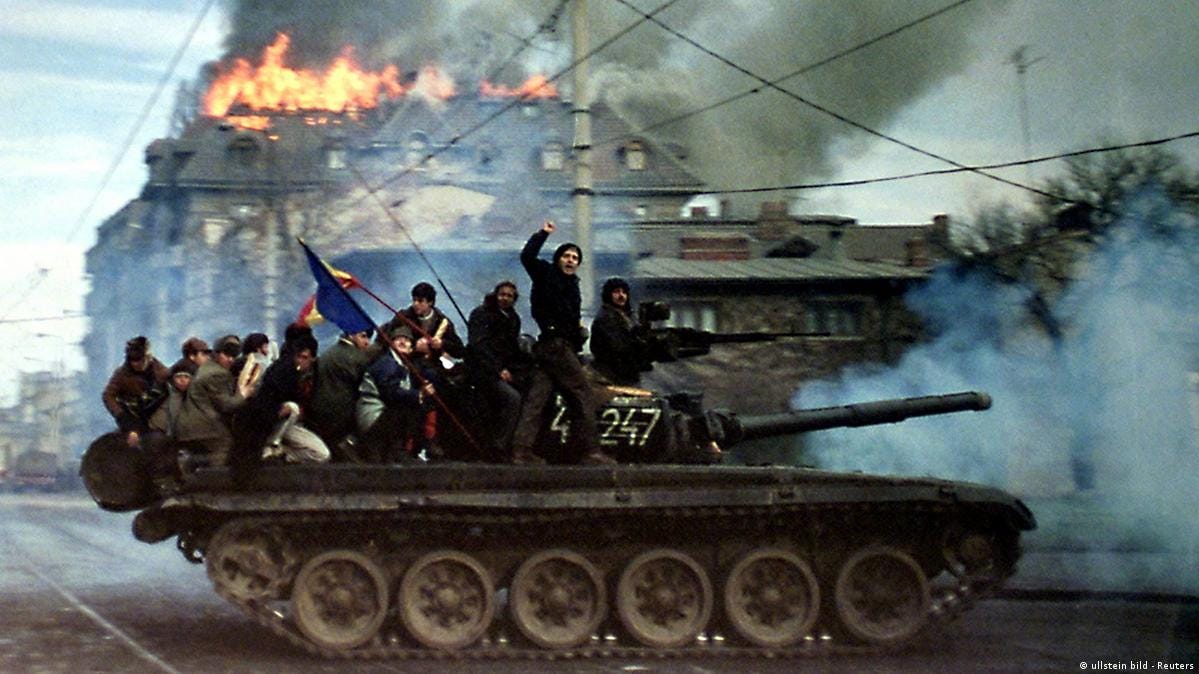
In other words, communist authorities had trapped themselves in a self-fulfilling prophecy they did not even realize they had made, and when they did realize it, it was too late and they imploded, essentially allowing the dissidents to fill in the gaps all over central and eastern Europe. As Kotkin writes, “Gorbachev’s ‘socialism with a human face’ was a bundle of contradictions that were impossible to reconcile,” and that “the bloc’s implosion vastly accelerated the exposure of those contradictions and emboldened many people […] to seek the formerly unthinkable: namely, full emancipation.”28 Kotkin’s formulation, intriguing and compelling as it is, is somewhat troubling in its complete and deliberate neglect—i.e., dismissal—of agency to the dissidents and even citizens of Czechoslovakia, and really all countries under the thumb of Soviet influence. In a way, Kotkin’s argument acts as the logical endpoint of the idea that grand, historical trends and forces shaped the end of the Cold War rather than a confluence of decisions made by people, large and small, inside the context of these trends and forces. It was therefore unsurprising that a shift back towards history from below was in order.
After 2010, many scholars saw this need and the potential for it being met by approaching the history of the Velvet Revolution from a different perspective. That is, by focusing on the more immediate, personal realities of those living through the Velvet Revolution, returning to a more bottom-up approach to the historiography. This led to a greater emphasis on the everyday lived experiences of those who took part in and lived through the Velvet Revolution as a means to illustrate the challenges that faced post-communist societies. Slovak historian Soňa Lutherová helped pioneer this approach for a wider, English-speaking audience in her 2010 paper that focused on the autobiographies of the Velvet Revolution’s youngest participants and witnesses, presaging the direction that the new approaches were beginning to take. As she notes, “the attitudes of child witnesses of the Velvet Revolution were characterized by a large measure of internal inconsistency,” which largely came from “a significant change of personal values, with the acquisition of new knowledge and new experience,” and reflected the overall nature of “the revolution of 1989, which in both individual and collective interpretations generally is distinguished by a large degree of ambiguity.”29 In essence, this clarifies why a need to zoom back down to earth developed in the Velvet Revolution historiography in order to understand it better and to address the shortcomings of previous work.
In 2013, historian James Krapfl did precisely that in his monograph, Revolution with a Human Face: Politics, Culture, and Community in Czechoslovakia, 1989–1992. From the outset, Krapfl seeks to break from the traditions established by the earlier works by scholars like Wheaton and Kavan, as well as the revisionist works by the likes of Kotkin. Instead of focusing on the figures cut by elites—both on the side of the revolution and those arrayed against it—or focusing on the broader forces faced by Czechoslovakia in 1989—namely state breakdown and transnational cultural forces—Krapfl seeks to focus on the Velvet Revolution’s “most important actor: Czechoslovak citizens”; seeing as “the revolution of 1989 was democratic revolution,” Krapfl writes, “then it follows that the demos—the people—should be at the center of our attention.”30 In so doing, however, the scope can still be broadened thanks to the Velvet Revolution’s success and its “[ability] to run its course,” and thus, Krapfl argues, “we can learn most about the revolutionary potential of 1989.”31
This is accomplished by following the lead of Kenney and looking at more than just the dissident intelligentsia’s writings and instead taking a closer look at “the words and actions of the citizens themselves,” immortalized by the “tens of thousands of declarations, flysheets, bulletins, posters, and open letters,” as well as “video recordings, newspapers, and the minutes of Party and administrative organs as well as the new citizens’ associations.”32 By forgoing the high-minded speeches (but not completely discounting them) or the machinations of the Kremlin and communist leadership of Czechoslovakia, Krapfl manages to bring about a deeper understanding of the Velvet Revolution from the perspective of its participants and, as mentioned, those lower down the Party ladder who opposed it.
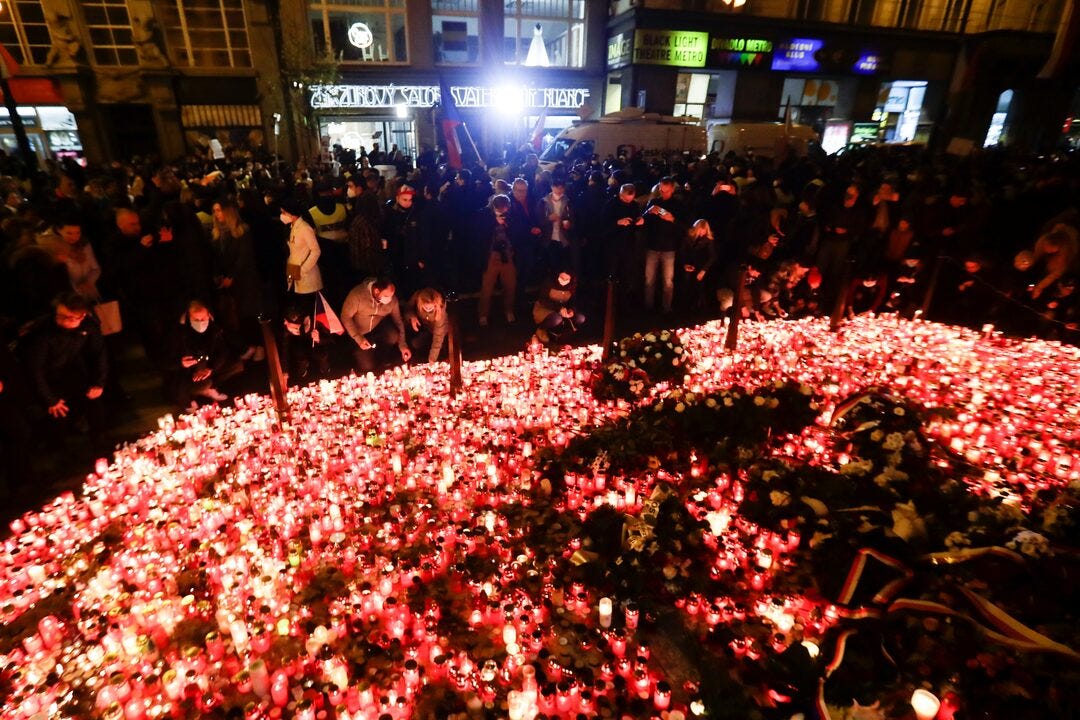
Krapfl also emphasizes the importance of what he calls “sacrality” when it comes to the Velvet Revolution, or the sacred “idea of ‘humanness,’ to which other revolutionary principles like nonviolence and democracy were logically related.”33 Based on the sources he uses, Krapfl is adamant that this focus on the human quality of things—and the inhuman quality of the communist regime—was what motivated the people that made up the true foundation of the Velvet Revolution and, by extension, what kept it “velvet,” so to speak. It was never about crude regime change or even ideological warfare (though ideology certainly came to the forefront after the new government took power); rather, as Krapfl writes, “Czechs and Slovaks did not reject the Communist regime because it was socialist but because it was unresponsively bureaucratic and ‘inhumane.’”34
This somewhat aligns with the revisionist approach taken previously by Kotkin, who pointed out the unresponsiveness as a factor leading to all the Communist regimes’ collective demise, but Krapfl singles out Kotkin’s argument as not matching that of the Czechoslovak experience, since “Czechoslovak citizens achieved a high degree of organization in a matter of days, consciously influencing the way Communist leadership surrendered political power and giving rise to forms of political practice that would set lasting precedents.”35 Krapfl also points out that Kenney’s characterization of the carnival-esque nature of 1989’s revolutions does not really apply to Czechoslovakia in the sense Kenney explored because, contra Kenney’s assertions, the Revolution was not a culmination; it was a beginning. This resonates especially in the context of the later Velvet Divorce and rise of Slovak nationalism discussed earlier.
Krapfl indeed follows Kenney’s lead in emphasizing the importance of ideals as cultural signifiers, especially when it comes to the attempts at spreading “the five ‘core’ ideals,” including non-violence, self-organization, democracy, fairness and, perhaps surprisingly to some readers, socialism, and finally, humanness, as mentioned earlier. These ideals all mattered in the Revolution, based on the evidence gathered, Krapfl emphasizes that “the central ideal of the revolution was suggested by the words l’udkost’/lidskost or humanita, which might be translated according to context as humanity, humaneness, or humanness” because “the desired new society was to be a society for people, not for parties, machines, systems, or bureaucracies.”36 The popular pursuit of these ideals are significant when it comes to explaining what those who participated in the Revolution wanted, but they do not necessarily explain the shortcomings that came to exist. Krapfl does address these shortcomings—particularly the revelations involving Havel’s backroom deals and negotiations that almost certainly violated the values he claimed to represent—but it would not be for three more years that a new approach was taken to help nuance the narrative of the Velvet Revolution and, especially, its aftermath.
In 2016, the historians Miroslav Vanek and Pavel Mücke released Velvet Revolutions: An Oral History of Czech Society, which brought to English-speaking audiences a missing link in the Velvet Revolution historiography: true oral history and recollections from the participants and witnesses to the revolution itself, as well as reflections on the triumphs and, more interestingly, the disappointments experienced by them. The disappointment on which many participants reflect in their interviews is especially stark, and while Vanek and Mücke do not go so far as to suggest that the feelings of disappointment means the revolution was a failure or a mistake, they do suggest that it “calls into question just how heinous and intolerable a ‘prison’ the Communist regime really was,” and that “by ascertaining both Czech individual and popular perceptions of the turning points and major processes, and gaining insight into the rhythms of their everyday lives,” some light can be shed on the ambiguities created by post-revolutionary disappointment.37
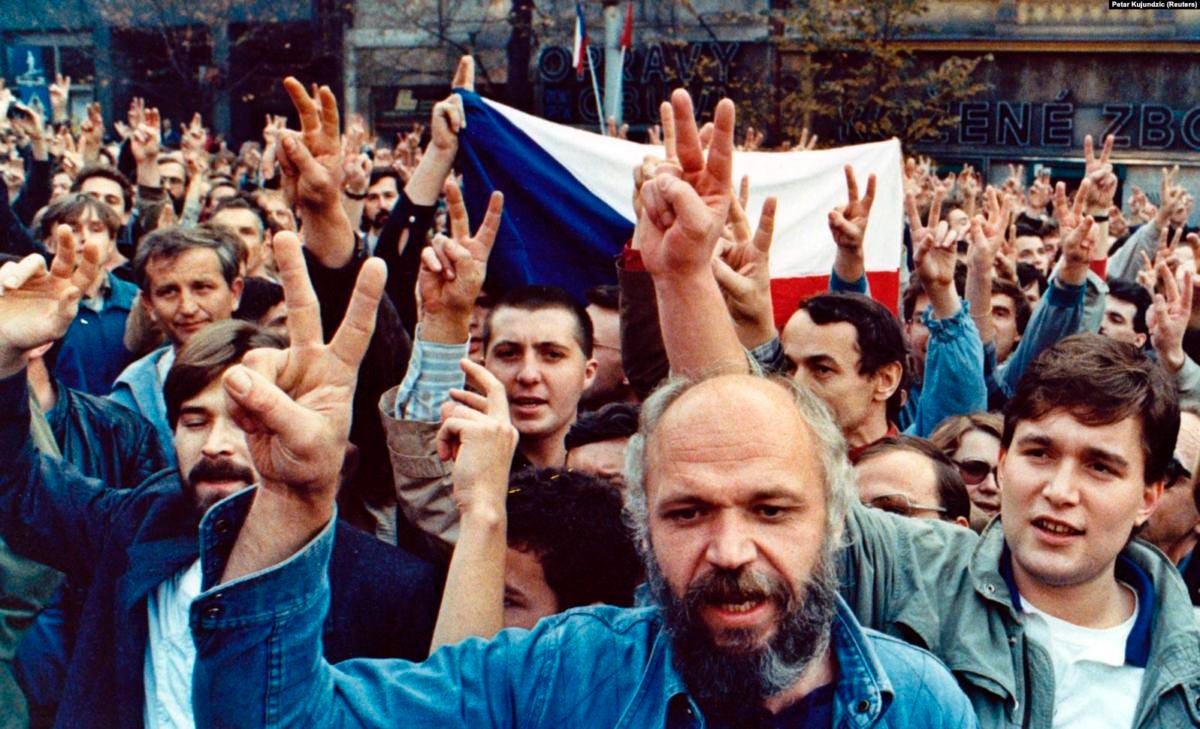
The most significant revelation to be found in Vanek and Mücke’s work is not that life under the communists was “better” or “worse” but that life existed in a variety of colors; there was no single person or experience that dominated that of anyone who lived in Czechoslovakia and the masses of trends and forces that supposedly cause everything to happen without the agency of those they happen to even mattering one iota. As the authors summarize, “Every individual has unique memories, priorities, and values,” in which “there are people who prefer freedom to any sort of state intervention, and alongside them, there are people who are willing to accept limitations on their personal freedom in exchange for guarantees of social security.”38 This reality of everyday life and the perception of forces larger than the individual from the individual perspective can only be accomplished via the approach taken by historians like Vanek and Mücke, whose use of oral history can only be accomplished when the event in question exists not only in living memory, but in living memory for so many. The limitations faced by so many oral historians trying to unravel the stories of many generations past are not as apparent in the case of the Velvet Revolution’s historiography and those of other, far more temporally distant events.
The question of where the Velvet Revolution historiography continues is something that can only be guessed. In the English-speaking world, there is a relative scarcity of histories that deal with the question of gender relations and the role of women in the revolution, as well as that relationship compared to those observed in other revolutions. There is also opportunity to expand the scope of comparative history, particularly in the context of other “non-violent” revolutions (that is, where violence was meted out against protesters rather than a mutual clash or violent overthrow) outside of 1989 in central and eastern Europe, such as the Indian Revolution or the Civil Rights Revolution of the United States in the 1960s, to name just two.
What is clear is that the attempt at historicizing the Velvet Revolution only a mere few years after its occurrence reveals both the limitations of trying to treat current events as history and the trajectory that longer scale historiographies tend to take. As we have seen, from the beginning, the larger than life figures—the so-called Great Men—loom large and dominate the narrative of the story in question. Then, as time goes on and the limitations of such a limited focus and emphasis on the romantic and nostalgic aspects of the story begin to wear thin, grander trends and forces begin to take center stage, often opening the door for revisionist and even contrarian interpretations to prompt further study. In such an interpretive frenzy, what is lost—the human element—makes itself apparent, and the need to approach the story “from below” becomes more pronounced, and social and oral histories arrive to fill in the gaps.
Normally, these shifts occur over the course of many decades, perhaps even centuries, depending on the subject in question. However, in the context of the Velvet Revolution, they occurred in a microcosm, in which observers and, eventually, historians knew that something truly transformational—and thus, historic—had indeed happened. It is ultimately a testament to the study of history that such rapid shifts occurred in the historiography with the goal all history sets out to achieve set firmly in mind: to allow everyone to understand what it was like to be there when the world turned upside down, or, perhaps, when the world was made right again.
…
BIBLIOGRAPHY:
Girard, Rene. Violence and the Sacred. Translated by Patrick Gregory. Baltimore: Johns Hopkins University Press, 1977.
Glenn, John K. “Competing Challengers and Contested Outcomes to State Breakdown: The Velvet Revolution in Czechoslovakia.” Social Forces 78, no. 1 (September 1999): 187-212.
Kenney, Padraic. A Carnival of Revolution: Central Europe 1989. Princeton, NJ: Princeton University Press, 2002.
Kotkin, Stephen, with Gross, Jan T. Uncivil Society: 1989 and the Implosion of the Communist Establishment. New York: Random House, Inc, 2009.
Krapfl, James. Revolution with a Human Face: Politics, Culture, and Community in Czechoslovakia, 1989–1992. Ithaca, NY: Cornell University Press, 2013.
Lutherová, Soňa G. “Before and After: the Phenomenon of Czechoslovakia’s ‘Velvet’ Revolution in Narratives by its ‘Youngest Witnesses.’” Sociológia 42 (2010): 671-690.
Shepherd, Robin H.E. Czechoslovakia: The Velvet Revolution and Beyond. London: Palgrave MacMillan, 2000.
Vanek, Miroslav and Mücke, Pavel. Velvet Revolutions: An Oral History of Czech Society. Oxford, UK: Oxford University Press, 2016.
Wheaton, Bernard and Kavan, Zdenek. The Velvet Revolution: Czechoslovakia, 1988-1991. London: Routledge, 1992.
NOTES:
1. Rene Girard, Violence and the Sacred trans. by Patrick Gregory (Baltimore: Johns Hopkins University Press, 1977), 79-80.
2. James Krapfl, Revolution with a Human Face: Politics, Culture, and Community in Czechoslovakia, 1989–1992 (Ithaca, NY: Cornell University Press, 2013), 49.
3. Bernard Wheaton & Zdenek Kavan, The Velvet Revolution: Czechoslovakia, 1988-1991 (London: Routledge, 1992), xi.
4. Ibid., 9.
5. Ibid., 12.
6. Ibid., 13.
7. Ibid., 24.
8. Ibid., 93.
9. Ibid., 177, 183.
10. Robin H.E. Shepherd, Czechoslovakia: The Velvet Revolution and Beyond (London: Palgrave MacMillan, 2000), 1.
11. Ibid., 3.
12. Ibid., 8.
13. Ibid., 40.
14. Ibid., 149.
15. Padraic Kenney, A Carnival of Revolution: Central Europe 1989. Princeton, NJ: Princeton University Press, 2002
16. Ibid., 34.
17. Ibid., 36.
18Ibid., 166-167.
19. Ibid., 283.
20. Ibid., 107-108.
21. John K. Glenn, “Competing Challengers and Contested Outcomes to State Breakdown: The Velvet Revolution in Czechoslovakia,” Social Forces 78, no. 1 (September 1999), 187, 188.
22. Shepherd, Czechoslovakia, 108, 109.
23. Stephen Kotkin, with Jan T. Gross, Uncivil Society: 1989 and the Implosion of the Communist Establishment (New York: Random House, Inc, 2009), 7.
24. Ibid., 9.
25. Ibid., 8.
26. Ibid., 10.
27. Ibid., 15.
28. Ibid., 136.
29. Soňa G. Lutherová, “Before and After: the Phenomenon of Czechoslovakia’s ‘Velvet’ Revolution in Narratives by its ‘Youngest Witnesses,’” Sociológia 42 (2010), 671-672.
30. Krapfl, Revolution with a Human Face, 1.
31. Ibid., 3.
32. Ibid., 4.
33. Ibid., 7.
34. Ibid.
35. Ibid., 36.
36. Ibid., 100.
37. Miroslav Vanek & Pavel Mücke, Velvet Revolutions: An Oral History of Czech Society (Oxford, UK: Oxford University Press, 2016), 4-5.
38. Ibid., 199.