


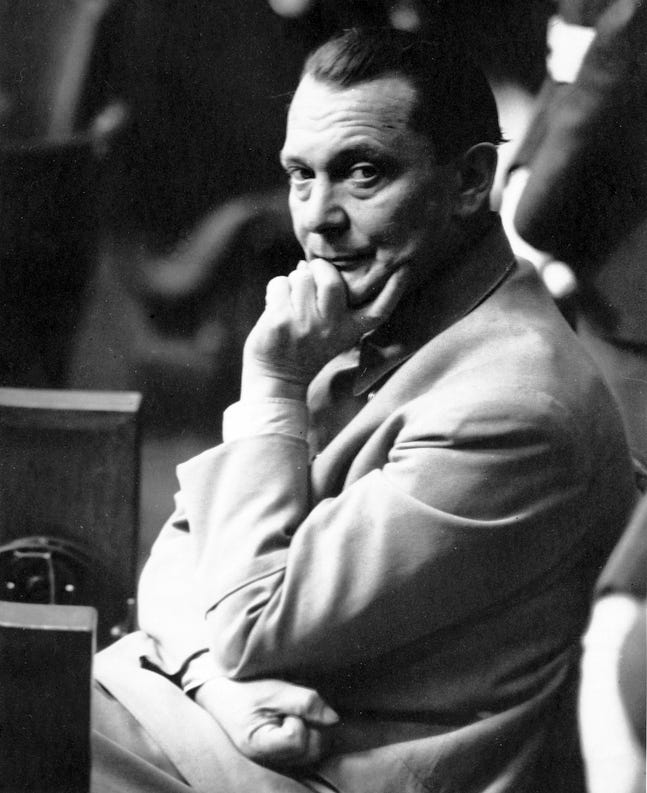
Hey everyone. I am happy/sad to report this is my last proper research paper that I have written for my time in graduate school, outside of my still-to-be-completed master’s thesis. But this one quickly became my favorite piece of academic writing I have done so far because it marries two of my great interests: the history of the Third Reich and psychology.
The seeming theme of History Impossible this year is about the end of the Second World War and in what sense it was, well, made sense of. That’s the theme of the research conducted here, the theme of all this Third Reich historiography I’ve been doing, the theme of the upcoming special episode, and the theme of the final episode of “The Muslim Nazis,” which is indeed being worked on as we speak. It makes sense that such a theme would resonate with me, but it also resonates with everyone who studies the war and its effects. I’d even go so far to say that I understand the position a lot of revisionists—both those I have criticized directly and not—find themselves in. The more one does a meta-analysis of the Second World War, the more chance of getting gobsmacked one seems to have.
It makes sense. Everything about this conflict, including its supposed heroes and villains and what they did, is unthinkable. There is no other way to put it. And instead of embracing this enormity, it breaks brains and requires explanation and a desire to put everything in a box; revisionists simply don’t like the current box. In a sense, that’s what inspired my research for this paper, along with the impressive film Nuremberg from 2025 that starred Russell Crowe as Hermann Göring. As we’ll see with this paper, the efforts to understand the Third Reich and how things got to the point that they did began even before the Second World War started. This speaks to its strangeness and its significance to history and, as we’ll also see, the drive to diagnose it at the deepest level possible.
Thanks, and enjoy.
—AVS
…
“Is evil something you are? Or is it something you do?”
—Bret Easton Ellis
“The social psychologist of the future will have a number of classes of school children on whom they will try different methods of producing an unshakable conviction that snow is black. When the technique has been perfected, every government that has been in charge of education for more than one generation will be able to control its subjects securely without the need of armies or policemen.”
—Bertrand Russell
“Kelley found some darkness in every person. Gilbert found a unique darkness in some. They were both right.”
—Joel E. Dimsdale
It was June 11th, 1945. The Second World War had yet to fully conclude in the Pacific Theater, but the Allies had been victorious in Europe for over a month. Despite the finality of this victory, and of the Fuhrer Adolf Hitler’s demise at his own hand, it had quickly become clear that there were more questions than answers forming among the Allies. How had things escalated this much? How had the Nazis managed to exceed the destruction of the First World War so quickly? How had so many crimes on a never-before-seen scale—the crimes that would come to be known as the Holocaust—managed to occur under the very noses of so many Germans? What kind of men could even do these crimes? Were they mad? Or were they truly evil monsters? Answering these questions had vital importance to many within American academia, from a variety of different fields including medicine, neurology, the arts, administration, and psychology. Leading a group of professors was the psychiatrist Dr. John Millet, and on that day, he drafted a letter to be sent to the chief prosecutor in what would become the famous Nuremberg trials, United States Supreme Court Justice Robert H. Jackson. The letter’s primary purpose was requesting that these experts get hold of the war criminals’ brains after they had been executed, with the letter reading as follows:
Detailed knowledge of the personality of these leaders […] would be valuable as a guide to those concerned with the reorganization and re-education of Germany. […] In addition to the psychiatric interviews it would be desirable to make a number of psychological tests such as the Rorschach. […] If and when the accused has been convicted and sentenced to death, it would be desirable to have a detailed autopsy, especially of the brain. Therefore it is urged that the convicted be shot in the chest, not in the head. [Signed,] John Millet.1
An agent for the Office of Strategic Services (OSS) named Sheldon Glueck echoed and even spelled out these sentiments three days later in a letter written to Major General William “Wild Bill” Donovan, the founder of that organization. Glueck wrote that “a chief aim of the [Nuremberg] trial […] will be to convince posterity of the facts and to interpret those facts and the entire Nazi leadership from the points of view of law, medicine, and sociology. For the first time in history, a thorough scientific study of the types of mentality possessed by the German military, political, and industrial insiders will be made.”2 Both of these letters demonstrate the enthusiasm many had for trying to understand the very nature of those they rightfully saw as the embodiment of evil on earth. Such measurements—the brain’s post-mortem and the Rorschach test—were considered the cutting edge for their time. There had been a growing chorus of speculation surrounding the psychology of the Third Reich since its very beginning, and now that they had been defeated, the victors could study their enemy up close and, so the thinking seemed to go, with few ethical limits or questions.
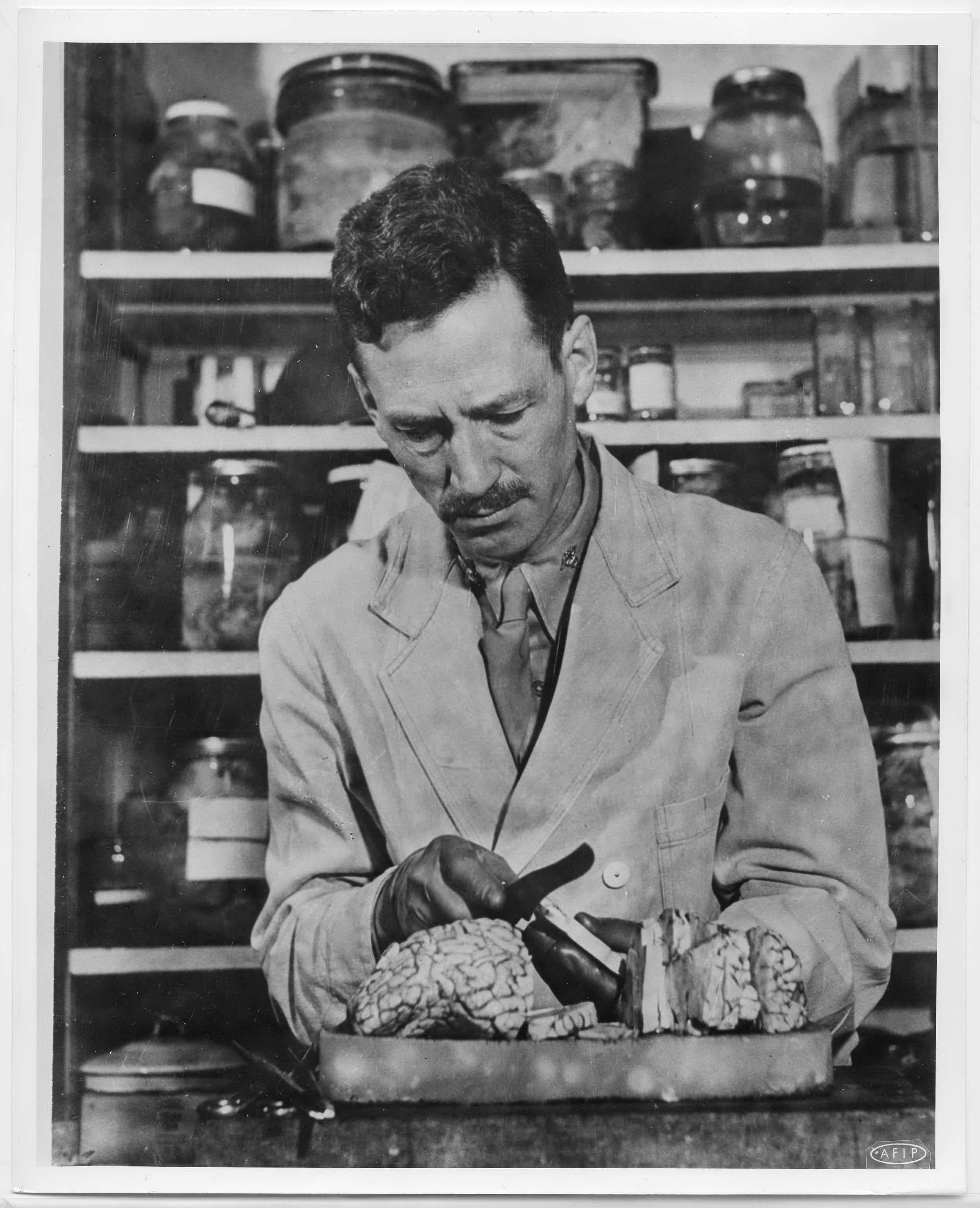
The professors eventually got their chance to study the literal mind of a Nazi. Justice Jackson had ultimately supported both proposals from Glueck and Millet, and had already allowed the Army to send in a psychiatrist in August of 1945, when the unthinkable happened that October: one of the accused war criminals held at Nuremberg, the Nazi politician and head of the German Labour Front Robert Ley, had hanged himself in his cell, using a towel that he had turned into a noose by ripping it into strips and fastening it to his toilet pipe. Within hours, Ley’s brain was extracted and sent to the Armed Forces Institute of Pathology in Washington, D.C. The neuropathologist found evidence of damage to the frontal lobe, likely caused by a head injury Ley had incurred during the First World War, and exacerbated by chronic abuse of alcohol, confirming what many assumed: Ley’s brain was abnormal. When the media learned of these findings, they began to trumpet the news, with the Washington Post proclaiming in their headline, “Nazi Ley’s Brain Found Diseased.” Surely this helped explain, many reasoned, how and why the Nazis’ reign had seemed so deranged. Despite another neuropathologist named Dr. Nathan Malamud of San Francisco offering a second opinion, backed up by microscopic analysis, that Ley’s brain did not show any signs of true pathology, the American media continued to promote the idea of the diseased Nazi brain. However, no one actually studying the Nuremberg criminals was resting on their laurels quite yet.
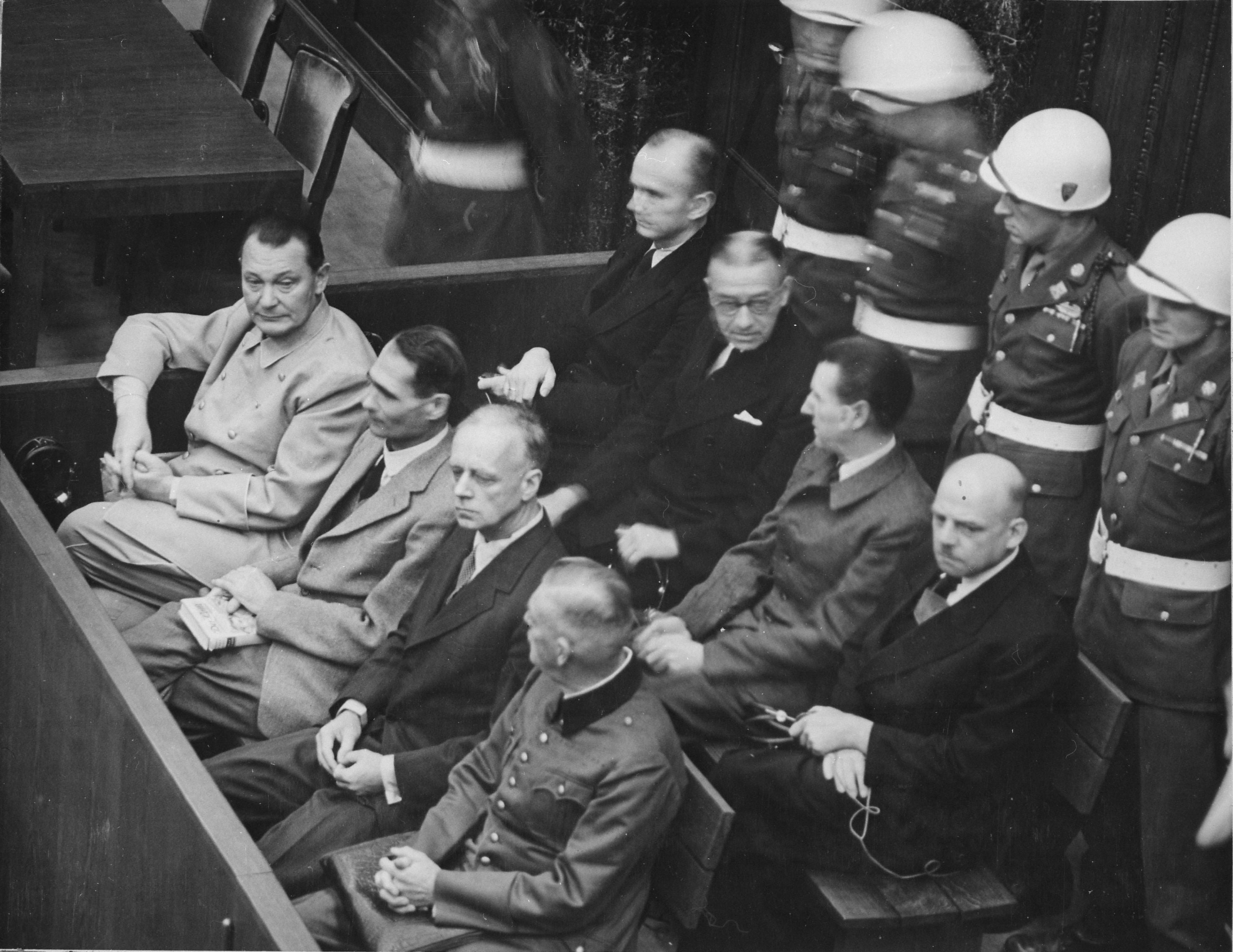
Ley, along with the other defendants, had already been analyzed by the U.S. Army psychiatrist, Dr. Douglas Kelley, as well as the Army psychologist, Dr. Gustave Gilbert, among others. Both were developing their own ideas about the nature of these men’s minds—men who included the Reichsmarshall himself, Hermann Göring, and other high-ranking Nazi officials and military figures—but Kelley had put it most bluntly after Robert Ley’s suicide, writing in his preliminary report on the Rorschach tests that had been conducted, “since Ley kindly made his brain available for postmortem examination, we were presented with the rare chance to verify our [...] findings.”3 It had become a matter of course that the Third Reich and its crimes would not just be understood, but quite literally, diagnosed, and Kelley, along with Gilbert, would be at the center of finding that diagnosis, arriving at what seemed to be completely different conclusions, but what would, with time and despite some later setbacks, be demonstrated to be complementary ones.
Arriving at a diagnosis of the Third Reich and its leaders has been at the root of many questions raised about the history of the Nazi years, but it had a wider impact on many fields of study that go beyond history, not least of which, psychology. With the collapse of the Third Reich, the destruction wrought by World War II, and the realization of the Holocaust’s extent, deeper questions about human nature were given a new lease on life, thanks to many developments and advancements in the relatively new field. Sigmund Freud had long been a household name, and had indeed made his own commentary on the Nazis known, alongside many of his followers and critics alike. However, the Nuremberg trials and the role of psychologists in their judgments made a much more lasting impact on the field. This impact would experience a number of diversions, beginning with Hannah Arendt’s reportage of the SS man Adolf Eichmann’s trial in 1961, but it found its origins in the differing interpretations of the two main psychological experts that spent time with the Nazi war criminals in 1945-1946: Douglas Kelley and Gustave Gilbert.
This paper addresses the extent to which the Kelley-Gilbert debate shaped the development of the theoretical frameworks that experimental social psychology used to explain perpetrator behavior. This paper also examines how Hannah Arendt’s “banality of evil” thesis overrode the influence of the Kelley-Gilbert debate on social psychology’s perpetrator frameworks during the subsequent decades of intellectual development. Finally, this paper assesses what was potentially lost in Arendt’s intervention, namely the missed opportunities in understanding crimes against humanity. The Kelley and Gilbert debate, I argue, offered vitally complementary insights into Nazi ordinariness, but their debate went cold after 1958, missing an opportunity for synthesis, and allowed Arendt’s provocative reframing as mere “banality” to fill this void, directly inspiring the most influential social psychological studies for decades to come and thus shaping the development of social psychology. That is, until recent challenges that resurrected both Kelley’ and Gilbert’s assertions, and revealing their complementary nature.
The paper thus contributes to the preexisting historiography, which often connects the work of Kelley and Gilbert to the later observations by Arendt, but has so far neglected to interpret Arendt’s contributions as a potential diversion in the development of social psychological theories of evil. In other words, the intellectual through-line observed in this paper is a novel one that attempts to bridge the gap rather than simply note the continuity. Thus, in attempting to chart this intellectual history of modern social scientific attempts to diagnose evil, it follows the lead of historian Peter E. Gordon, who wrote that “intellectual history resists the Platonist expectation that an idea can be defined in the absence of the world,” and instead “tends instead to regard ideas as historically conditioned features of the world which are best understood within some larger context.”4 In other words, our psychological understanding of evil did not sprout from the ground, unbidden; it was thanks to our attempts at diagnosing the Third Reich.
…
Attempts at psychologically diagnosing the Third Reich occurred well before the Nuremberg trials themselves, beginning even before the Second World War began. In fact, these attempts appeared shortly after the Nazi Party seized power in 1933. Most psychological commentary was based heavily on the principles of Freudian psychoanalysis. The unconscious mind held the key, many of these analysts believed, to understanding how and why Germany had transformed so completely in such a short period of time; it held the key to understanding the people who led this new Germany, particularly its Fuhrer. This was why Hitler inspired so much close, behavioral scrutiny from psychoanalysts. As medical historian Daniel Pick writes, “it was noted by a number of commentators that the personality of Hitler, his style of performance, and the panoply of rituals that surrounded him and his henchmen inflamed his followers far more deeply than they knew,” leading to what many of these analysts believed was a “an erotic and destructive enjoyment at stake in politics.”5 It mystified many observing the Nazis’ rise to power that there seemed so little resistance, at least effective resistance, against their ascent and increasing belligerence. Therefore, the explanation had to be internal; thus, psychological.
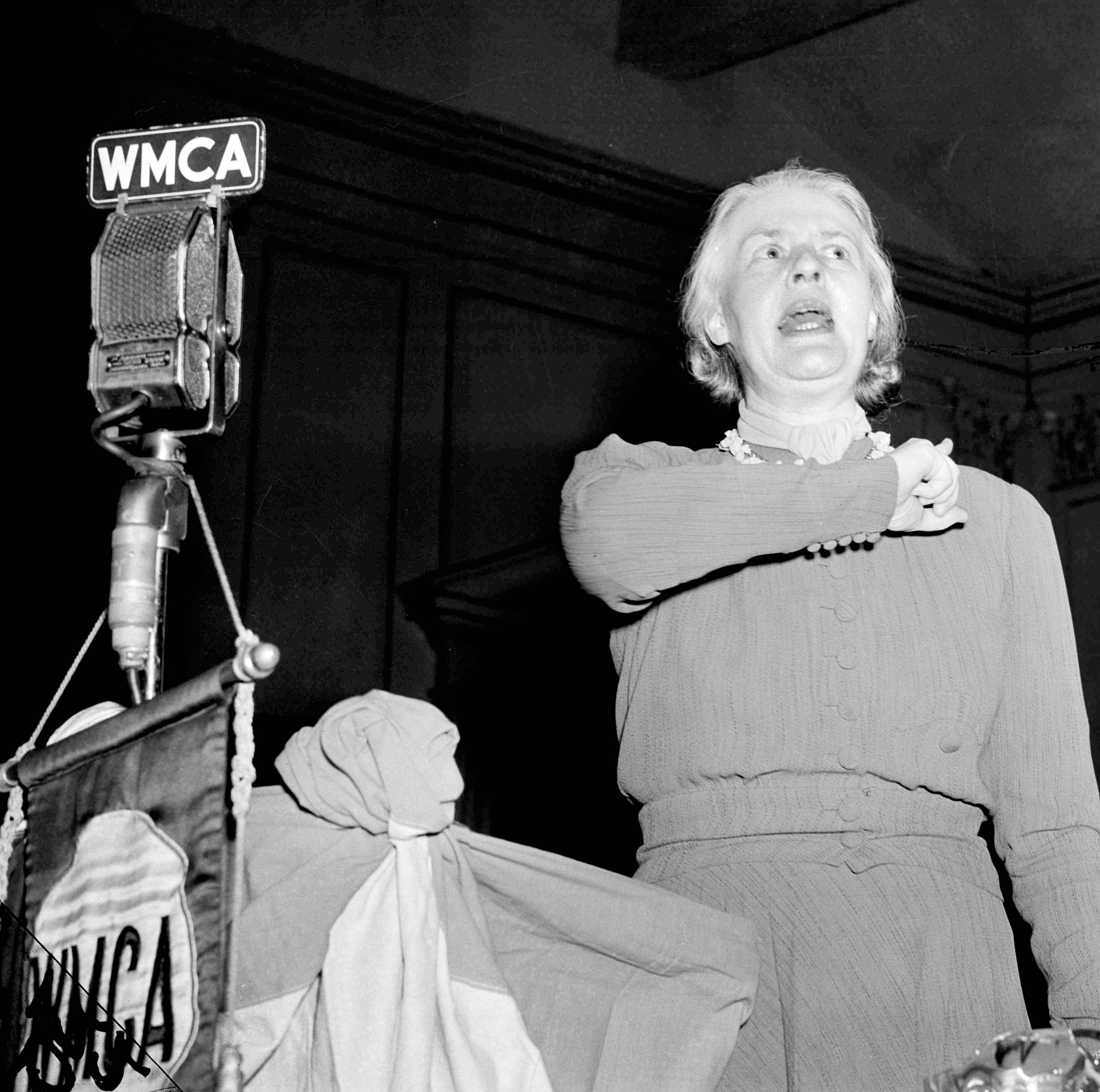
Those searching for the key to Hitler’ and the Party’s continued success acknowledged political realities and historical grievances, “but the unconscious, charismatic effect of the Fuhrer was widely recognized to be of central importance,” which was reinforced by the widespread coverage of Nazi propaganda material that depicted “mass enthusiasm,” such as the footage of the Nuremberg rallies of the mid-1930s.6 The Third Reich’ and the Fuhrer’s popular support was thus frequently conflated with psychopathology and seen as something alien, understood the same way as one might understand a novel virus; contemporaries in government and media certainly “wondered if the Chancellor [Hitler] was out of his wits,” which included the likes of George Orwell, to whom “the madness of Hitler [was] assumed.”7 As a more pointed example, the American journalist Dorothy Thompson wrote an article for Cosmopolitan in 1931 (followed by a book in 1932 called I Saw Hitler!) in which she famously characterized Hitler as a “little man.” She later doubled down on her charge in an interview with the New York Times after the Nazis’ seizure of power, in which she called the dictator “the apotheosis of the little man in Germany,” further extending her analysis to include the German people, who were “the victims of a war-defeat psychosis” who “were taught to believe the German military machine could not fail” and that “when Hitler tells them it did not fail, but was betrayed, they believe it.”8
These sentiments had intellectual merit at the time. Within the dominant Freudian psychoanalytic school of thought, this was completely normal; the Nazis and those who followed them were the mass embodiment of “illness,” which was seen as “the price of the impossible conflict between unconscious desire and social restraint,” and leading to “fears of sociopolitical degeneration and a wider sense of cultural malaise,” in the decades following the First World War.9 Freud’s daughter Anna, a psychoanalyst in her own right, wrote in 1936 that victims of aggression often identified with their aggressor, representing “a preliminary phase of superego development and, on the other, an intermediate stage in the development of paranoia.”10 This observation, among others, “was soon taken up in interpretations of the psychology of Nazism and even sometimes of concentration camp inmates,” demonstrating the influence of a psychoanalytic approach when trying to make sense of the nascent, and eventually dead and buried, Third Reich.11
The psychoanalysts’ assessments of the Third Reich were mostly theoretical, especially before the outbreak of war, but military intelligence officers with the OSS interested in psychoanalysis decided to turn theory into practice with the analysts’ help and guidance, especially after the outbreak of war in 1941. Dr. Walter Langer was one of these analysts. He had studied with the Freud’s in Austria and assisted in their and other anti-Nazi activists’ escape in 1938, developing a keen personal interest in finding a psychopathological explanation for what was unfolding in Germany. Back in the United States in 1941, Langer, with the help of his brother William, applied for and received funds from “Wild Bill” Donovan, chief of the OSS. Langer did work on troop morale, but he also produced a “report on the unconscious phantasmagoria in Hitler’s mind,” that “would finally see the light of day after decades as a secret document: The Mind of Adolf Hitler became a surprise best-seller in the early 1970s.”12
Langer’s report had a number of issues, mostly involving the use of speculations and assumptions that could not and cannot be disproven, but it makes for a compelling document. It is certainly steeped in hindsight to point out, but it is noteworthy that Langer’s report accurately predicted, based solely on his interviews and observations of the man, that “one outcome was highly likely: the German leader would carry on to the end, staying true to his desire,” finally seeing a clash “between his wishes and reality,” leading to “his mind [collapsing] altogether, even as his political regime and military organization came apart around him,” and “a final total breakdown.”13 Langer also interviewed figures like Hitler’s old friend, and later enemy, the industrialist Ernst “Putzi” Hanfstaengl, who was able to sketch out a fairly detailed image of the Fuhrer and his personality characteristics, at least as he saw them. As Pick summarizes, Hanfstaengl would “[recall] how the leader would enter in states of what he called ‘destructive madness,’” and “claimed that Hitler was a madman who understood life through the ‘muzzle of a gun,’”; but most significantly Hanfstaengl presaged a similar diagnosis of the German people when he warned that “German culture […] was producing a nation of ‘Machine Beasts.’”14
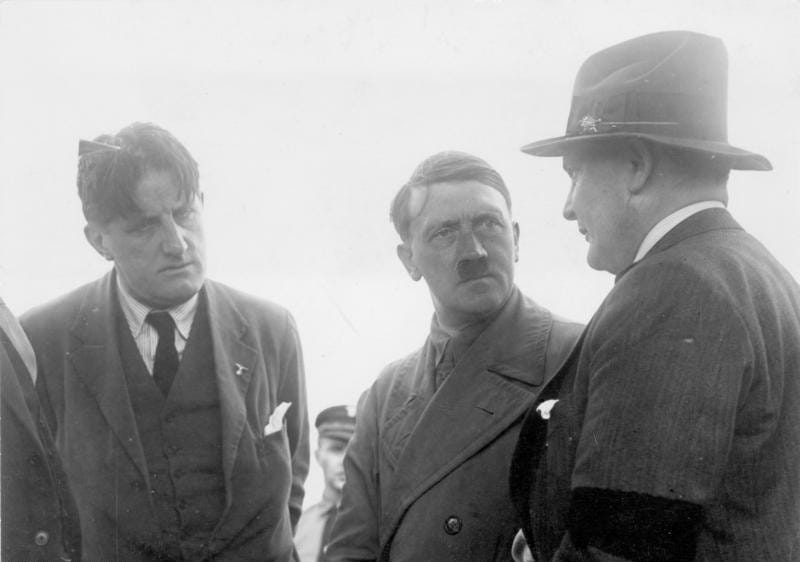
While Langer’s report has its limitations, it was a hit with military intelligence. It provided a vector for understanding the enemy, particularly its leader. The idea of the Fuhrerprinzip was understood by U.S. military intelligence as a very real thing, not simply propaganda, so understanding the Fuhrer was key to understanding the German people who supported him; the theories of crowd psychology from Gustave Le Bon would only take them so far, so grasping the inner world of the Fuhrer became paramount. This was, after all, part of the shared premises of Nazism and fascism, in which “the party would gather the people into a unity,” with an “ideological promise […] of unity, singularity, and resolute direction: only through total allegiance to the masterful leader […] could the hopeless confusion of modern life be ended.”15 The notion of “understand the Fuhrer, understand the people” thus became the lodestar for the intelligence community.
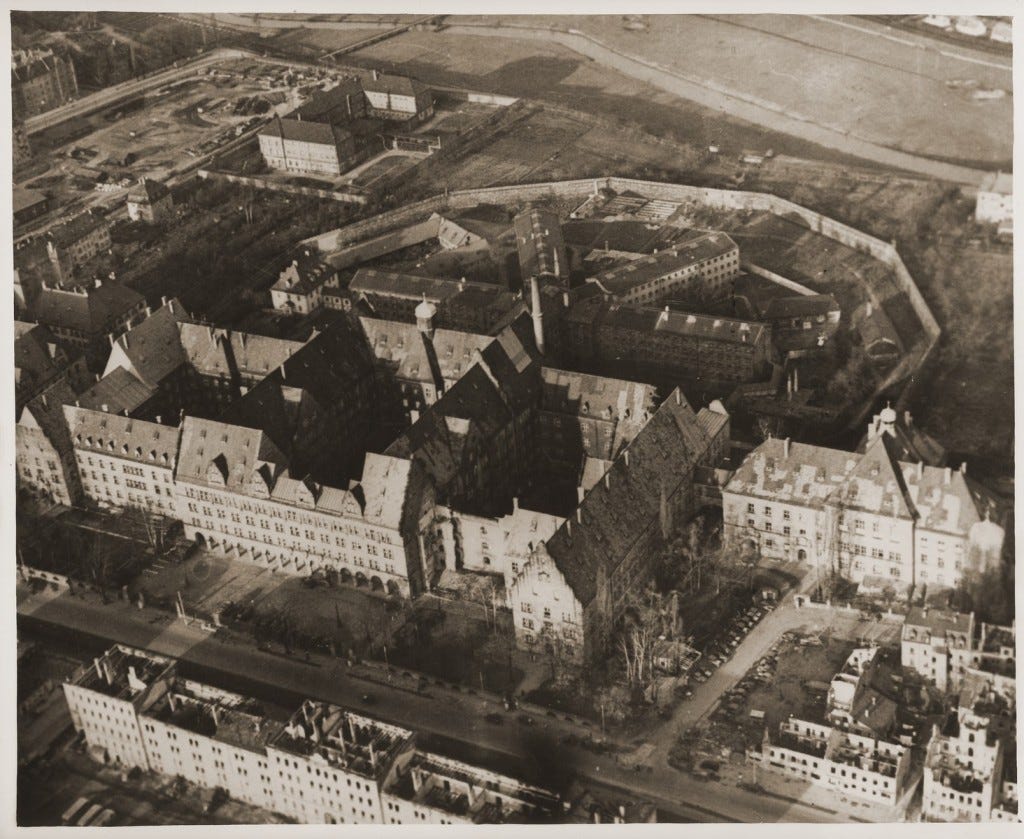
Unfortunately for everyone involved, they would not get the chance. While Langer had written nothing about suicide as the likely outcome of the Nazis’ defeat, when Hitler and much of the upper echelons of the Third Reich including Joseph Goebbels and Heinrich Himmler killed themselves, his assessment of Hitler reaching a total final breakdown likely felt eerily prophetic to those who had read his report. Nevertheless, as it quickly became clear in the months that followed VE Day, there were other high-ranking Nazis who could be questioned and profiled and, hopefully, provide the diagnosis that so many had been trying to find. Even better, all of these Nazis would be in a completely controlled—that is, experimental—environment: the jail cells at Nuremberg’s Palace of Justice.
…
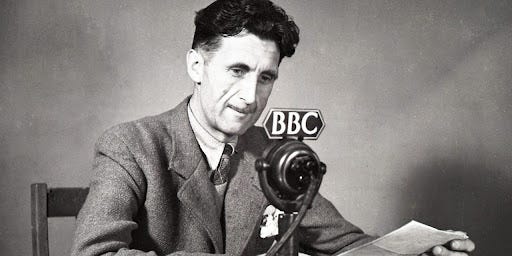
Little did the two psychological professionals at the center of the coming debate likely know, the essence of their debate had already emerged, and not exclusively from fellow psychologists. It had actually come from two very influential media commentators: the aforementioned Dorothy Thompson and George Orwell. Echoing Putzi Hanfstaengl’s lament about Germany becoming a nation of “Machine Beasts,” Dorothy Thompson, had, while still assigning Hitler the role of proverbial band-leader of the Third Reich phenomenon, described the German people as “the accompaniment of a tom-tom of mechanized howls from a drilled mob — howls that seemed to come from the throats of ten thousand robots.”16 While Thompson’s early assessments of the Fuhrer suggested a belief in his madness, she had become more concerned with exposing the danger of a charismatic leader who could, in all likelihood, whip any people up into a frenzy. Conversely, Orwell had become less concerned with “drilled mobs,” and more with the idea that “creatures out of the Dark Ages have come marching into the present,” and that there were indeed those who simply possessed “a Fascist streak.”17
These interpretations echoed the growing split among psychologists and psychiatrists regarding the particularity of the Third Reich and its crimes that had become clear by 1943 with the publication of two separate inquiries by New York psychiatrist Richard Brickner, and Vienna-born psychiatrist and former prisoner of the Nazis, Bruno Bettelheim. As Daniel Pick summarizes, “Brickner’s Is Germany Incurable? and Bettelheim’s work on camp inmates, ‘Individual and Mass Behavior,’ pointed the way towards two different trajectories of post-war thought: the former concerned with localizing the horror of Nazism to the German ‘case’; the latter suggesting that, under given conditions, certain victims—perhaps any victims—might start to think and even function like perpetrators,” the latter case logically expanding into the idea that anyone could become a perpetrator of heinous crimes.18 Apart from the pointed allusions of media commentators like Thompson and Orwell, this diagnostic split had remained confined to academic journals and monographs like those written by Brickner and Bettelheim, but it was about to grow in notoriety and significance thanks to the arrival of Dr.’s Douglas Kelley and Gustave Gilbert at Nuremberg.
That debate emerged from the needs created by the Nuremberg trials, which sought to create a new precedent in which the international community would, collectively, charge a foreign state with a crime (and a crime that had to be defined; that is crimes against humanity). In that spirit of expanding the purview of a typical court, the judges and prosecutors had to first address the basic question of whether any of the defendants were, in fact, mentally ill and therefore unfit to stand trial. While there was some controversy with Deputy Fuhrer Rudolf Hess’ fitness due to his claims of amnesia, and other more outlandish behavior from figures like the propagandist Julius Streicher, none of the twenty-two defendants were deemed unable to testify. However, there were more than practical, legal reasons to consider that had more to do with providing answers to a deeper question that many psychologists had been trying to puzzle out for years; in the words of historian Laurence Rees, “was there, as popular mythology suggested there might be, a Nazi personality type?”19 The incentive to address this question, as previously covered, had been in place for over a decade. Finally, there was a chance to find answers, though they would come in pieces rather than as a whole.
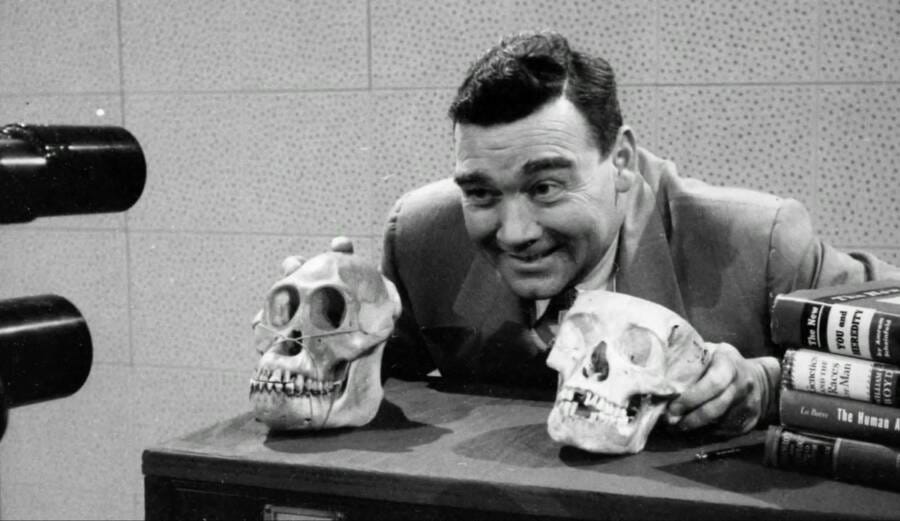
Kelley was the first to arrive at Nuremberg in August of 1945 and immediately got to work trying to make sense of his subjects, as he saw them. By Kelley’s own estimation, he spent around eighty hours with each prisoner, though as psychiatrist and historian Joel E. Dimsdale explains, “he may have stretched things a bit,” in his telling, since “the defendants arrived in Nuremberg on August 12, 1945, and Kelley left in January 1946.”20 Based on his notes and the number of pages dedicated to each criminal, he almost certainly spent the most amount of time with Reichsmarshall Hermann Göring, but he provided assessments of every one of the defendants in his 1947 memoir, 22 Cells in Nuremberg: A Psychiatrist Examines the Nazi Criminals. This memoir provides insight into Kelley’s assessments of the defendants themselves, and how he saw his own role in assessing them. Kelley believed that “as a scientist I regarded my duty in the Jail to be not only to guard the health of men facing trial for war crimes but also to study them as a researcher in a laboratory,” because “Nazism was a socio-cultural disease which, while it had been epidemic only among our enemies, was endemic in all parts of the world” and thus required “prepar[ing] a vaccine or serum that will protect against it.”21 He concluded his psychobiographical sketches of the twenty-two prisoners with a relatively speculative portrait of Hitler based on the testimonies of his subjects and preserved medical records, writing that “the Hitler legend can be rendered relatively harmless only if we help all the world to see Adolf Hitler as he actually was,” or, as he later put it, “an abnormal and a mentally ill individual.”22 This was, in essence, an early version of the “never again” argument, intended to inoculate the reader from manipulation by a Hitler-like figure in the future.
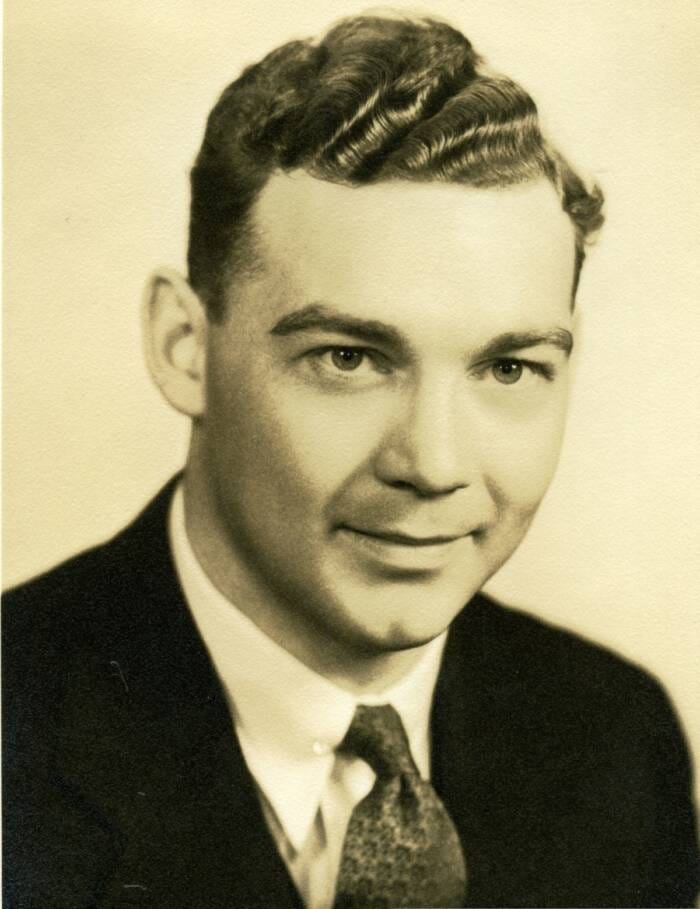
Despite labeling the Fuhrer as mentally ill, Kelley was quite insistent that the people who followed him, including his closest followers, were anything but. He painted a picture of a country enthralled by a capable, intelligent, and socially adaptable madman of extraordinary skill; certainly unique as an individual, but by no means different in terms of those capabilities. There were, in other words, no shortages of human beings who had possessed similar qualities to Hitler, who possessed them at the time and who would possess them in the future. And given that the prisoners under his care were all sane by most measures, and thus recognizable to him even as an American, there was no reason to doubt that “there is no real difference between the individual German and the individual American,” psychologically speaking.23 Most powerfully and famously, Kelley claimed that “the Nazi leaders were not spectacular types, not personalities such as appear only once in a century,” and only shared three things: “overweening ambition, low ethical standards, [and] a strongly developed nationalism which justified anything done in the name of Germandom,” plus “the opportunity to seize power.” Dramatically concluding, Kelley proclaimed:
Let us look about us. Have we no ultranationalists among us who would approve any policy, however evil, so long as it could be said of advantage to America? Have we no men so ruthlessly eager to achieve power that they would not quite willingly climb over the corpses of our minorities, if by so doing they could gain totalitarian control over the rest of us?24
Kelley had clearly developed a dim view of the sociopolitical nature of humanity, informed largely by his time spent with the twenty-two accused war criminals at Nuremberg, particularly the time he spent with Hermann Göring. According to Kelley himself, “of all the Nazis tried at Nuremberg, the one who made the greatest impression [was] Göring.”25 Some scholars tend to put an even finer point on it, given Kelley’s own mental deterioration in the decade that followed the war, marked by alcoholism and a deep depression, culminating in a dramatic suicide in 1958 that mirrored Göring’s own method: ingestion of cyanide. Jack El-Hai points out that “there was more behind Kelley’s choice of that particular poison and that exceedingly rare form of suicide,” considering that he kept a loaded gun in his office, strongly suggesting that it had been “a deliberate evocation of Göring’s defiant suicide and the Reichsmarschall’s pose of a hero backed into a corner.”26 Dimsdale concurs, going even further by citing contemporaneous articles covering Kelley’s suicide, which were “quick to note the link to Nuremberg and Göring,” leading to “dark questions and speculations […] as to where Kelley got the cyanide,” including the “San Francisco Chronicle report[ing] that Kelley’s poison ‘was brought back from the war criminal trials,’” and “the New York Times [taking] the matter further, stating that the cyanide was ‘one of several capsules Dr. Kelley had brought home from Nuremberg. The capsules had been discovered on Hermann Göring.’”27 In the aftermath of his death, rumors of who supplied the cyanide to whom became more notable than Kelley’s own work. But Kelley’s own assessment of Göring’s own suicide carries with it the most weight, writing that “[Göring’s] suicide, shrouded in mystery and emphasizing the impotency of the American guards, was a skillful, even brilliant, finishing touch, completing the edifice for Germans to admire in time to come” [Emphasis added].28 It is a striking addendum to his otherwise critical assessment of the infamous Reichsmarshall.
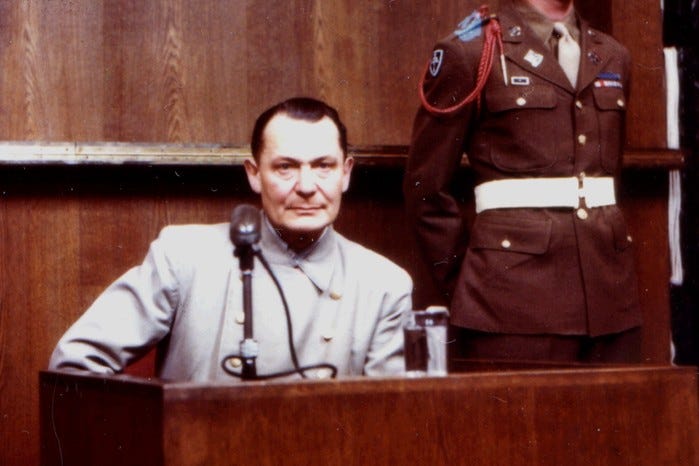
Göring’s influence was at the center of Kelley’s diagnosis of the Third Reich, as most scholars and Hollywood screenwriters tend to claim. During their interviews, Kelley found the Reichsmarshall “a man of charming manner (when he chose to be charming), of persuasive speech, and of excellent intelligence bordering on the highest level [with] a keen imagination and good educational background,” which was paired with “no sense whatsoever of the value of human life, of moral obligation, or of the other finer attributes of civilized man when they conflicted with his own egocentric aims.”29 Even as a prisoner, “he still maintained his extroverted reaction patterns, his need for attention, his narcissistic bodily fixations,” as well as “his dominant drives, his ability to visualize clearly his goal, and his willingness to attain his end regardless of the cost,” complete with “all the forcefulness, brutality, ruthlessness, and lack of conscience which made him the ideal executive for Adolf Hitler.”30
These broader observations largely fall in line with Kelley’s eventual replacement, Dr. Leon Goldensohn, who characterized Göring as “up and down […] always playing to the public,” and one who “can turn on a smile and turn it off like a faucet, almost at will, mechanically.”31 In addition, Goldensohn observed that Göring’s “attitude toward Hitler was quite different in reality [...] than it seemed to be from his testimony in court during his defense,” to which Göring replied that “’as a loyal German and a follower of Hitler, I accepted orders as orders,’” and that “’I am a man who is basically opposed to atrocities and ungentlemanly actions,’” which quickly contrasted with his callous sentiment that the “’drunken Robert Ley […] did us a favor by hanging himself before the trial started [because] he was not going to be any advantage for us defendants when he took the stand.’”32 It was these characteristics, as well as those of Göring’s compatriots, that led to Kelley’s own counter-intuitive conclusion about the relative normalcy of the Nazis, as far as their mental health went (their Fuhrer’s notwithstanding). Kelley’s own compatriot, Dr. Gustave Gilbert, would ultimately come to a much different conclusion.
Gilbert arrived in Nuremberg in October of 1945, and like Kelley, “desperately wanted in at Nuremberg to study and characterize the depravity of the Nazi leadership,” but where Kelley saw them as specimens for his lab, “Gilbert didn’t find them interesting in Kelley’s dispassionate way but loathed them and told them so.”33 This almost certainly colored his impressions of the accused criminals, but he took diligent notes and produced two books out of his experience profiling them, unlike Kelley’s one. A fluent speaker of German of Austrian Jewish heritage, Gilbert took his position at the prison very seriously, which contrasted with Kelley’s own manner, and this led to clashes between the two men that were likely just as personal as they were professional. Their ultimate conclusions also differed, though not in the sense that Gilbert believed the Nazis were insane; quite the contrary. Generally speaking, Gilbert “diagnosed the defendants as narcissistic psychopaths whose lives were formed by a diseased German culture,” in which they “represented a unique category of psychopathology.”34 They were not insane, in other words; but they were different from everyone else.
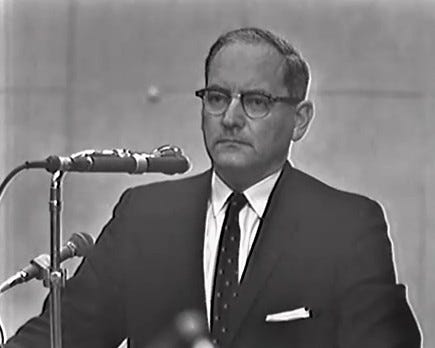
Gilbert’s first book was more detailed than Kelley’s, more resembling Goldensohn’s own work in which he reproduced the questions and responses of the defendants and recapitulated the trial proceedings as he recalled them, including the prosecution’ and defense’s statements, “refrain[ing] from embroidering the data with too much psychological speculation, leaving that to later collaborative studies which would be more comprehensive and objective than my own immediate reactions could possibly be.”35 And indeed, this was the point; “as a reviewer from the New Yorker put it […]: ‘The author lets the defendants talk for themselves and introduces himself into the picture very little.’”36 It was not until he later published The Psychology of Dictatorship in 1950 that he clarified his conclusions on Nazi psychopathology.
Gilbert claimed “that authoritarian leadership, like any other, reflects the nature of the culture in which it emerges,” and “is expressed […] in the social values developed among the leaders of the given culture,” leading to “motivational development in interaction with society and culture, so that the individual level of explanation cannot be fully understood without reference to the social and vice versa.”37 This framing allowed Gilbert to explain that the Nazis were, in fact, unwell; as individuals, as an organization, and as a culture, but all thanks to the singular influence of a dictator. To help make this case, Gilbert spent much of the first section of his book exploring the psychology of Adolf Hitler himself, pointing to the “dark recesses of Hitler’s libido there lay the smoldering ashes of violent, unresolved Oedipal conflicts,” leading him to embrace, and thus encourage others to embrace, a “rigidly obsessive development of aggression.”38 By placing Hitler at the forefront of his argument, Gilbert telegraphed his conclusions about where the Third Reich, and the German people, had gone wrong.
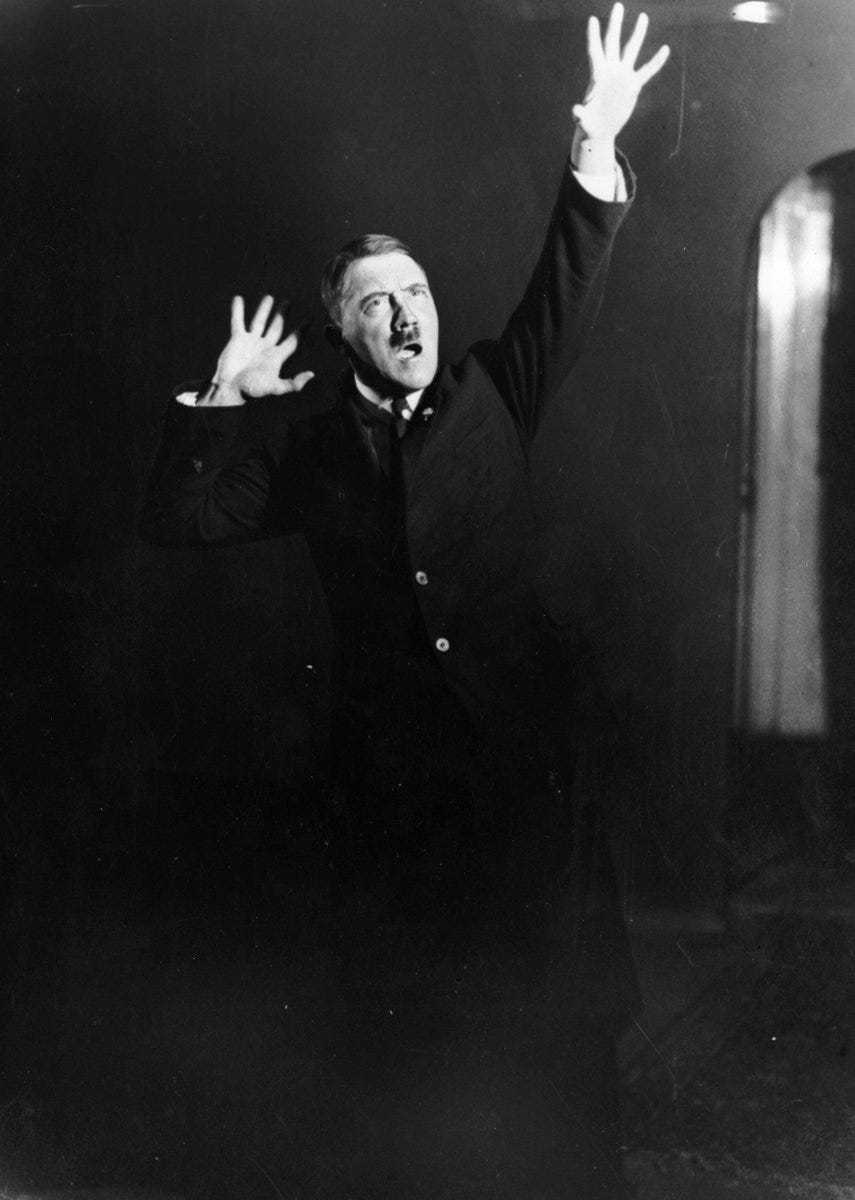
As Gilbert saw it, understanding Hitler was key to understanding, and thus diagnosing, the Third Reich. Drawing from his experiences interviewing the Nazi war criminals at Nuremberg as well as the growing body of knowledge and scholarship about those who had died, Gilbert finally concluded that “the irrational behavior of the crowd may not determine the decision [to wage war], but the emotional tensions of the leader in an authoritarian system do determine it,” and that the evidence available “leads inevitably to the conclusion that the final decision to go to war and commit genocide was determined by the irrational obsession of a dictator to ‘exterminate my enemies.’”39 In addition, unlike Kelley, Gilbert was not convinced that dictatorship was as easy as flipping a proverbial switch; conversely, Gilbert characterized “the struggle between democracy and dictatorship as fundamentally a struggle between two modes of social organization and value systems developed in [the] process of adaptive social behavior.”40 The Third Reich could not just happen anywhere; authoritarianism and dictatorship needed to be value systems in and of themselves. The United States was not akin to Nazi Germany, no matter how tempted one might be to draw parallels; they had distinct cultures and distinct value systems, in which one produced democracy, however flawed it might be, and the other produced a violence-obsessed dictatorship.
Gilbert had more reason than Kelley to come to this conclusion. While Kelley was looking at the accused war criminals with a detached eye that placed everyone on a morally neutral playing field, Gilbert had no interest in doing that. Evil was evil and the evidence was right in front of his eyes. In addition to that, Gilbert had witnessed far more than Kelley had, having stayed in Nuremberg many months longer than Kelley. In particular, Gilbert witnessed the Soviet Union’s prosecution during the trial, and what he witnessed was far more disturbing than even the film that had been shown during the United States’ prosecution. One of the Soviet prosecutors named Lev Smirnov displayed a film titled Atrocities Committed by the German Fascist Invaders in the USSR, which depicted “a basement [where], the narrator explained, human corpses had been rendered into soap,” as well as “a pile of decapitated bodies, stacked near large vats [while] severed heads were heaped nearby in a bin.”41 These images had a profound effect on the court, and this likely included Gilbert, who even “agreed that the film had hit the mark even more than the one the Americans had shown.”42 Gilbert also clearly came to this conclusion before finishing his time at Nuremberg, believing that the defendants were always paying attention to how their circumstances changed during the trial, thus showing that he saw most of those in his charge as more calculated than they might let on, and therefore exhibiting what he would later define as an authoritarian personality.
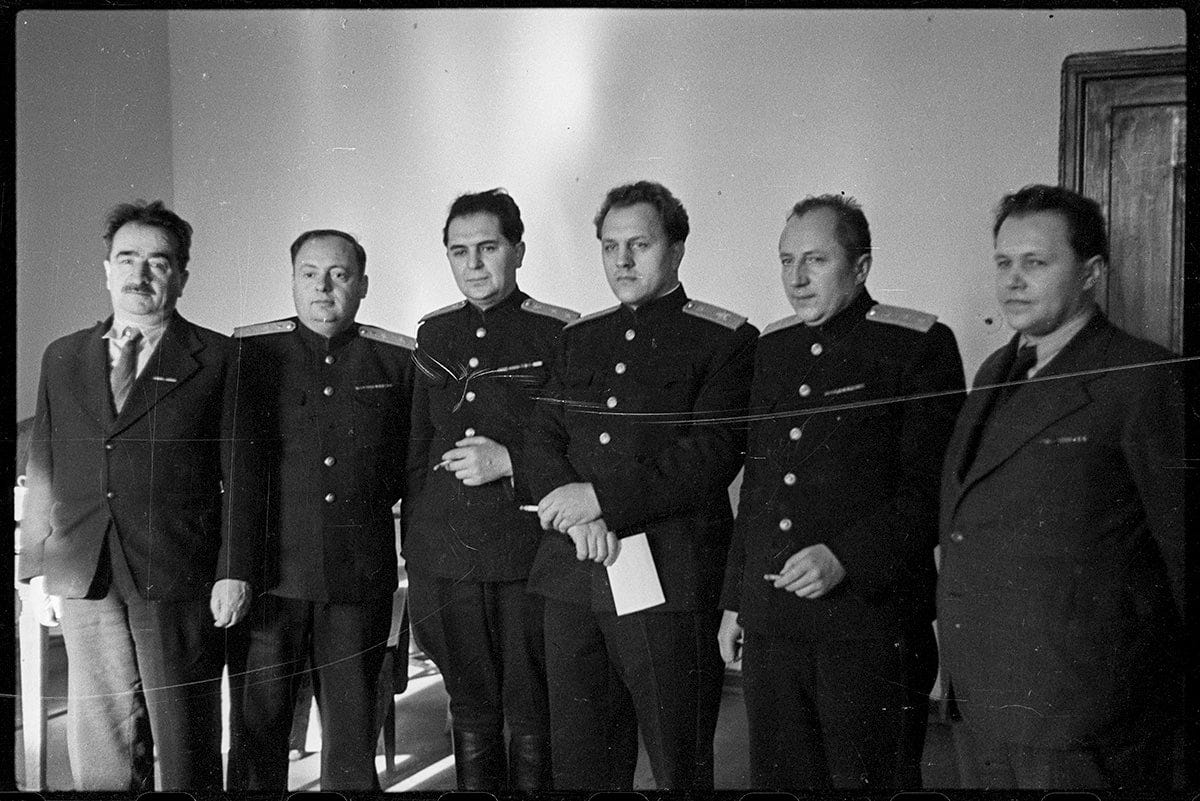
Gilbert’s view on the authoritarian personality was also shaped by his time spent with the Nazi leaders, and like Kelley, it was deeply informed by his interactions with Hermann Göring in particular; they also “both agreed that Göring was venal, corrupt, and brutal.”43 However, unlike Kelley, Gilbert ultimately saw Göring in relatively simple terms: as a criminal psychopath, unable to muster any real empathy or humanity. In describing him in his second book, Gilbert believed that “Göring continued to use the Nazi ideology as a camouflage for his own aggressive narcissism,” thus connecting ideology with psychopathology, and making it clear that he saw the two as codependent.44 This was further evidenced by “the persecution of scapegoats [serving] a three-fold purpose: (a) distraction and suppression of criticism of the Nazi regime; (b) the conditioning of public opinion to accept an aggressive ‘defense against our enemies’; (c) material incentives for the faithful,” all of which satisfied Göring’s narcissism, “least of all the third” purpose.45 While genocide was “something that shattered [Göring’s] entire frame of reference,” that did little to shatter his—or, by Gilbert’s estimation, Germany’s—complicity in it, for it was part and parcel with Hitler’s own ambitions, and Germany was in thrall.46 In the end, Gilbert assessed Göring as “a ruthlessly aggressive personality camouflaged by a disarming amiability when it suited his purpose; cyclothymic in affect, extremely narcissistic in his ego-gratifications, but lacking in moral courage which might have given his heroic fantasies more than theatrical substance.”47
All of this helped explain Gilbert’s attitude toward Göring, which was less detached interest, and more moral disgust, something he could not hide. As the psychiatrist Goldensohn reported, “I knew that Gilbert, the psychologist, had been on rather strained terms with Göring,” which likely came from the fact that Gilbert did indeed see the Reichsmarshall as a deranged criminal at a deeper level than one simply of socialization, and treated him as such.48 Göring did little to dissuade anyone from characterizing him this way, proclaiming to Goldensohn during their time together that “’frankly, it is my intention to make this trial a mockery,’” adding later that “’if I really felt that the killing of the Jews meant anything, such as that it meant the winning of the war, I would not be too much bothered by it.’”49 For Gilbert, Göring represented the Nazi personality and the perversion of German culture. As Gilbert bluntly concluded in his Nuremberg Diary, “Göring died as he had lived, a psychopath trying to make a mockery of all human values and to distract attention from his guilt by a dramatic gesture.”50
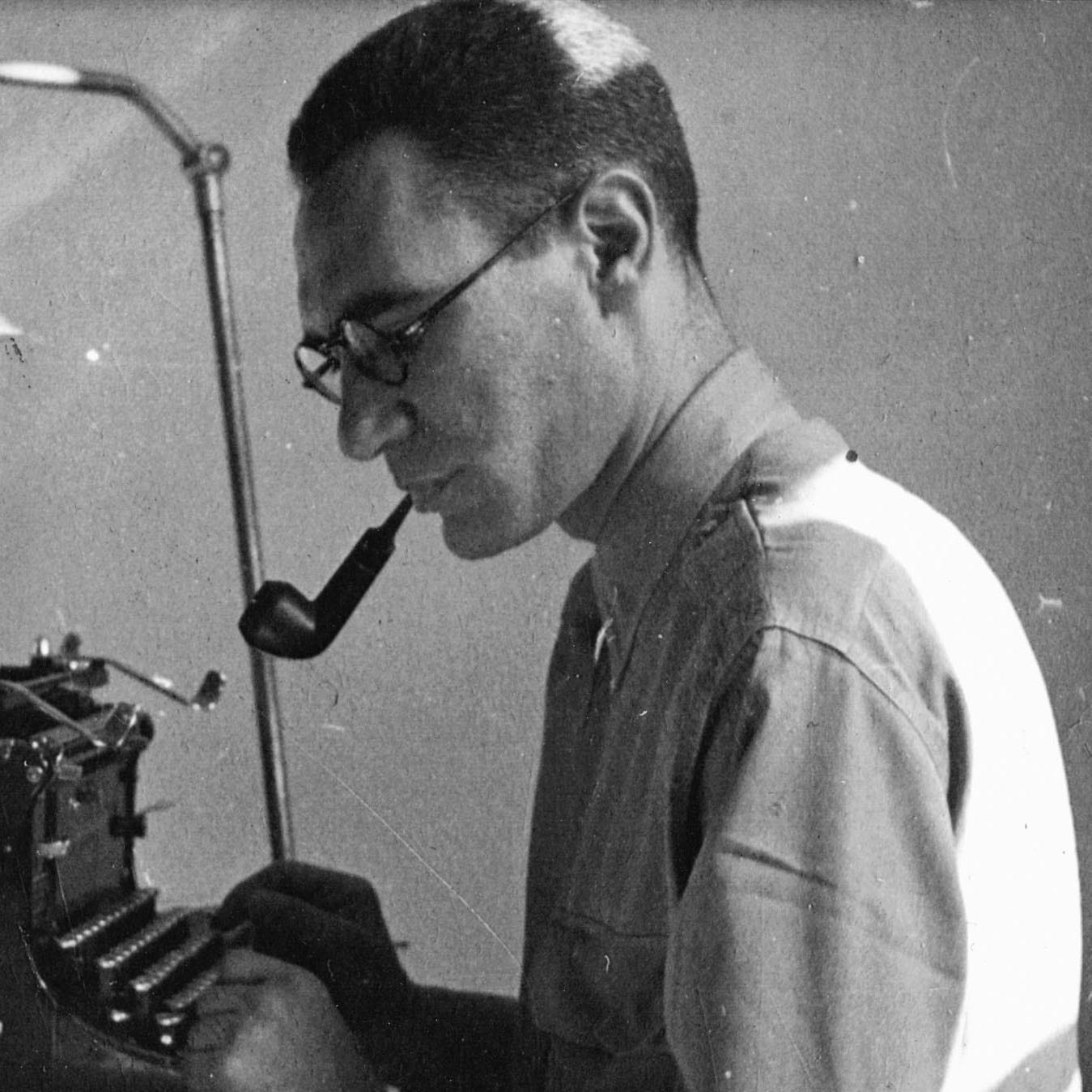
In the end, Kelley’ and Gilbert’s interpretations of the war criminals could not have sounded more different; the garrulous Kelley saw the potential for a Nazi war criminal in everyone, while the dour Gilbert saw a developed, distinct Nazi personality. As Laurence Rees summarizes, “Douglas Kelley maintained […] that the Nuremberg defendants were not only ‘essentially sane’ but that ‘such personalities […] could be duplicated in any country of the world today,’” while “Gustave Gilbert […] believed that the psychological evidence showed how ‘diseased elements of the German culture’ were ‘inflamed to epidemic proportions under the Nazi regime.’”51 While both men emphasized the importance of social forces in their work, it was clear that what divided the two interpretations was a greater emphasis on nature versus a greater emphasis on nurture in generalizing the Nazis. Kelley clearly came out in favor of the nurture argument, writing that “insanity is no explanation for the Nazis,” and that “they were simply creatures of their environment, as all humans are.”52 This aligned with his later warning about how, in essence, the Nazi menace could just as easily happen in the United States. Conversely, Gilbert carefully laid out “the chief psychosocial qualifications of leadership for a revolutionary dictator,” which included “(a) the social resolution of frustrations in a manner which had a certain resonance in the needs of the people at the time, and (b) aggressive pursuit of goals which had a deceptive identity of purpose with the ulterior motives of other leaders and groups in that culture and abroad,” while also acknowledging that there was a “crucial relationship between any leader and his supporters” informed by the leader’s “purposes and values.”53
The debate quickly turned into “acrimonious arguments between Kelley and Gilbert about the nature of the Nazis’ diagnoses,” resulting in a lack of mediation between the two schools of thought; “Kelley […] saw little to be gained by including ‘narcissistic psychopaths’ in the same boat as patients with depression or schizophrenia,” while Gilbert merely saw criminals like Göring as “psychopaths [who] bore the mark of Cain,” and could not be helped in their deeply-rooted pathology.54 This difference of biases proved unshakable and turned into “squabbling and accusing each other of having purloined each other’s notes,” and later threats of lawsuits over the matter, as well as accusations of ethical violations.55 They went their separate ways, with Gilbert writing his second book and Kelley turning to a career in television. The debate’s essence became forgotten, and in 1958, when Kelley committed suicide, there was no chance it could ever meaningfully reignite again. The door had been left open for a new diagnosis to be applied to the Third Reich, and in 1961, Hannah Arendt would provide it.
…
“Is Eichmann in all of us?” wondered the New York Times headline on May 26th, 1974, reflecting the controversial claim that had been circulating for well over a decade. Discussing the series of experiments run by the Yale psychologist Stanley Milgram from 1961-1962 that claimed “to show that the ordinary person, in situations of ‘normal’ obedience to authority, would do things which go against decent or humane behavior,” the article summarized CBS’ “Sixty Minutes” co-anchor Morley Safer’s own assessment during the show’s segment on Milgram that “in introducing the experiment, if concentration camps were ever created in the United States, it would not be difficult to staff them.”56 Had the Kelley-Gilbert debate remained active during the previous two decades, this summary would have been redolent of Kelley’s own claims regarding the nature of Nazi evil. The article’s author Daniel Bell, however, did not agree, and in fact took major umbrage, writing that “Mr. Milgram is simply promoting, wittingly or unwittingly, a liberal platitude that in the end erases any grounds for moral responsibility, on the basis of saying ‘we can all’ be guilty,” and that all the experiment had revealed was that “the subject in Mr. Milgram’s experiment was simply in a stacked situation where he had no recourse to independent judgment.”57
Bell’s refutation of Milgram’s experimental methods, ethical dimensions, and ultimate conclusions were not, in fact, unique for the time; they had been inspiring debate within the psychological field for many years (and would for many years to come). Bell’s outrage had simply helped maintain the controversy’s mainstream status and keep it in the public consciousness for longer still. However, the reference point was perhaps less clear; most understood what was meant by Milgram’s references to the Third Reich, but why was there a reference to Eichmann—that is, the infamous SS-Obersturmbannführer Adolf Eichmann, by then many years dead—when discussing an experiment conducted by a Yale psychologist? The reason was simple: Eichmann, and specifically one woman’s assessment of him as he sat in a Jerusalem courtroom in 1961, had inspired Milgram’s obedience experiments in the first place.
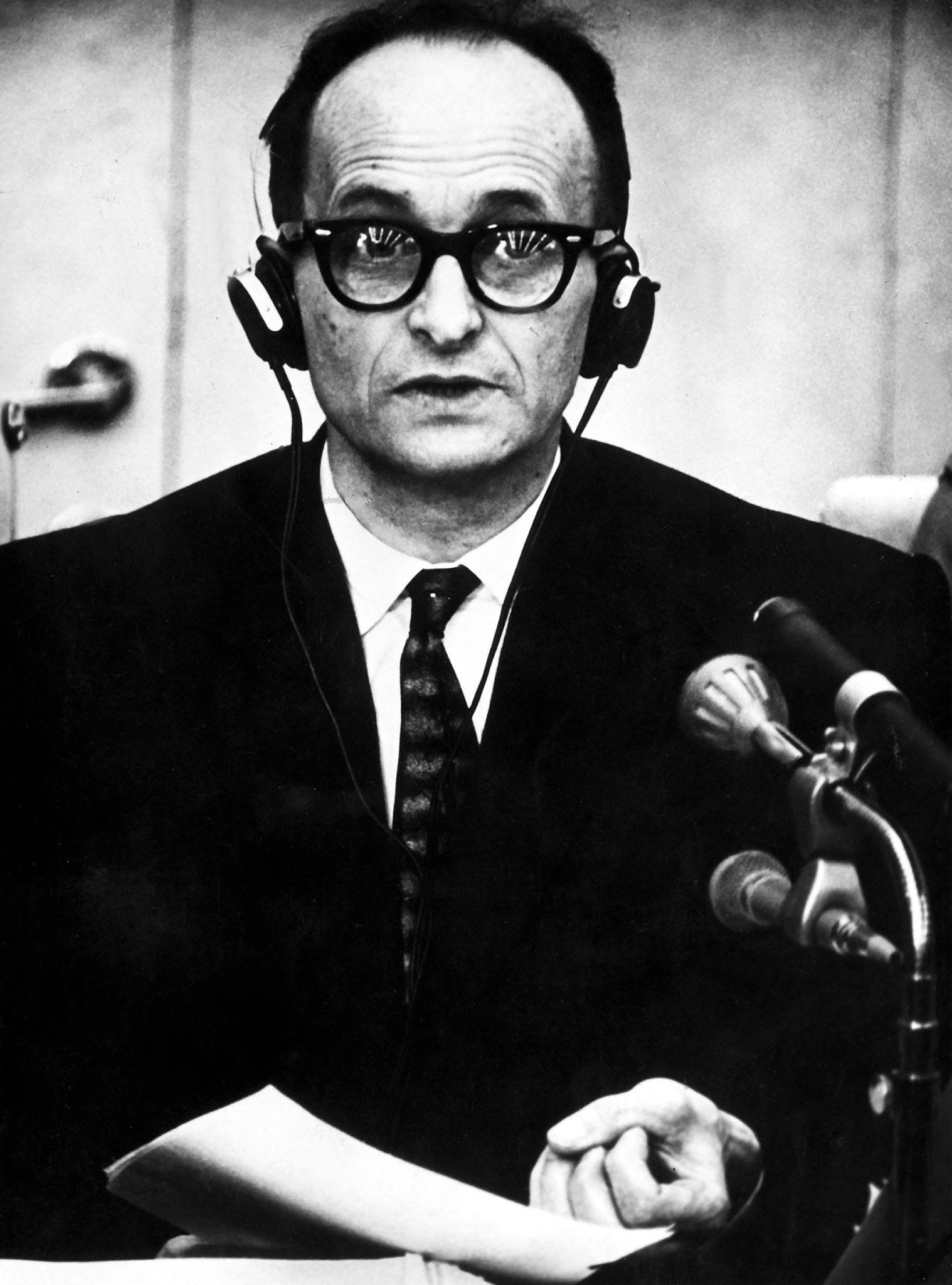
The famed philosopher Hannah Arendt had arrived in Jerusalem in April of 1961 to cover the trial of Eichmann for the New Yorker. Eichmann had been tracked down and captured by Israel’s Mossad in Argentina the year before, with the sole purpose of putting him—a supposedly key functionary of the Nazis’ Final Solution—on trial for his crimes. It had been fifteen years since the Nuremberg trials, but the moral imperative of putting Eichmann on trial (and, to many participating, arriving at a guilty verdict) was as strong in 1961 as it had been in 1945-1946. Arendt did not exactly know what to expect apart from her own disgust at Eichmann’s monstrous crimes: arranging the transportation of millions of European Jews from all over the continent to the locations where they would be slaughtered en masse. But as she watched the middle-aged, bookish-looking man in the glass box at the front of the courtroom, she was shocked at what she heard. She was “surprised to discover on the stand a nondescript man who did not even distinguish himself by a special dislike for Jews,” and believed that “the most striking thing about Eichmann, for a supposed criminal mastermind, was his dullness,” thus making it clear that “Eichmann was monstrous precisely because he was not a monster.”58 Everything about Eichmann, and by extension the Third Reich, was deeply and unsettlingly evil, Arendt began to believe, because of how normal the personification of that evil appeared to be.
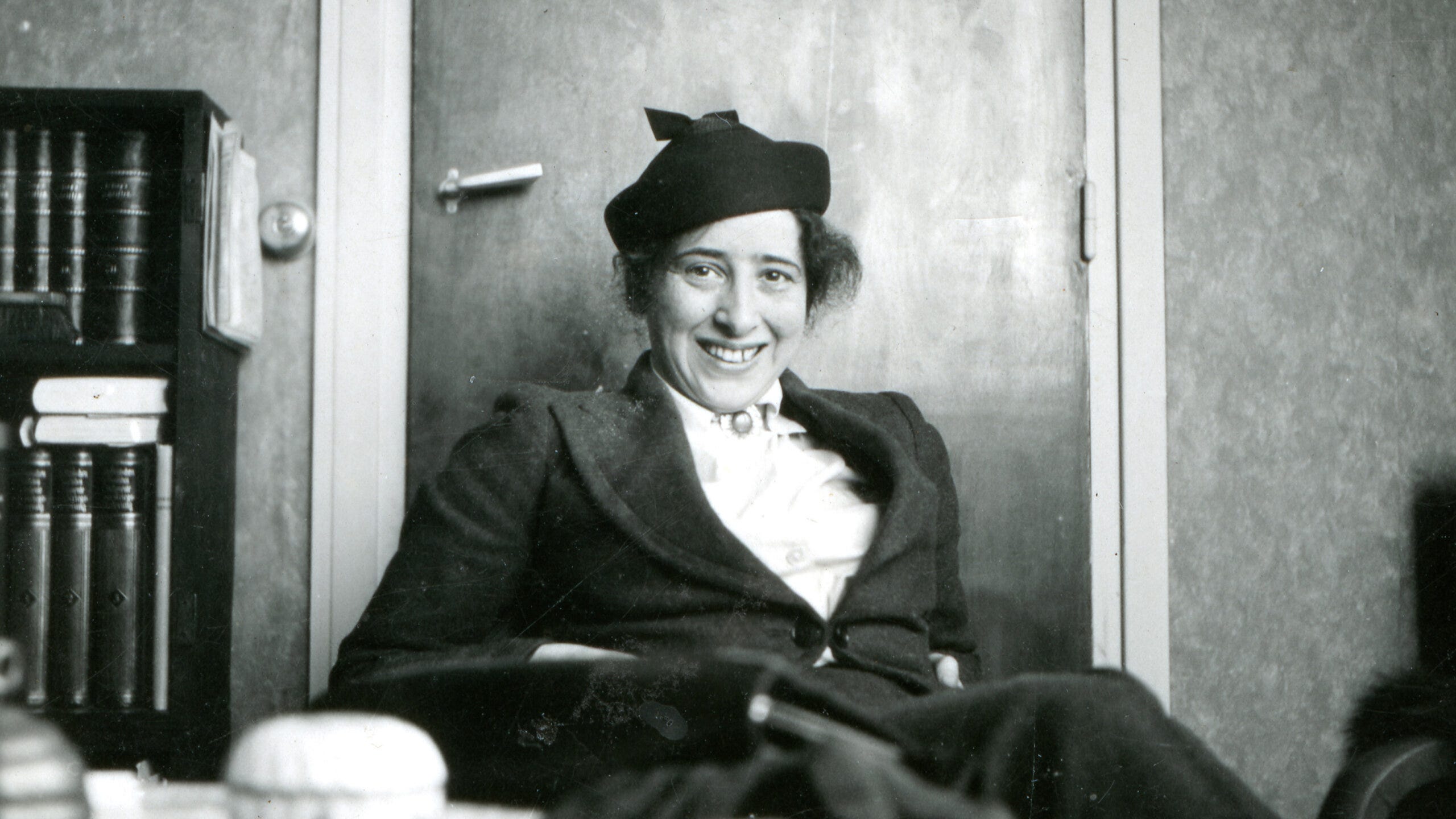
Following the trial and after Eichmann’s unceremonious execution in 1962, Arendt adapted her New Yorker coverage into a full length book, which was published in 1963 under the title Eichmann in Jerusalem: A Report on the Banality of Evil. In her book, she fully fleshed out her case for Eichmann’s normalcy, her book’s subtitle previewing exactly what she was about to lay out. Eichmann had made an impression on Arendt and a number of other observers in the Jerusalem court for a number of reasons. First was his plea of innocence, “to each count Eichmann pleaded: ‘Not guilty in the sense of the indictment,’” along with protests that “’with the killing of Jews I had nothing to do. I never killed a Jew, or a non-Jew, for that matter—I never killed any human being. I never gave an order to kill either a Jew or a non-Jew; I just did not do it,’” though Arendt also wrote that by the end of the trial, “he left no doubt that he would have killed his own father if he had received an order to that effect.”59 His splitting of hairs regarding the question of his guilt (or responsibility) left less of an impression made by “half a dozen psychiatrists [who] had certified him as ‘normal’—’More normal, at any rate, than I am after having examined him,’ one of them was said to have exclaimed,” leading to “the hard fact that his was obviously no case of moral let alone legal insanity.”60
Ultimately, Eichmann was banal, both as a criminal and as a man, who only spoke one language; that is the language of the soulless bureaucrat, one focused only on his career. As she explained, “officialese became his language because he was genuinely incapable of uttering a single sentence that was not a cliche,” leading to the perception by psychiatrists and others that he was indeed normal.61 This made it clear that Eichmann’s “inability to speak was closely connected with an inability to think, namely, to think from the standpoint of somebody else.”62 In Eichmann, Arendt saw the depth of evil that could only be explained by this banality; his cliches lasted to the bitter end as he headed to the gallows and proclaiming that “’We shall meet again,’” to the gathered observers, offering a “lesson of the fearsome, word-and-thought-defying banality of evil.”63 Perhaps most disturbingly of all, Eichmann’s case was generalizable, perhaps to the scale of the Third Reich itself, because “the trouble with Eichmann was precisely that so many were like him, and that the many were neither perverted nor sadistic, that they were, and still are, terribly and terrifyingly normal,” indeed suggesting that “this normality was much more terrifying than all the atrocities put together.”64
The intellectual power of this assessment, as well as Arendt’s clever arguments, cannot be underestimated. Her “courtroom portrait of that quintessentially obedient Holocaust ‘manager’ became a classic, an indispensable starting point of discussion.”65 It was felt in all fields, particularly history where Arendt’s claims created some controversy, including “a storm of denunciations and threats,” with the celebrated historian Barbara Tuchman “[giving] voice to the public anger,” writing in the introduction of Gideon Hausner’s Justice in Jerusalem in 1968 that “’the attractiveness of the thesis is that by shifting guilt onto the victim, it relieves everyone else.’”66 But the power of Arendt’s argument was felt most keenly in the world of psychology. The Third Reich and the Holocaust had certainly not been forgotten among psychological researchers, but it did not still possess the same moral imperative that it had in Kelley’ and Gilbert’s day. Gilbert had continued to practice and write, and was even called to testify during the Eichmann trial, but beyond that, there had not been much in the way of motivation to litigate Nazi evil as there had been. Eichmann’s trial and Arendt’s coverage had changed that, particularly with the young Stanley Milgram.
Whether he was aware of it or not, Milgram had become part of the intellectual lineage forged by the forgotten Kelley-Gilbert debate. This is not to suggest the interest in diagnosing the Third Reich had waned; indeed, as psychologist Robert M. Farr writes, “coming to terms with the Holocaust set the research agenda in social psychology for decades following the end of the war. It was difficult for many to understand, never mind to come to terms with, what had taken place in the death camps.”67 For his part, Milgram had been following the Eichmann trial with great interest and had been “moved and fascinated by Arendt’s controversial thesis,” beginning his experiments only three months after the start of the trial.68 He was among those, like Kelley, who wondered “what if there was nothing demonically ‘special’ any of [the Nazis] at all?” and Arendt’s observations of Eichmann seemed to suggest this, observing as many had, “the machine of the state and the chemistry of the group that was most horrifying.”69 After all, so many Nazis had claimed to be following orders, and there was no reason to disbelieve them, including Eichmann, whose supposed thoughtlessness had been so pointedly observed by Arendt. This was how Milgram conceived of what became known as his series of obedience experiments, conducted between 1961 and 1963 (though planned as early as 1960). There were some variations but the general procedure went as follows:
Under the guise of an experiment on the effects of punishment on learning, the teacher-subject, seated in front of the shock machine, was instructed to give increasingly painful shocks to the learner, who was seated in an adjacent room and not visible to the subject, each time he made an error on the word-matching task [he had been given].70
The most famous variation of the experimental design involved the learner, who was an experimental confederate (that is, who was in on the deception), crying out in pain at increasing severity, eventually going silent, as if to simulate their having lost consciousness—and even dying—from the shocks. Any time the teacher-subject protested or expressed concern during the procedure, the researcher in the room, often dressed in a white lab coat, simply, but firmly, replied that the experiment required the teacher-subject to continue. At the conclusion of the experiments in 1963, Milgram “found that in a controlled laboratory environment, more than 65 percent of his subjects could be readily manipulated into inflicting a (seemingly) lethal electrical charge on a total stranger,” far outweighing the estimated one percent predicted by a group of psychologists and psychology students that Milgram had interviewed prior to the experiments.71
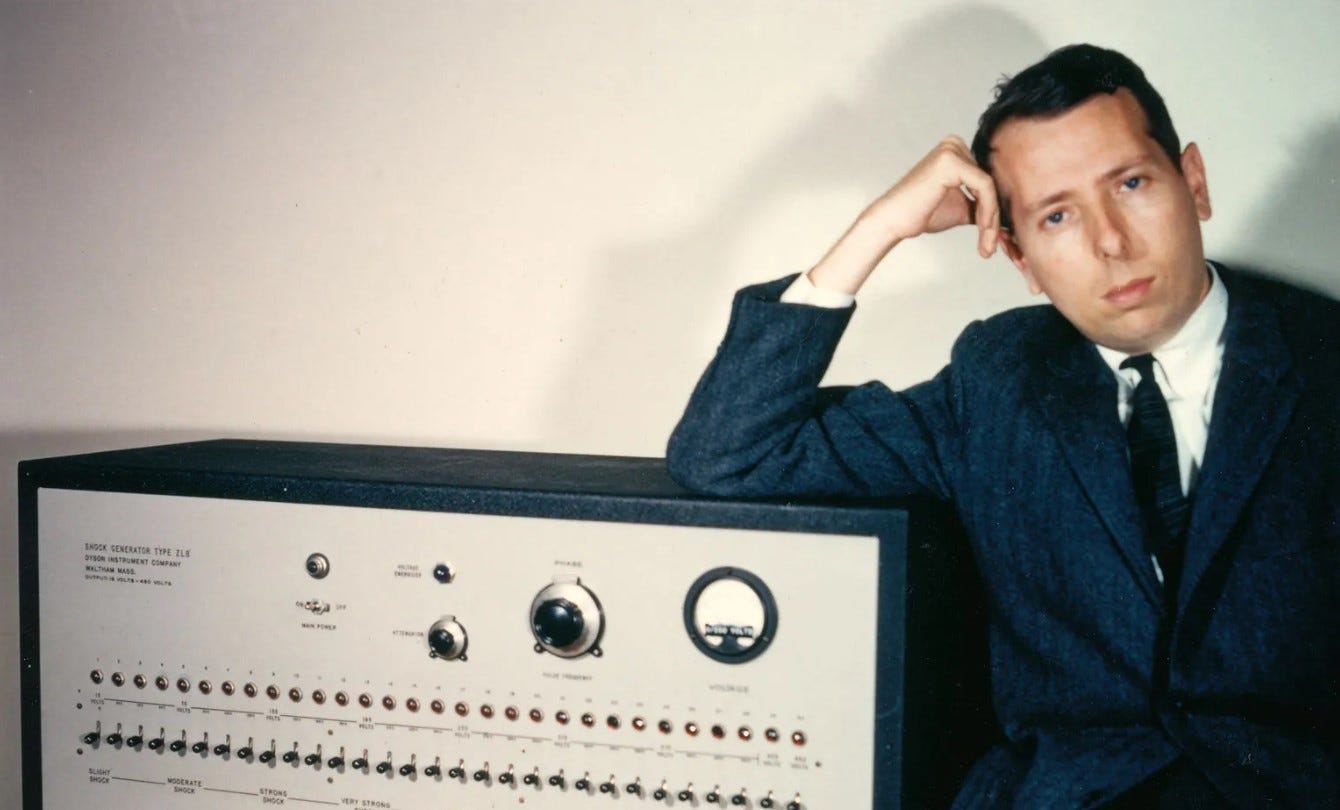
The results were staggering and disturbing to many when they were published in 1963. Milgram claimed that “obedience is the psychological mechanism that links individual action to political purpose,” and believed that the results suggested that “the tendency to obey those whom we perceive to be legitimate authorities” could very easily override “the disposition not to harm other people.”72 This was a difficult prospect for many people to accept, and it became a national story, especially when the New York Times reported that the experiment had “also shown, however, that such people do not enjoy being cruel. In fact, some of the subjects became distraught.”73 This led to a greater backlash, both because of the dark implications suggested about human nature—namely, the apparently then-open question, “was there a hidden Nazi in two-thirds of the good citizens of New Haven?”—but also because “some deemed the experiments unethical,” thanks to the distress caused to the subjects of the experiment.74 As reported in a New York Times review of Milgram’s later book on the subject, “the experiments themselves were a cause of distress and debate among professional psychologists, and Milgram came in for harsh criticism for having both devised and gone through with them,” and he was “accused of unethical practices; in manipulating his subjects and in not protecting them beforehand from what might be the consequences upon them of their behavior in an extremely stress‐filled experimental situation.”75 These accusations have followed his experiments ever since. Nevertheless, Milgram seemed to have proven Hannah Arendt right and demonstrated that his experiment had “provided the scientific underpinnings for [her] ‘banality of evil’ perspective,” by “insist[ing] that such behavior could indeed be studied and, by applying the tools and language of social science, he helped forge a new perspective.”76 Milgram directly addressed the Arendt connection in the book he published in 1974 about the obedience experiments, in which he stated that:
After witnessing hundreds of ordinary people submit to the authority in our own experiments, I must conclude that Arendt’s conception of the banality of evil comes closer to the truth than one might dare to imagine. The ordinary person who shocked the victim did so out of a sense of obligation—a conception of his duties as a subject—and not from any peculiarly aggressive tendencies. This is, perhaps, the most fundamental lesson of our study: ordinary people, simply doing their jobs, and without any particular hostility on their part, can become agents in a terrible destructive process.77 Little did Milgram seem to realize, his perspective had already been suggested, at least to a certain extent, during the Kelley-Gilbert debates in postwar years, but had indeed become largely forgotten by the 1960s and 1970s.
Milgram’s obedience experiments may have been controversial, both then and now, but they nevertheless “endure as a powerful form of folklore, useful in explaining situations in which a person suddenly finds herself doing something untoward.”78 This suggestion about human nature—and thus, the explanation for the Holocaust and diagnosis of the Third Reich—was compounded by similar experiments conducted by social psychologists, including the bystander apathy experiments conducted by John Darley and Bibb Latané in 1968 (which revealed the bystander effect phenomenon, in which intervention became less likely with greater numbers of people present), and even more infamously, the prison experiment conducted at Stanford University in 1971 by Philip Zimbardo (a fellow graduate student of Milgram’s, it should be noted).
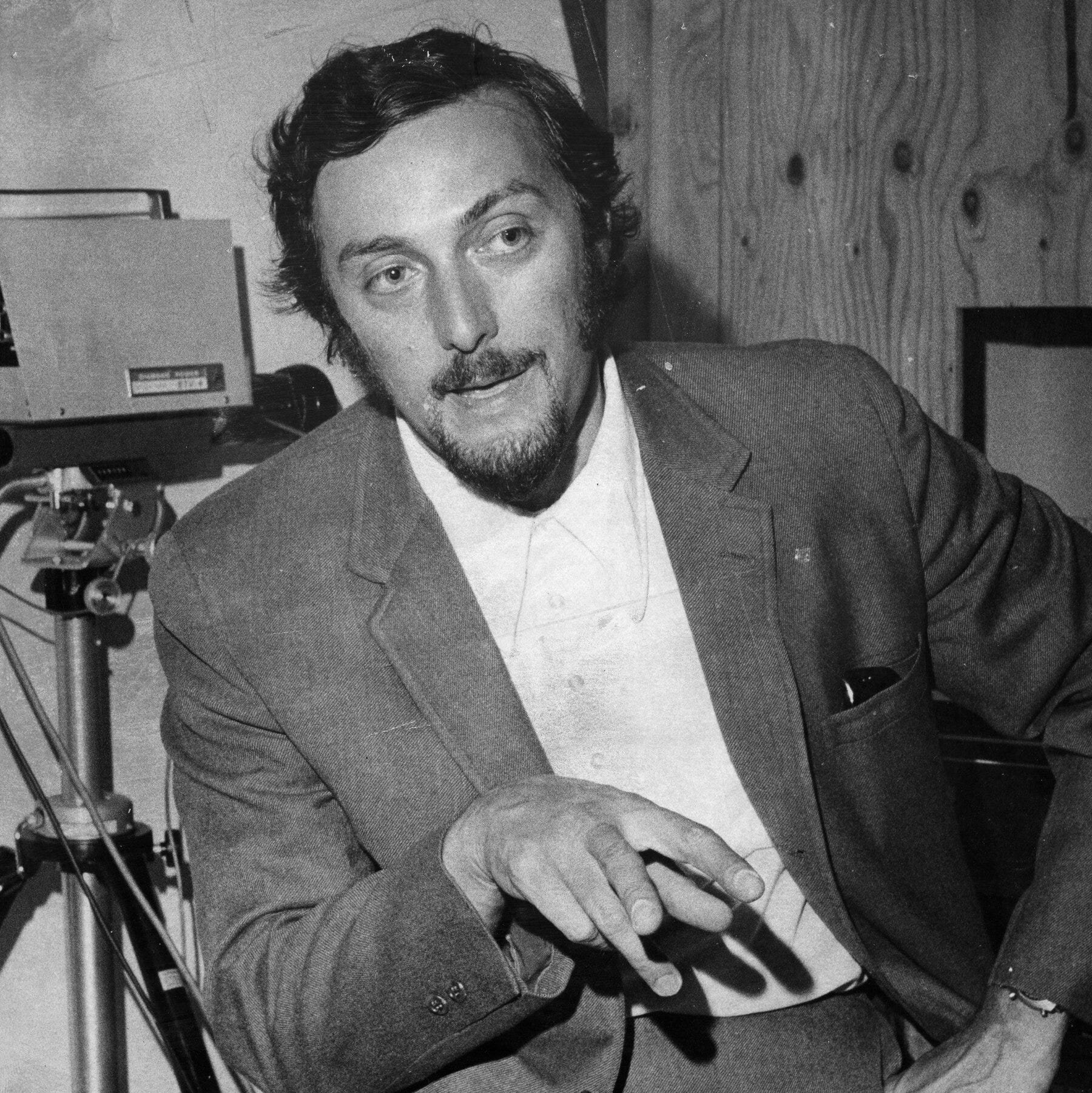
Zimbardo’s experiment, in which “volunteers were told that Stanford was studying prison behaviors and that they would be randomly assigned to be either prisoners or guards in a simulated prison experiment,” quickly ran out of control, with many of the volunteers assigned as guards engaging in their roles with disturbing zeal, leading to Zimbardo canceling the experiment before it had been completed.79 The drama that had unfolded had not necessarily been part of the experimental design but it supposedly had disturbing implications. As Zimbardo himself later explained in the New York Times, “normal, healthy, educated young men could be so radically transformed under the institutional pressures of a ‘prison environment,’” and this suggested that “the subjects’ abnormal social and personal reactions are best seen as a product of their transaction with an environment that supported the behavior that would be pathological in other settings, but was ‘appropriate’ in this prison.”80 The guards’ disturbing behavior—which included abusing and humiliating the prisoners in increasingly creative ways—was not indicative of anything wrong with them psychologically; they were, in fact, merely inhabiting roles. The experiment suggested that “social context alone could foment a phenomenal amount of nastiness,” which in turn suggested that “power corrupted, and brutality emerged.”81 Zimbardo’s prison experiment, even more problematic in its implementation than Milgram’s, had added to the notion posited by Arendt (and by extension Douglas Kelley) that normal, everyday people, and even people deemed intellectual elites like students at Stanford University, were perfectly capable of engaging in monstrous behavior due to socialization. Everyone had, in so many words, an inner Adolf Eichmann.
Given the preexisting ethical questions regarding Milgram’s own experiments, much more scrutiny was given to Zimbardo’s, both on ethical grounds and in terms of his conclusions, with many “critics [arguing] that such studies cannot generalize to the Third Reich” and that his experiment “was like a fraternity hazing gone bad.”82 This is certainly possible, and much evidence was gathered in the decades that followed that challenged the social psychological findings of these various studies and, by extension, Arendt’s assessment of Eichmann and the Third Reich. Critics suggest a flattening had occurred, in which “Milgram can be seen as setting up the scene, Zimbardo start[ed] from the already scripted scene,” and more problematically, “Milgram [had] psychologized the past of the Nazi era,” while “Zimbardo […] pre-empted forms of torture to come, creating, as it where, a rationale for so-called psychological torture.”83 These sorts of problems are rooted in the criticism of the most high-profile social psychological studies conducted in the field’s history (particularly those from Milgram), and those were essentially derived from Hannah Arendt’s observations of Adolf Eichmann. There were indeed problems with both.
In the decades that followed, more information about Nazi war criminals, as well as their motivations, had continued to come to light. Milgram’s conclusions in particular had been challenged on psychological and historical grounds over the decades, with S. Alexander Haslam and Stephen D. Reicher pointing out that “[the banality of evil] thesis loses credibility under close empirical scrutiny,” by its ignoring of “copious evidence of resistance even in studies held up as demonstrating that conformity is inevitable” and of “the evidence that those who do heed authority in doing evil do so knowingly not blindly, actively not passively, creatively not automatically.”84 Other, broader critiques of Milgram’s conclusions involved his use of “strictly monocausal terms,” an assumption “that the process of obedience to authority operates uniformly across levels of a social hierarchy,” and a failure “to describe the type of gradual and irreversible conversion process that […] transformed basically ordinary medical professionals into autonomously evil actors.”85 Other critics pointed out that socialized genocide was insufficient because it provided credence to the Nazis’ frequent defense of just following orders; in fact, “the orders may have provided an opportunity for the expression of more powerful, emotion-based motives,” while “there [was] little or no evidence of moral opposition or distress by the killers,” which contrasted with the behavior of many of Milgram’s subjects (whose experience in a college psychology lab was, it must be said, far different than that of a Wehrmacht soldier on the Eastern Front).86
There was also the matter of Adolf Eichmann and Hannah Arendt’s own conclusions about him. As more information became revealed about the supposedly banal face of evil, it became clear that he was not as much of a boring, cliché-spouting bureaucrat as Arendt had suspected. Indeed, while hiding in Argentina, Eichmann was interviewed by the Dutch Nazi collaborator and member of the Waffen-SS, Willem Sassen. During the course of these interviews, which were eventually published in Life magazine in two parts under the title “Eichmann Tells His Own Damning Story,” Eichmann frankly admitted, as the titles of each installment suggested, “I transported them... to the butcher” and “To sum it all up, I regret nothing.”87 More consequently, tapes of the Sassen-Eichmann interviews were uncovered in 2022, revealing that Eichmann believed “’had we put 10.3 million Jews to death, then I would be content and would say, ‘’Good, we have destroyed the enemy,’‘’” and that “’I didn’t care about the Jews deported to Auschwitz, whether they lived or died.’”88 This completely runs counter to the picture that Arendt painted of Eichmann. This shows that it was not as clear that Arendt’, Milgram’, or Zimbardo’s observations were as definitive as they might appear.
Nevertheless, despite all of these valid critiques of the post-Arendt boom of social psychological assertions about the learned capacity for evil, including Arendt’s own, these assertions remained not just valid, but doctrinaire and popular, especially when seemingly supported by historical evidence, such as that provided by the likes of Christopher Browning in his landmark work Ordinary Men. This helps explain the resistance experienced by later psychologists when they explored the idea that some things were more ingrained than many liked to admit. The developmental psychologist Simon Baron-Cohen observed that human cruelty is very much connected to psychopathic characteristics; that is, that psychopathic individuals have psychopathic brains and thus, when they engage in cruelty, they are doing something that is as much a part of their inner nature than it is something to which they have been socially conditioned. Baron-Cohen explains that “psychopaths are blunted in their moral development,” thanks to a number of factors including an inability to “fear punishment,” and “less of a startle reflex […] to a loud sound or to an object looming toward them,” leading to a diminished or even completely absent capacity for empathy.89 Their brains even register differently on neurological scanners, such as fMRIs and MRIs, particularly in a major part of what Baron-Cohen calls the empathy circuit, or the ventral part of the medial prefrontal cortex (vMPFC), which activates when people think about their own or other people’s feelings. In psychopaths, “just as we might predict, abnormalities in the empathy circuit are seen,” producing “a problem in the frontal lobes because these are meant to provide ‘executive control’ over action, stopping us from doing what could lead to punishment.”90
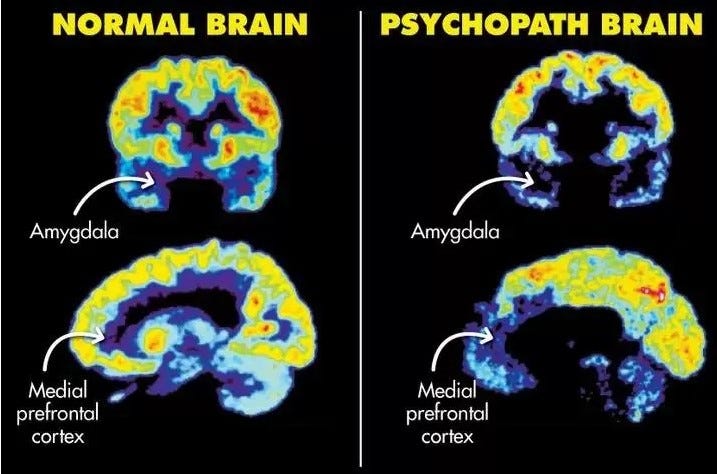
It seems likely that based on many of the previously described assessments of many of the most notorious Nazi war criminals, like Eichmann, or Göring, that they too would have shown similar abnormalities. The lack of available insight or technological capabilities at the time of both trials certainly makes this impossible to say, and it certainly is not to say that the diagnosis of the Third Reich begins and ends with psychopathy. But it does suggest that after Hannah Arendt’s intervention in Jerusalem, there had been a lack of psychological insight that could well have been a boon to everyone interested in diagnosing the Third Reich. That is, of course, excepting the insight that had been provided by both Douglas Kelley and Gustave Gilbert.
…
Primo Levi once stated that “Auschwitz defies ‘understanding,’ or at least understanding in terms of the culprits’ rationality,” while at the same time “reject[ing] the idea that the perpetrators could be categorized, for the most part, as abnormal, especially sadistic individuals.”91 Nevertheless, many tried, especially in the decades following the Second World War, to thread this needle; to explain why so much suffering had been caused by people so supposedly normal in their disposition. That seeming contradiction was explored most famously by Hannah Arendt as she covered the Eichmann trial in 1961, and was furthered by the social psychologists who, instead of looking for previously obtained evidence, simply appeared to take her observations at face value and find evidence that confirmed them. What these psychologists like Stanley Milgram and Philip Zimbardo and others discovered was valuable insight about the nature of phenomena like obedience and role fulfillment and indeed, they appeared to be providing a scientific basis for Arendt’s observations and thus, a profound diagnosis for the Third Reich that, in its own provocative way, implicated everyone.
One can only speculate why the Arendt framing was so intellectually attractive to so many scholars and experts in various fields, but it seems likely that it was an attempt to essentially refute Levi’s observation; after all, to say something so profoundly and tragically human as the Holocaust defies understanding feels like abdicating responsibility. In making these observations that supposedly implicated everyone, however, Arendt’, Milgram’, and Zimbardo’s observations implicated no one. After all, if everyone had a little Eichmann within them, and given how banal he supposedly was like all of us, what made him—an actual war criminal, even partly responsible for the murder of millions—special or even worthy of meaningful condemnation, to say nothing of the death penalty? If anything, by morally flattening the Nazi war criminal into something recognizable in all of us, it calls into question human agency itself, and thus our ability to make destructive choices that deserve punishment of any kind. To say embracing this paradox opens a window for nefarious apologia, revisionism, and justification of unspeakable crimes is putting it mildly.
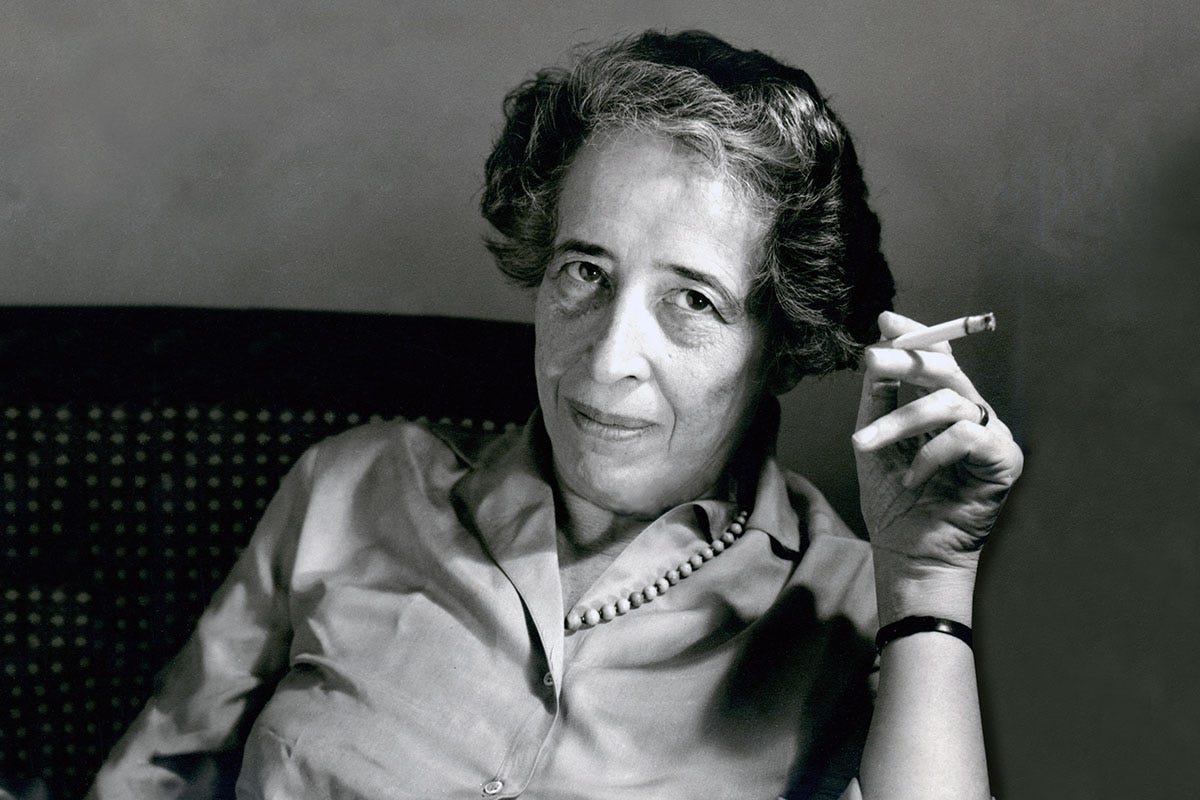
Not only were Arendt’s observations misguided—something she eventually admitted, to far less media attention, after the Frankfurt trials of twenty-two SS guards stationed at Auschwitz in 1963-1965, “giving recognition to the fact that there was another face to the Holocaust besides that of the dutiful bureaucrat”—but their downstream effects on the intellectual history of the Holocaust were profound.92 As Eichmann biographer David Cesarini once wrote, “Anyone writing on the subject today works in the shadow of Hannah Arendt. Her notion of ‘the banality of evil’, combined with Milgram’s thesis on the predilection for obedience to authority, straight-jacketed research into Nazi Germany and the persecution of the Jews for two decades.”93 Her provocative reframing of Eichmann—and thus, Nazi war criminals and the Third Reich in general—as generally banal was such that it inspired the most influential social psychological studies for decades to come—that is, the Milgram and Zimbardo experiments, as well as others following their lead—and thus shaped the development social psychology with very little resistance in either the psychological or historical fields. The impressive work by Holocaust scholars such as Christopher Browning and others who demonstrate that the horror of the Final Solution was the result of social pressures, if only in part, helped reinforce what had become an intellectual tradition, with only slight challenges.
This paper has attempted to make the argument that the true Third Reich diagnosis had already been achieved, at least in a complementary sense by the psychological experts, Douglas Kelley and Gustave Gilbert, appointed to the prisoners at Nuremberg. Neither of their arguments were solely persuasive on their own. Kelley’s heavy focus on the ordinariness of the criminals, including the likely psychopath of Hermann Göring, led to him seeing more of himself and others in them than he probably would have liked, and subsequently underestimated what it would take to convince regular citizens—American, German, or otherwise—to commit monstrous crimes. Gilbert’s focus on the criminals’ pathology as part of an authoritarian and dictatorial value system, inspired by a psychologically unwell Fuhrer that attracted similarly unwell individuals to positions of power, led to him seeing something deeply wrong with German culture at the time of the Third Reich, and likely missing the role that general socialization—significantly part of Kelley’s equation—provided. But instead of contradicting one another, these were complementary insights into Nazi ordinariness and pathology, and later research, inspired by Arendt’s flawed interpretation of Eichmann, missed this opportunity for synthesis, thanks largely to the debate going cold after Kelley’s suicide. As much influence as Arendt’s thesis and the subsequent psychological studies by the likes of Milgram and Zimbardo enjoy, the growing body of evidence bears this out.
What was also lost without the synergy of the Kelley-Gilbert debate leaving room for these developments is the role of agency in the actions of criminals, both in the context of an authoritarian state and in the context of pathological behavior. As Daniel Pick has explained, “something like Nazism might be commonplace in ‘us’ [but] this thought has always had to be balanced against the fact that there is no equivalent of, or precedent for, Auschwitz.”94 This balance was never properly struck, despite a few less-known monographs engaging with the debate in the decades that followed that mostly focused on Kelley’ and Gilbert’s use of Rorschach tests, but it might indeed have been if the arguments made by Kelley and Gilbert had been synthesized into one, and we do see this when looking at both the margins of historical and psychological research.
For example, in the 1980s, the psychologist and historian Robert Jay Lifton had interviewed many former Nazis, especially those who had taken part in medical experimentation and atrocities, and come to the conclusion that things were more complex than learned or socialized savagery. Contra Arendt’s (and by extension Milgram and Zimbardo’s) assertions, Lifton explained, the Nazis were not “faceless bureaucratic cogs or automatons,” and were, in fact, “actors and participants who manifested certain kinds of behavior for which they were responsible.”95 In other words, Lifton’s theory of the case was that while the Nazis were indeed ordinary human beings, they fundamentally made themselves extraordinary by doing what they did. Lifton emphasized the fact that “in order to [perform demonic acts] the men themselves changed,” and even went so far to reframe what killing innocent people actually meant: a medicalized form of “killing as a therapeutic alternative,” all in service of a biomedical vision of the world driven solely—particularly, uniquely, in other words—by Nazi ideology, which could be called a “biocracy,” or a type of “theocracy, a system of rule by priests of a sacred order under the claim of divine prerogative […] of cure through purification and revitalization of the Aryan race.”96
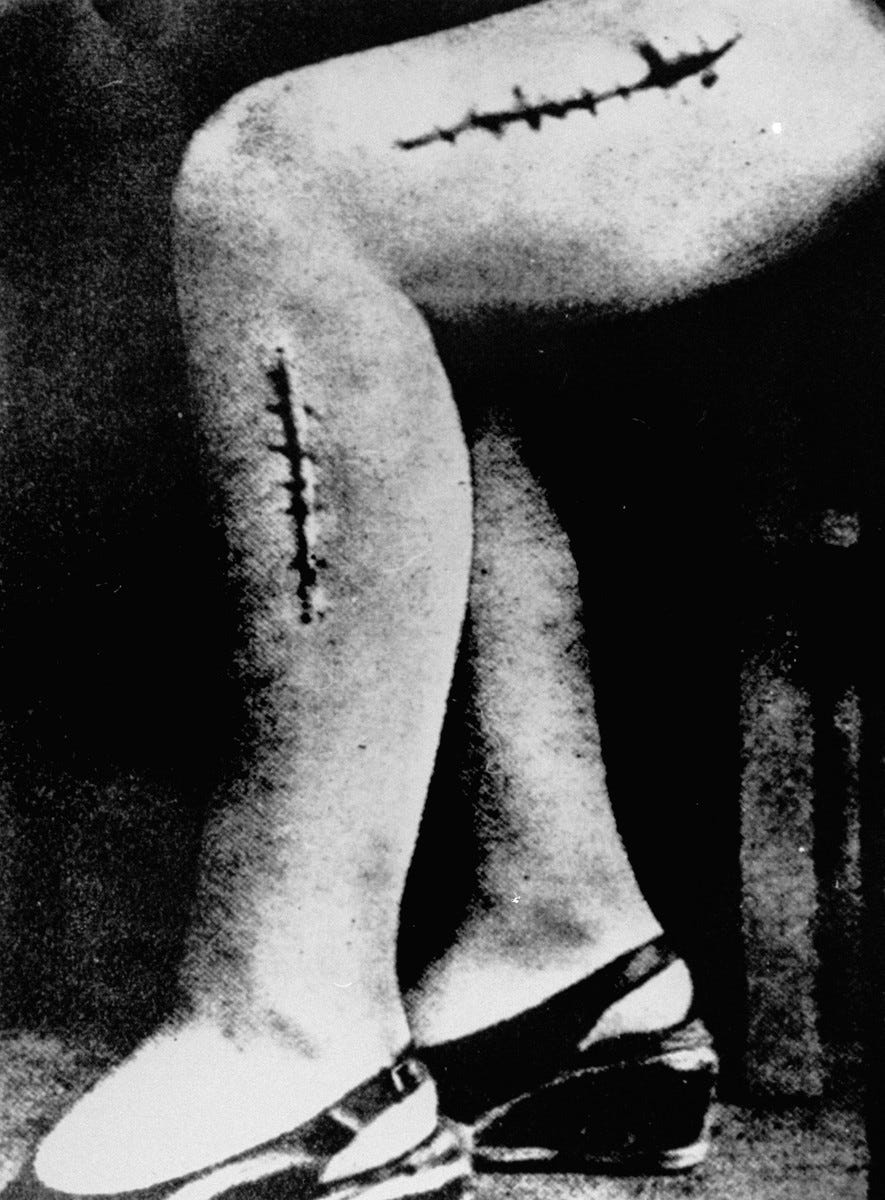
Lifton had managed to nuance the arguments that had been taken for granted among many social psychologists and a growing number of historians by particularizing Nazi ideology in this way. He also particularized the perpetrators via his observations on the “doubling” that so many of the titular Nazi doctors engaged in to justify their actions, where there is a “division of the self into two functioning wholes, so that a part-self acts as an entire self” in which the “humane self can be joined by a ‘professional self’ willing to ally itself with a destructive project, with harming or even killing others,” and, thanks to the biomedical vision of Nazism, allowed them to believe that “if you are curing a sickness, anything is permissible.”97 When examining Lifton’s arguments, one starts to see a striking similarity to Gilbert’s own assertions about the war criminals’ socialization played a part in allowing them to develop a true pathology, which was indeed unique to Nazism, but never downplaying the notion that the Nazis were indeed people with motives and defense mechanisms recognizable to the rest of us, per Kelley’s own assertions.
Insights like Lifton’s, however unwittingly synthesizing the Kelley-Gilbert debate, would echo through the emerging field of perpetrator studies, which aims to bring nuances like his to bear when explaining the human capacity for evil in a way that avoids the monocausal trap unwittingly laid by Arendt. As criminologist Augustine Brannigan explains, given the wealth of both historical and psychological evidence we have gathered over the decades since World War II, the Nazis’ ability to “produce an over-control over their citizenry” to make them complicit and participants in genocide was “not a function of obedience to bureaucratic authority, but an overidentification with the political leadership that cultivates a powerful sense of duty characterized by both pathological altruism and a sense of fatalism,” which was, as it happened, “reflected in Eichmann’s testimony” in 1961.98 In addition, perpetrator studies expert Alette Smuelers—ultimately a defender of Arendt’s thesis—acknowledges that “obedience, conformity, group dynamics,” do indeed play a part in genocide, but so too do “many other social-psychological mechanisms,” leading to a true multi-variate explanation lacking in the previous scholarship derived from Arendt’s conclusions.99 However, synthesizing Kelley’ and Gilbert’s arguments made eighty years ago accomplishes the same thing. Kelley and Gilbert both saw the criminals of the Third Reich for what they were: complicated individuals that were part of a singularly-minded ideological system that, in the end, necessitated the genocide of a supposedly eternal enemy. While it is certainly a shame that an opportunity for a more accurate Third Reich diagnosis was missed as the Kelley-Gilbert debate moldered following the Nuremberg trials, leading to decades of compelling, if still inadequate, theorizing, one can also reasonably say that it is better late than never.
Better late than never though this may be, this delay in diagnosing the Third Reich may also suggest something deeper: that there were, and thus always will be, limitations to psychologizing history. The limitations of psychologizing historical figures long dead is problematic enough, but how does one psychologize something as complex as a society, particularly one as chaotic as the Third Reich? A society is made up of individual people, each with their own motivations, dreams, fears; that level of granularity makes it incredibly difficult to generalize, perhaps even impossible, especially many decades on. And lest we forget, cultural and political norms, as well as historical circumstance, can easily overwhelm our understanding of individual psychology, and neglect the role of agency. In addition, by focusing on the pathologies of the leaders or the social forces that help facilitate their will, it potentially neglects factors like institutional capture or even breakdown. While it is certainly possible that understanding the mind of an all-encompassing personality like Adolf Hitler can be accomplished through thorough biographical analysis, how can one be certain that understanding him, or understanding any of the Third Reich’s leadership, allow us to accurately understand—or diagnose—the whole of German society that lived under their collective boot? We may be able to understand the psychological contours of the Third Reich’s system and the personalities of those who directed it, but to claim that this gives us a window into the soul of an ordinary German—from the small town baker that voted for the NSDAP in 1933, to the Einsatzcommando with the blood of a hundred innocents on his hands—is quite possibly a fool’s errand.

BIBLIOGRAPHY
Primary Sources
Arendt, Hannah. Eichmann in Jerusalem: A Report on the Banality of Evil. New York: Viking Press, 1963.
Bell, Daniel. “Is Eichmann in All of Us?” New York Times, May 26, 1974. Accessed via: https://www.nytimes.com/1974/05/26/archives/is-eichmanna-in-all-of-us-eichmann-in-us-all.html?searchResultPosition=14.
Elms, Alan C. “The Crisis of Confidence in Social Psychology,” American Psychologist (October 1975), 967-976.
Freud, Anna. The Ego and Mechanisms of Defense, rev. ed. London: Karnac Books, 1966. Accessed via: https://psptraining.com/wp-content/uploads/Freud-A.-1936-1993.The-ego-and-the-
mechanisms-of-defence.-London-Karnac-Books.pdf.
Gilbert, Gustave M. Nuremberg Diary. New York: Farrar, Straus, & Cudahy, 1947.
Gilbert, Gustave M. The Psychology of Dictatorship: Based on an Examination of the Leaders of Nazi Germany. New York: The Ronald Press Company, 1950.
Goldensohn, Leon. The Nuremberg Interviews: An American Psychiatrist’s Conversations with the Defendants and Witnesses, edited by Robert Gellately. New York: Alfred A. Knopf, 2004.
Kelley, Douglas M. 22 Cells in Nuremberg: A Psychiatrist Examines the Nazi Criminals. London: W.H. Allen, 1947.
Lifton, Robert Jay. The Nazi Doctors: Medical Killing and the Psychology of Genocide. New York: Basic Books, Inc., 1986.
Marcus, Steven. “Obedience to Authority An Experimental View. By Stanley Milgram. illustrated. 224 pp. New York: Harper & Row.” New York Times, January 13, 1974. Accessed via: https://www.nytimes.com/1974/01/13/archives/obedience-to-authority-an-experimental-view.html?searchResultPosition=10.
Milgram, Stanley. Obedience to Authority: An Experimental View. New York: Harper & Row, 1974.
Milgram, Stanley. “Behavioral Study of Obedience,” The Journal of Abnormal and Social Psychology 67, no. 4 (1963), 371-378.
New York Times Editorial. “Hitler Power Seen in Middle Class; Dorothy Thompson, Back From Germany, Calls Him ‘Apotheosis of the Little Man.’” New York Times, May 12, 1933. Accessed via: https://www.nytimes.com/1933/05/12/archives/hitler-power-seen-in-middle- class-dorothy-thompson-back-from.html.
Orwell, George. “Wells, Hitler, and the World State,” in Critical Essays. London: Secker & Warburg, 1946). Accessed via: https://www.telelib.com/authors/O/OrwellGeorge/essay/CriticalEssays/wells_hitler.html
Ring, Kenneth. “Experimental Social Psychology: Some Sober Questions About Some Frivolous Values.” Journal of Experimental Social Psychology 3 (1967), 113-123.
Sullivan, Walter. “65% in Test Blindly Obey Order to Inflict Pain; Yale Experiment Shows Many Became Distraught Over Cruelty but Did Not Stop.” New York Times, October 26, 1963. Accessed via: https://www.nytimes.com/1963/10/26/archives/65-in-test-blindly-obey-order-to-inflict-pain-yale-experiment-shows.html?searchResultPosition=5.
Thompson, Dorothy. Let the Record Speak. Boston: Houghton Mifflin Company, 1939.
Zimbardo, Philip. “The Mind is a Formidable Jailer.” New York Times, April 8, 1973. Accessed via: https://www.nytimes.com/1973/04/08/archives/a-pirandellian-prison-the-mind-is-a-formidable- jailer.html?searchResultPosition=12.
Secondary Sources
Baron-Cohen, Simon. The Science of Evil: On Empathy and the Origins of Cruelty. New York: Basic Books, 2011.
Blass, Thomas. The Man Who Shocked the World: The Life and Legacy of Stanley Milgram. New York: Basic Books, 2004.
Brannigan, Augustine. Beyond the Banality of Evil: Criminology and Genocide. Oxford, UK: Oxford University Press, 2013.
Cesarini, David. Becoming Eichmann: Rethinking the Life, Crimes, and Trial of a “Desk Murderer”. Boston: Da Capo Press, 2006.
Dimsdale, Joel E. Anatomy of Malice: The Enigma of the Nazi War Criminals. New Haven, CT: Yale University Press, 2016.
De Vos, Jan. “From Milgram to Zimbardo: The Double-Birth of Postwar
Psychology/Psychologization.” History of the Human Sciences 23, no. 5 (2010), 156-175.
El-Hai, Jack. The Nazi and the Psychiatrist: Hermann Göring, Dr. Douglas M. Kelley, and a Fatal Meeting of the Minds at the End of World War II. New York: MJF Books, 2013.
Farr, Robert M. The Roots of Modern Social Psychology, 1872-1954. Oxford, UK: Blackwell Publishers, 1996.
Fenigstein, Allan. “Milgram’s Shock Experiments and the Nazi Perpetrators: A Contrarian Perspective on the Role of Obedience Pressures During the Holocaust.” Theory and Psychology 25, no. 5 (2015), 581-598.
Gordon, Peter E. “What is Intellectual History? A frankly partisan introduction to a frequently misunderstood field.” Unpublished manuscript, Harvard University, revised Spring 2012.
Grossman, Dave. On Killing: The Psychological Cost of Learning to Kill in War and Society. Boston: Back Bay Books, 1995.
Haslam, S. Alexander, and Reicher, Stephen D. “Contesting the ‘Nature’ of Conformity: What the Milgram and Zimbardo Studies Really Show.” Public Library of Service Biology 10, no. 11 (2012), 1-4.
Hirsch, Francine. Soviet Judgment at Nuremberg: A New History of the International Tribunal After WWII. Cambridge, UK: Oxford University Press, 2020.
Lemov, Rebecca. World as Laboratory: Experiments with Mice, Mazes, and Men. New York: Hill and Wang, 2005.
Mandel, David. “The Obedience Alibi: Milgram’s Account of the Holocaust Reconsidered.” Analyse & Kritik: Zeitschrift fürSozialwissenschaften 20 (1998), 74-94.
Pick, Daniel. The Pursuit of the Nazi Mind: Hitler, Hess, and the Analysts. Oxford, UK: Oxford University Press, 2012.
Rees, Lawrence. The Nazi Mind: Twelve Warnings from History. New York: Public Affairs, 2025.
Smeulers, Alette, Maartje Weerdesteijn, Barbora Hola, eds. Perpetrators of International Crimes: Theories, Methods, and Evidence. Oxford, UK: Oxford University Press, 2019.
NOTES:
1. Robert Houghwout Jackson Papers, box 107 (Library of Congress), quoted in Joel E. Dimsdale, Anatomy of Malice: The Enigma of the Nazi War Criminals (New Haven, CT: Yale University Press, 2016), 58.
2. Ibid., 59.
3. Douglas Kelley, “Preliminary Studies of the Rorschach Records,” 45-48, quoted in Dimsdale, Anatomy of Malice, 80.
4. Peter E. Gordon, “What is Intellectual History? A frankly partisan introduction to a frequently misunderstood field.” Unpublished manuscript (Cambridge, MA: Harvard University, revised Spring 2012), 2.
5. Daniel Pick, The Pursuit of the Nazi Mind: Hitler, Hess, and the Analysts (Oxford, UK: Oxford University Press, 2012), 9.
6. Ibid., 10.
7. Ibid., 24, 101.
8. “Hitler Power Seen in Middle Class; Dorothy Thompson, Back From Germany, Calls Him ‘Apotheosis of the Little Man.’” New York Times, May 12, 1933.
9. Ibid., 16, 17.
10. Anna Freud, The Ego and Mechanisms of Defense, rev. ed. (London: Karnac Books, 1966), 120.
11. Pick, The Pursuit of the Nazi Mind, 19.
12. Ibid., 32-33.
13. Ibid., 149.
14. Ibid., 139.
15. Ibid., 87.
16. Dorothy Thompson, Let the Record Speak (Boston: Houghton Mifflin Company, 1939), 217.
17. George Orwell, “Wells, Hitler, and the World State,” in Critical Essays (London: Secker & Warburg, 1946), 98.
18. Pick, The Pursuit of the Nazi Mind, 172.
19. Laurence Rees, The Nazi Mind: Twelve Warnings from History (New York: Public Affairs, 2025), 316.
20. Dimsdale, Anatomy of Malice, 63-64.
21. Douglas M. Kelley, 22 Cells in Nuremberg: A Psychiatrist Examines the Nazi Criminals (London: W.H. Allen, 1947), 12.
22. Ibid., 204, 235.
23. Ibid., 237.
24. Ibid., 239.
25. Ibid., 51.
26. Jack El-Hai, The Nazi and the Psychiatrist: Hermann Göring, Dr. Douglas M. Kelley, and a Fatal Meeting of the Minds at the End of World War II (New York: MJF Books, 2013), 210.
27. Dimsdale, The Anatomy of Malice, 152.
28. Kelley, 22 Cells in Nuremberg, 76.
29. Ibid., 52, 64-65.
30. Ibid., 75-76.
31. Leon Goldensohn, The Nuremberg Interviews: An American Psychiatrist’s Conversations with the Defendants and Witnesses, ed. by Robert Gellately (New York: Alfred A. Knopf, 2004), 101.
32. Ibid., 118.
33. Dimsdale, The Anatomy of Malice, 64.
34. Ibid., 144, 145.
35. Gustave M. Gilbert, Nuremberg Diary (New York: Farrar, Straus, & Cudahy, 1947), 10.
36. Pick, The Pursuit of the Nazi Mind, 177.
37. Gustave M. Gilbert, The Psychology of Dictatorship: Based on an Examination of the Leaders of Nazi Germany (New York: The Ronald Press Company, 1950), 6, 14.
38. Ibid., 64.
39. Ibid., 299-300.
40. Ibid., 304.
41. Francine Hirsch, Soviet Judgment at Nuremberg: A New History of the International Tribunal After WWII (Cambridge, UK: Oxford University Press, 2020), 231.
42. Ibid., 232.
43. Dimsdale, The Anatomy of Malice, 93.
44. Gilbert, The Psychology of Dictatorship, 100.
45. Ibid., 102.
46. Ibid., 106.
47. Ibid., 109.
48. Goldensohn, Nuremberg Interviews, 119.
49. Ibid., 130, 131-132.
50. Gilbert, Nuremberg Diary, 397.
51. Rees, The Nazi Mind, 316.
52. Kelley, 22 Cells in Nuremberg, 3.
53. Gilbert, The Psychology of Dictatorship, 297.
54. Dimsdale, The Anatomy of Malice, 146.
55. Ibid., 148.
56. Daniel Bell, “Is Eichmann in All of Us?” New York Times, May 26, 1974.
57. Ibid.
58. Rebecca Lemov, World as Laboratory: Experiments with Mice, Mazes, and Men (New York: Hill and Wang, 2005), 226, 227.
59. Hannah Arendt, Eichmann in Jerusalem: A Report on the Banality of Evil (New York: Viking Press, 1963), 21, 22.
60. Ibid., 25, 26.
61. Ibid., 48.
62. Ibid., 49.
63. Ibid., 252.
64. Ibid., 276.
65. Pick, The Pursuit of the Nazi Mind, 246.
66. Dimsdale, Anatomy of Malice, 168.
67. Robert M. Farr, The Roots of Modern Social Psychology, 1872-1954 (Oxford, UK: Blackwell Publishers, 1996), 153.
68. Lemov, World as Laboratory, 227.
69. Pick, The Pursuit of the Nazi Mind, 219.
70. Thomas Blass, The Man Who Shocked the World: The Life and Legacy of Stanley Milgram (New York: Basic Books, 2004), 94.
71. Dave Grossman, On Killing: The Psychological Cost of Learning to Kill in War and Society (Boston: Back Bay Books, 1995), 141.
72. Stanley Milgram, “Behavioral Study of Obedience,” The Journal of Abnormal and Social Psychology 67, no. 4 (1963), 371, 378.
73. Walter Sullivan, “65% in Test Blindly Obey Order to Inflict Pain; Yale Experiment Shows Many Became Distraught Over Cruelty but Did Not Stop,” New York Times, October 26, 1963.
74. Lemov, World as Laboratory, 227.
75. Steven Marcus, “Obedience to Authority An Experimental View. By Stanley Milgram. illustrated. 224 pp. New York: Harper & Row,” New York Times, January 13, 1974.
76. Blass, The Man Who Shocked the World, 268.
77. Stanley Milgram, Obedience to Authority: An Experimental View (New York: Harper & Row, 1974), 5-6.
78. Lemov, World as Laboratory, 227.
79. Dimsdale, The Anatomy of Malice, 178.
80. Philip Zimbardo, “The Mind is a Formidable Jailer,” New York Times, April 8, 1973.
81. Dimsdale, The Anatomy of Malice, 179.
82. Ibid.
83. Jan De Vos, “From Milgram to Zimbardo: The Double-Birth of Postwar Psychology/Psychologization.” History of the Human Sciences 23, no. 5 (2010), 171, 172.
84. S. Alexander Haslam & Stephen D. Reicher, “Contesting the ‘Nature’ of Conformity: What Milgram and Zimbardo’s Studies Really Show,” Public Library of Service Biology 10, no. 11 (2012), 3.
85. David Mandel, “The Obedience Alibi: Milgram’s Account of the Holocaust Reconsidered,” Analyse & Kritik: Zeitschrift fürSozialwissenschaften 20 (1998), 5, 6, 7.
86. Allan Fenigstein, “Milgram’s Shock Experiments and the Nazi Perpetrators: A Contrarian Perspective on the Role of Obedience Pressures During the Holocaust,” Theory and Psychology 25, no. 5 (2015), 589, 594.
87. “Eichmann Tells His Own Damning Story,” Life, November 28, 1960 & December 10, 1960.
88. Nirit Anderman, “Long-lost Recordings of Eichmann Confessing to the Final Solution Revealed,” Haaretz, May. 23, 2022.
89. Simon Baron-Cohen, The Science of Evil: On Empathy and the Origins of Cruelty (New York: Basic Books, 2011), 78, 80.
90. Ibid., 29, 81.
91. Pick, The Pursuit of the Nazi Mind, 251-252.
92. Blass, The Man Who Shocked the World, 276.
93. David Cesarini, Becoming Eichmann: Rethinking the Life, Crimes, and Trial of a “Desk Murderer” (Boston: Da Capo Press, 2006), 15.
94. Pick, The Pursuit of the Nazi Mind, 249.
95. Robert Jay Lifton, The Nazi Doctors: Medical Killing and the Psychology of Genocide (New York: Basic Books, Inc., 1986), 5.
96. Ibid., 12, 15, 17.
97. Ibid., 418, 464, 488.
98. Augustine Brannigan, Beyond the Banality of Evil: Criminology and Genocide (Oxford, UK: Oxford University Press, 2013), 206.
99. Alette Smuelers, “Historical Overview of Perpetrator Studies,” in Alette Smuelers, Maartje Weerdesteijn, Barbora Hola, eds. Perpetrators of International Crimes: Theories, Methods, and Evidence (Oxford, UK: Oxford University Press, 2019), 19.
The notion of "banality of evil" for me is encapsulated in these words from an iconic song. It explains not just WW2
Country in depression
Nation in despair
One man seeking reasons everywhere
Growing hate and anger
The fuhrer's orders are precise
Who is to be blamed and sent to die!
On one hand, we can definitely look at Germany now, look at Germany before and separate the Nazi crimes from the wider German people. But on the other hand, Nazi are, regrettably, a product of their time, inevitable in a kind of historic sense. The conditions that happened in the late Weimar republic did resolve in a radical movement taking the power.
A very interesting notion of this article is that Nazi psychological analysis was a very necessary direction of study to answer a question in court "can a man testify for himself?" and as such was a widely requested study. I never thought of it this way as a judicial necessity and not just as a fascination of some. Thank you for providing such a detailed insight into the topic. Also it is very empowering to see a podcast host taking the academic degree and writing scientific articles in a style, familiar from your presentation of your podcasts. I wish you all the best on your journey in this direction!