



Let me start by saying, as a way of throat-clearing, I am not a fan of the health insurance industry in the United States. I don’t have a burning hatred for it, but you won’t see me trying to claim it’s amazing or that there isn’t something somewhat ghoulish about combining profit-seeking and human health.
But with that said, if Ted Kaczynski’s brother isn’t on your side, you’re probably on the wrong side of an argument. Or at least one that isn’t as clear-cut as many are claiming it is.
In the wake of the terroristic assassination of UnitedHealthCare CEO Brian Thompson, I can’t say I’m surprised that there were people who would celebrate the killing. I was and remain relatively ambivalent about the act beyond simply seeing it as, like I just said, an act of domestic terrorism and a tragedy for Thompson’s family.1 My surprise built, however (and turned into disgust) as I saw very little attempt at anything resembling actual humor or even irony being expressed. All I saw was contemptuous cheerleading. Nihilistic humor can be funny, but the nihilism on display was anything but. It was just empty, devoid of commentary except repeated catechisms about how “evil” insurance companies supposedly are from people who, from what it appears, have little to no idea how they work as entities. As I said at one point, the commentary reminded me less of the gallows humor we saw following 9/11, COVID, or other mass tragedies, and more of the humorless kind commentary we saw from the likes of Osama bin Laden. Zero irony, zero self-awareness; just self-righteous rage. It was a sign and one that will remain with me for some time to come.
There have been some examples of funny commentary on this whole thing, including the hilarious comedians Sam Morril and Matt McCusker bantering about the killer’s stop-over at Starbucks. There was also a fantastic meme worth sharing here that went down the ethnic comedy route:
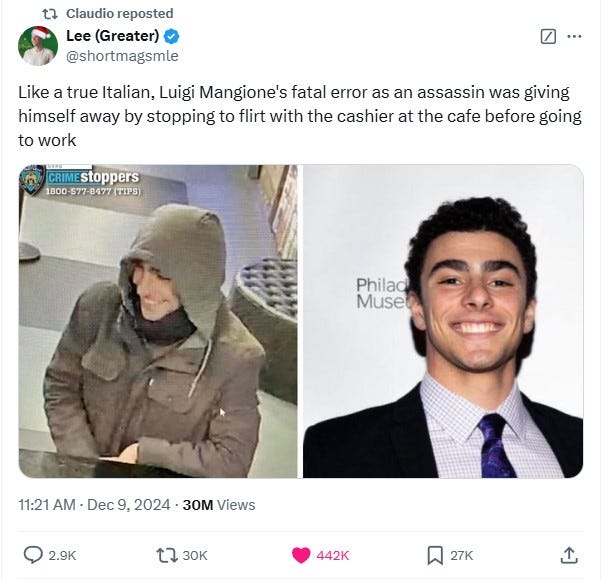
Unfortunately, these seemed to be diamonds in the rough. Most memes seemed dedicated to deifying the guy or simply thirsting after him for being a total Italian stallion. This is why the real irony came from the impulse I shared with many people to have a humorless response to the humorless cheerleading. I managed to get my own off-color joke in when the inevitable sexual thirst for the shooter—whose name I won’t repeat, both because he doesn’t deserve the attention, and because it’s just too goofy—began to make the rounds. Instead of repeating it here, I’ll just provide a screenshot.
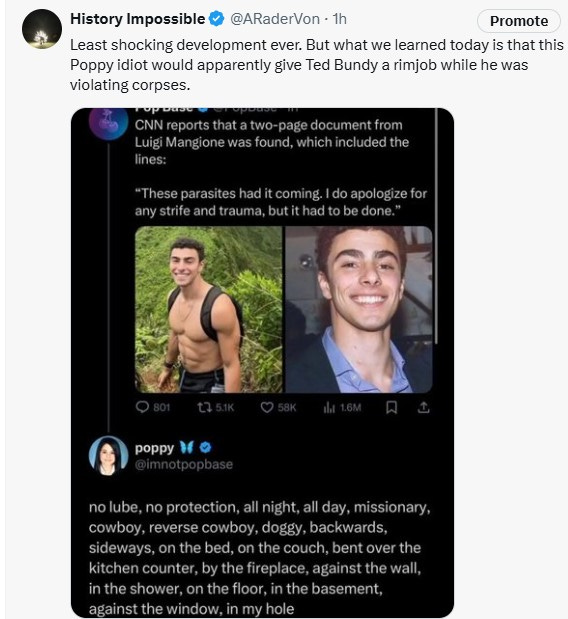
Not my proudest moment or by far the funniest joke I’ve ever made, but damn it, I do think it’s funnier than anything I’ve seen celebrating Thompson’s execution.
Regardless, there is a fair amount to unpack, and most of it has to do with my own feelings on this sordid event and even more sordid response, mostly because it’s starting to feel like I’m on the opposite side of the argument from most of my friends and comrades on this issue. I begrudge no one as human beings for having their own opinions on this event—I share Greg Lukianoff’s view that we should absolutely be free to celebrate whatever the hell we want, even if we don’t approve of it or think it’s a bad idea—and I don’t even begrudge people for thirsting after an obviously very handsome man. People can feel whatever they want; conversely, I can judge their interpretation of things however I want.
However, what I can’t seem to get past is the rampant hypocrisy, obvious emotional coping, and complete lack of meaningful moral principles disguised as having the best kind of moral principles, that have all been attached to this story via the people most rabidly celebrating the slaughter of a man they didn’t even know existed over a week ago.
…
It’s been made clear in the past couple of weeks that United HealthCare was not a great place when it came to claim denials; Josh Szeps discussed these at length on his recent podcast discussing the ethics of the assassination (and generally the ethics of murder) with philosopher Tim Dean, and it’s worth listening/watching in full, especially because I don’t feel like reiterating all of the different ways that United HealthCare is, in many ways, a pretty wretched company on an ethical level (when there is a one in three chance that the company who insures you will deny your claims, it may be good for shareholders, but it’s not good by pretty much any other metric).
However, the oft-repeated claim—including by Columbia professors cheerleading murder—that companies like United HealthCare are directly responsible for 26,000 deaths every year needs to be addressed, because it is another classic example of bad statistical analysis (or let’s be honest: a complete lack of statistical analysis and rather just a number used to create a moral gut punch). This 26,000 number I’ve been seeing appears to be coming from a National Institutes of Health analysis from 2008; a more updated number comes from an article on the Physicians for a National Health Program (PNHP) site that claims a pretty wide range of 40,000 to 80,000. The point is, those numbers are big and therefore scary and therefore the kind of people that make those numbers happen are evil and should be killed; that is the thinking, it seems, behind the folk hero status being heaped upon the hyper-privileged Unabomber cosplayer.
The problem is, those numbers are not counting the number of people who are denied coverage. Those numbers are counting those who are uninsured. The reason for that lack of insurance is not remarked upon because, as one might guess, it’s kind of hard to determine such minutiae, and probably not ideal if you’re trying to make a deeper, moral point about why the American insurance industry is a bad, wrong, evil thing. Funny enough, the PNHP even somewhat gives the game away when they cite a Commonwealth Fund report that “about half of all adults skip or delay care.” Do they explore why delayed or skipped care occurs? Of course not. Because, despite the assumption we’re expected to have—that it’s prohibitively expensive—makes the case on its own, that does a disservice to the complexity of human motivation. The truth is, people delay and avoid care for all sorts of reasons; sometimes financial, for sure, but also due to busy schedules, a desire to “tough it out,” and even a straight up fear of entering a doctor’s office. Iatrophobia, as in the fear of seeing a physician, affects an estimated one in three Americans, according to the Cleveland Clinic. Strange as it might seem, trying to spin a yarn about care avoidance being due to financial worries is a far simpler, morally resonant explanation than something all too common in the human experience: fear.
Shocker, I know: people would rather believe nefarious external forces are to blame for something that, in at least some cases, has more to do with our remarkable brain’s capacity to betray us and make us do irrational things. Or to put it more simply (and perhaps empathetically), no one wants to admit that they’re afraid.
The point being, it quickly became clear that the people who had found so much emotional solace in Brian Thompson’s murder likely didn’t consider any of this. More to the point, they didn’t even know who Brian Thompson was until he was killed and only then did they decide he was a monster on the level of Adolf Hitler. Most cheering this on likely don’t even know how the insurance industry works, all while investing in and benefiting from it (granted, at a mandate from the state, but that is a completely different issue not worth getting into here; let’s just say, a mandate only makes sense when you also offer a public option, which, as we all know, was never done). In claiming that Thompson was some kind of vampiric creature enriched by the suffering of others, the people thirsting after his killer are, in essence, revealing their hypocrisy; that is, unless they can demonstrate the causal chain that began with a decision made by Thompson himself that made its way through the United HealthCare administrative apparatus and resulted in a denial of coverage of even one person—never mind the claim of “tens of thousands” we keep seeing—that then resulted in that person—or tens of thousands of persons—dying a horrible, painful, avoidable death(s). Unless that chain can be demonstrated with significantly correlational evidence, then even discussing whether or not his execution was justified is completely pointless.
Some might insist that this is ridiculous; that this is a deliberately unreasonable bar to set when it comes to cheering on an execution. Perhaps. But would these same people insist the same leniency on standards when it comes to the death penalty? Do they even support the death penalty at all? This is one of the many maddening inconsistencies in the worldviews of so many people who seem to develop a Pavlovian drool response when they even think about this story (myself included, to be fair; just in a different direction). I don’t include the libertarians in this camp because, as best I can tell, libertarians remain against the death penalty while also generally keeping their heads on straight about this story. I myself do support the death penalty (I guess now is as good a time as any to admit this to all of you), but only in the most extreme and proven cases, in which the standards met are astronomically high—that is, in my view, the necessary trade-off when it comes to the state (or any authority) having the ability to execute criminals. So yes, it is ridiculous to insist upon standards like this. That’s because the death penalty is, in a sense, ridiculous: it is something reserved for the worst of the worst. And unless we’re missing some crucial, dark details about Brian Thompson’s life and deeds, he doesn’t quite fit the bill the way someone like Saddam Hussein did.
Other moral inconsistencies abound. We’ve been told, for example, for the past several years that the biggest threat to American life is domestic terrorism, often from white people. Granted, the killer was not part of a right wing militia, which is usually what “domestic white terrorist” usually implies, but he still fit the bill of progressive villain du jour—he was not only white, he was not only a domestic terrorist, but he was also extraordinarily privileged, both materially, and socially. Extraordinarily handsome and from an extraordinarily wealthy background (in relative and absolute terms), and even an actual, honest-to-goodness frat bro, this guy was the textbook definition of what only a week ago, most women thirsting over him would call a total “fuckboi.” But he targeted the right person with supposedly righteous intent at the right time (i.e., in the wake of a catastrophic electoral loss for dyed-in-the-wool progressives).
What about vigilante justice? I seem to recall a certain event in the 2010s—that is, the extrajudicial killing of a 17-year-old kid named Trayvon Martin—had a lot of United HealthCare haters worked up over the vigilantism of that kid’s killer. It was unacceptable, the claim was often made, that a grown man should take the law into his own hands, driven mad by all the petty crime that occurred in his neighborhood. Now granted, Trayvon’s killer was thrashing at shadows, and his actions really said more about him than the person he killed, but vigilante justice is vigilante justice. If the problem was vigilante justice, then that’s the problem with Brian Thompson’s killing as well; if the problem is that Trayvon Martin’s murder was wrong, while Brian Thompson’s murder was right, then that would be honest. However, I have yet to see that argument get made.
And what about the means of execution this man utilized? What about it stands out? First, the fact that it was a 3D-printed firearm—something I suspected early on only thanks to firearm-obsessed friends of mine saying the same thing—which, if memory serves, was something everyone except the most freedom-obsessed libertarians were wringing their hands over not that many years ago. But more to the point, this was a literal gun crime. You know, the kind of crime that struck fear in everyone’s soul every time it happened, and prompted somber reflection and urgent calls for reform. The kind of crime that was always fearsome thanks to the means by which the crime was committed. A gun crime. And the root cause of these crimes, we were constantly told, was access to firearms, firearm culture, and firearms themselves. Given the reaction to this particular firearm crime, though, it is now clear that this was never the issue. I guess firearms, even ones created with a 3D printer, are perfectly acceptable tools, as long as they’re targeting the right people. This argument, self-evidently ghoulish as it is, would at least be acceptable, had that always been the argument from these people. But it wasn’t, and it likely won’t be next time a classroom of young children is gunned down by an autistic murderer.
These inconsistencies are indeed maddening, but they also prove something the cynic always at their core knows, which is that moral principle is almost always a total fiction. What most see as principle—like, the principle of assassinating a multi-millionaire who works for an industry coded as “evil”—is beholden to circumstance, social pressure, and cognitive bias. Think of the following counterfactual to see this in action, possibly even within yourself: one of the founders of the Black Lives Matter organization is leaving their hotel, en route to an anti-racism conference of some kind. Lying in wait is the younger brother of a victim of police violence that BLM has been highlighting on their press materials and website for years. He shoots her through the back of the head and flees on a CitiBike.
Is this young man a hero? It should be obvious by now that I believe the answer is no. But let’s apply the same kind of standards and emotional reasoning being applied to the murder of Brian Thompson. Black Lives Matter, while small potatoes in comparison to United HealthCare, is a multi-million dollar organization. It also faced understandable scrutiny for what appeared to be pretty flagrant embezzlement after raising a staggering 90 million dollars in 2020. The scrutiny and eventual outright distrust of the organization got so bad that family members of slain black men lambasted the organization for their cynicism and sought to have their kids’ names and faces removed from the Black Lives Matter website and other promotional materials. As a profile of Tamir Rice’s mother was poignantly titled in 2021, “Stop hustling black death.” Clearly, the organization—which carries far less weight than it used to—is not without fault, to put it mildly; mothers who are still grieving their sons being taken from them because of over-zealous police are forced to simply sit by and watch the women who run the organization rake in millions upon millions of dollars, call themselves “trained Marxists,” and then have the gall to enrich themselves, using these mothers’ pain as their means.
Should something not have been done about that?
Obviously, I am not personally suggesting anything should be done, as disgustingly cynical as I’ve found the founders of Black Lives Matter to be. It should be obvious that I believe the opposite. But if we’re to run with the logic used by the people cheering on the slaughter of Brian Thompson—that unbelievable suffering was caused his organization’s actions—then the same kind of cheerleading should occur if someone acting on behalf of a grieving family member took matters into their own hands and decided to plug a bullet or three into one of the former leaders of the Black Lives Matter organization (the casings reading something like “Hustle,” “Black,” and “Death,” for good measure). It’s the principle after all; the rich and powerful, which include both Brian Thompson and the leaders of Black Lives Matter, must be held to account for their callous disregard for human life.
The point, should it not be obvious by now, is that this case has done a lot to make the political and even philosophical discourse on the internet far more interesting—and infuriating—to me during the past month, but the most pointed thing it’s revealed is that if there has ever been such a thing as principle, it is as dead as Brian Thompson. Expecting principle, especially in 2024, is likely a tall order; we saw very similar indications that principle was extremely malleable back in 2020, but I always chalked that up to pandemic-caused hysteria (and I still do). However, I am starting to think that that’s just the baseline and it always has been, and we’ve simply remained rooted to it instead of seeking to transcend it. I’m not sure if society has ever truly sought to transcend such a depressing baseline—I don’t want to romanticize a fictional past, after all—but we certainly seem to have made ourselves comfortable.
…
Let’s take a chill pill (I say to myself). That might be a good way to wrap this up.
I initially thought that this venting was all I would have to say on the matter of this story. And it felt good to vent, so I’m glad you’ve indulged me this far. But my jam is less current events than it is history, and I’ve found that what usually connects current events to history is usually something more essential—human psychology, environmental forces, and, in this case, moral philosophy. I am by no means a moral philosopher and any philosophical position I take is bound to change to one degree or another at any given time. But thanks to the aforementioned interview with Tim Dean that Josh Szeps did, it got me thinking about the moral philosophy behind the very simple question: is murder ever okay? Do the ends ever justify the means?
It wasn’t until I listened to that conversation and began thinking about these questions that I realized I wouldn’t be offering readers much in the way of introspection or zoomed-out analysis of this event if I didn’t tackle them and try to articulate why I feel the way I do about this story that has captured the imagination of my country, and then try and link it into thoughts I’ve had about relevant historical events. Without any attempt at doing that, I felt like I would be wasting everyone’s time. This is especially the case because, unlike real historians, I tend to (openly, at least) make value judgments on the subjects I cover; I feel that it is the only honest way to operate. And I think this case reveals some very important (or at least interesting) ruptures that exist in American culture that have led to what I see as a death (or perhaps revealed non-existence) of anything resembling consistent principle.
When discussing whether Brian Thompson deserved his execution or did not deserve it, the central question being answered is whether or not the ends justify the means. In this particular case, we really can’t say one way or another because it hasn’t even been a month since the event in question. However, there have been plenty of people—including people in my own life—saying that if this one event leads to a small amount of reform, then we can at least say that’s a victory. I could go on to explain why that’s almost certainly not the case, but I think to keep things as concise as possible, I’ll just leave this shockingly relevant clip from the extremely underrated 2009 political thriller, The International.
Regardless of the validity of such a hope, the real question is whether that end—of reform to the American health insurance industry or even American healthcare itself—would justify the means of Thompson’s killing. What this really comes down to is a classic philosophical debate of deontological thought and consequentialist thought; does the state of mind and inner motive matter more or do the outcomes matter more? I thought about this and I was unsurprised to fall more into the deontological camp in which the motive and state of mind matters more than the outcomes, but I was a little more surprised why—at a philosophical and even historical level—I felt the way I did.
I’ve pseudo-jokingly referred to myself as a “psychological essentialist” and my self-assessment really hit the “pseudo-” part of that “jokingly” qualifier home for me. Because I realized that I not only believe that the state of mind matters more than the consequences, I don’t believe that consequences are what people believe they are, in their very essence. Consequences are obviously real, and they do exist, but they are, in my opinion at least, framed incorrectly when placed in this moral framework.
As I see it, the ends do not justify the means because the means tend to dictate the character of the ends. Violent means tend to produce violent ends, in other words; look no further than the consequences—that is World War I and by extension World War II and the Holocaust—for Gavrilo Princip’s assassination of the Archduke Franz Ferdinand. But more to the point, the means are really all we have; there are no ends, except death. Existence is a constantly-moving process that doesn’t have an “end.” People have ends, but reality does not. Claiming that the ends justify the means is really just a sneaky way of giving oneself a permission slip to do what one wants. The man who killed Brian Thompson killed him because he wanted to. That’s it. He created a narrative—and likely believed it wholesale—that gave him that permission slip but at the end of the day that was all it was: a narrative, a story. I have said before that I don’t take seriously the notion of historical progress, nor do I take seriously the idea of historical cycles; merely that human history is an ongoing process that I suppose technically has a beginning, but never has an end. History is still unfolding and it will not stop until the species goes extinct. As it turns out, this way of thinking also applies to my view on the ends supposedly justifying the means. We can’t possibly know what the “ends” of anything still happening really are; even if we believe we do, we’re really just guessing.
This gets to the core of what I mean when I talk about hindsight bias. We can, for example, make pretty strong moral claims about what happened during World War II and the decisions that the Allies made in the effort to stop the Axis powers. That is why it’s easy for so many people to make compelling arguments for why things like the firebombing of Tokyo, the leveling of Dresden, or the use of atomic weaponry were justified. The problem is that, in terms of moral calculus, we’re making judgments on things with more information in our minds than the people who made those decisions had; we have the luxury of taking a consequentialist stand on those events because we know so much. Therefore, making the argument that the ends justified the means, while certainly sound when not controlling for hindsight bias, is not really getting at the truth of the matter in the proper context; that is, in the context of the moment in which those decisions were made.
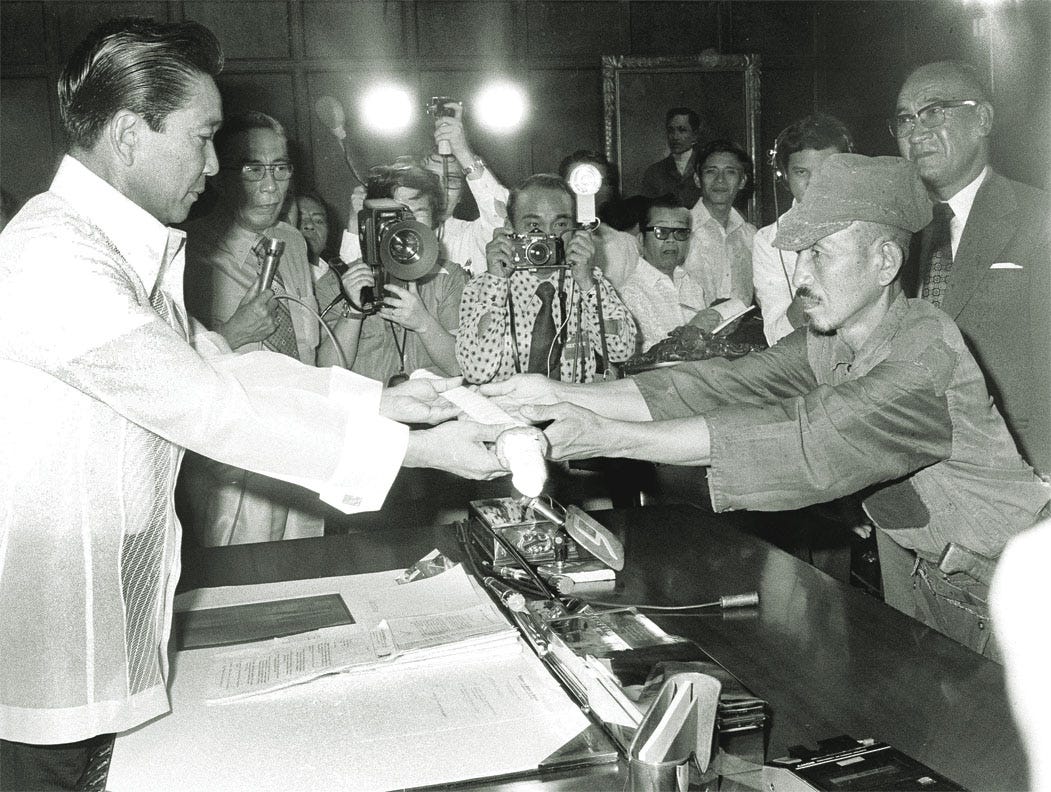
So were those objectively horrific means—cumulatively incinerating hundreds of thousands of people, most of whom civilians—justified by the end of the war, and thus end of the vile regimes controlling Germany and Japan at that time? No. Not without hindsight. This doesn’t mean that those actions were incorrect; that gets into moral relativism, and usually the kind that radicals and revisionists begin to play with in order to create justifications for things that they just feel like doing. In fact, despite all that I’ve said, I believe that we can and should make value judgments on specific actions like those. But the judgments need to be confined to the actions themselves and not on the ends that resulted from those actions. Because again, there are no ends. There is an end to the Second World War based on surrender and occupation, but nothing ended. It’s usually agreed that the Second World War killed the ideologies that killed millions, but only in the most superficial sense. As we know, the Japanese and the Germans continued to have radical true-believers among them, including the infamous Hiroo Onoda who continued the fight until the 1970s, and the Nazi Werwolf movement, whose terrorism continued until at least 1950. This is not even touching on the continued brands of German and especially Japanese ultra-nationalism that have continued into the 21st century, with the former seemingly never able to resist the pull of genocide denial.
It’s not incorrect to say that historical events do end; it’s simply incorrect—again, just in my opinion—to say that ends and means can be cleanly defined as they often are when discussing history, or, more to the point, radical action in the present. Consequentialist thinking, especially when applied to history, is what ultimately leads to revisionism, and, again, denial of atrocities. It’s what animated Tucker Carlson so much when he suggested/implied that Churchill’s victory in World War II is what allowed Great Britain to descend into the foreigner-ridden cesspool it supposedly is today. That example, among others, helps illuminate the real problems with consequentialist thinking more broadly, and the ends justifying the means in particular.
I touched on this theme when discussing the idea of historical progress and historical cycles, but not in these terms. Historical cycles and ideas of progress are essentially the consequentialist fallacies you see most often in popular historical writing and thinking; it’s because they make the complex story of history far easier to understand and digest. But they, like the idea that the ends justify the means, are merely permission slips to excuse or condemn things that the person engaging in the consequentialist argument of progress or cycles (or revisionism) want to talk about. It’s not history; it’s not even really politics. It’s just someone wanting to say something out loud without really owning what they’re saying. It is, ultimately, cowardice.
This is not to say that counterfactuals or causal/correlational chains are bad or wrong and shouldn’t be part of examining history (though historians do seem to have a bit of an allergy to counterfactuals, which still annoys me). It’s always fun to look at these “what if” scenarios or “what events did these events allow for down the line” questions; they can even be revealing about certain things. I’ve engaged in a fair bit of causal/correlational chain theorizing myself, particularly in the context of global pandemics and their own downstream effects. I saw, for example, a pretty obvious connection between the Spanish flu’s ravages and German losses in the First World War, which as we all know, allowed for the Second to happen. I saw the connection between the printing press and the translation and mass production of the Bible as an important result of institutional failure during the Black Death. I’m currently researching the very same kind of institutional disintegration created by the Salem Witch Trials and seeing how much we can thank that failure for the rise of American revivalism.
These things matter, and consequences do exist in history; but they do nothing to reveal what is right and wrong. That is the high-handedness of human beings writ large, to believe that we can possibly know what is right and wrong based on consequences, either on our own or through a supposed connection to a deity. We can determine what is true and what is false, but determining what is right and wrong is the nut that has never really been cracked in a way that will please everyone. The act of trying to figure it out has been the constant in the human experience, challenged only by those so arrogant that they have the answer. Always searching—embracing the process—is all we really have.
If I give Brian Thompson’s killer credit for anything, it’s that his actions have forced me to feel a certain way, which has, in turn, encouraged some reflection on my own positions on things. These positions are, like all processes, not static and may change. I may even change my mind on this particular case if significant information comes to light, which will, in turn, lead to me changing my perspectives on ends and means. I can’t imagine that happening, but I can’t imagine a lot of things until they actually happen. I guess that just makes me human.
And apparently coworkers. A friend of mine works for UHC, and told me about the sheer bulk of tears being shed during the all-hands-on-deck Zoom meeting that occurred the day after the shooting. That will likely move very few people, but I thought it was worth mentioning.
Thanks a lot for this deep dive into the notorious American healthcare
All I can tell people who exalt this guy is give up any health ins you may have and reject it if your employer offers it to you. Stand up and against the evil insurance companies and be principled. Then I had one guy tell me it’s illegal to do that in the US and it’s not. Some states fine you but if you are really triggered by these Joo run health insurance organizations then leave and go somewhere else.