


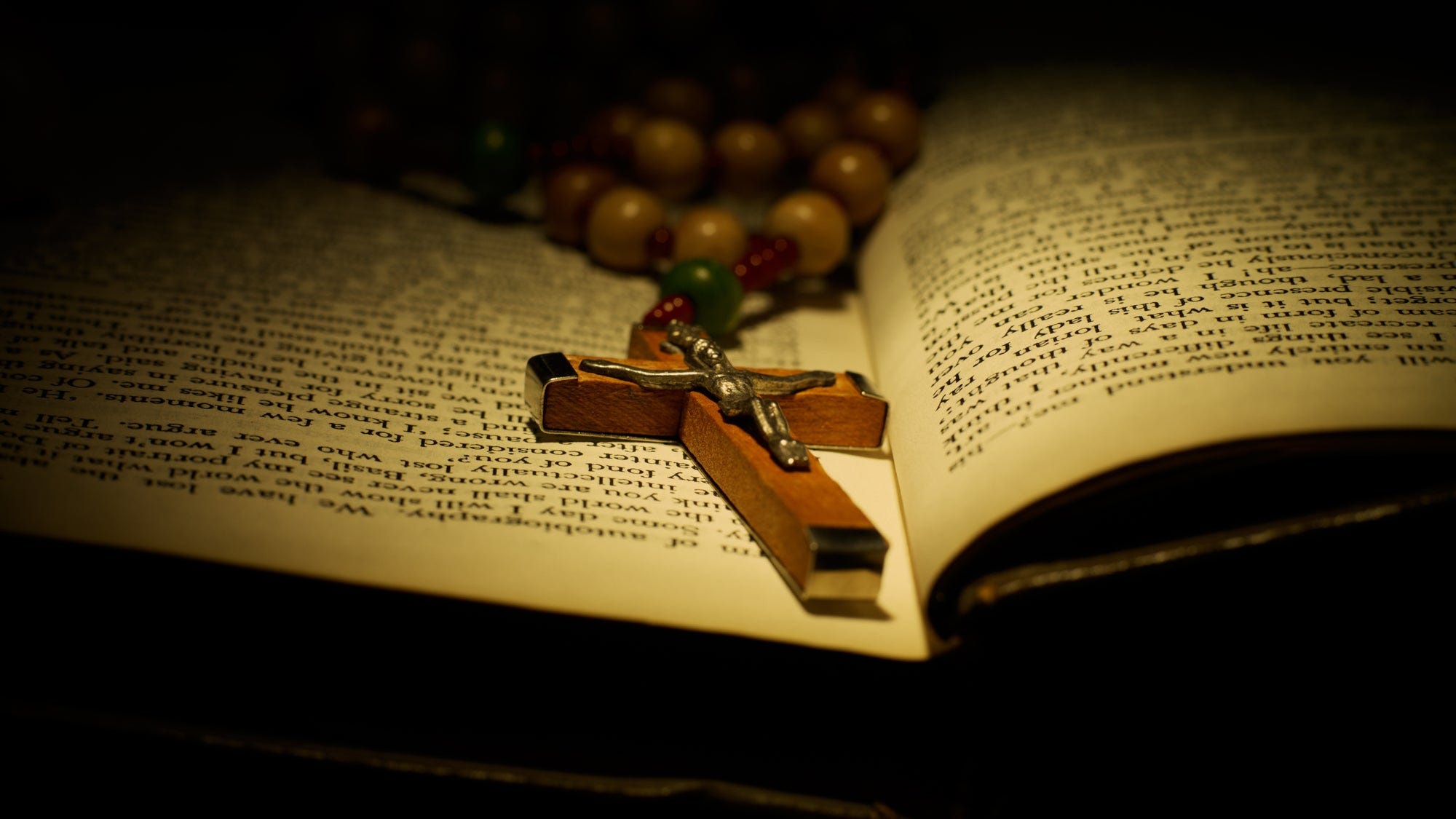
First of all, I hope everyone has been having a low-stress holiday season. Tall ask, I know. But I’m hoping there aren’t too many family ruptures occurring, at least if the toxic types complaining about their wrong-voting relatives on social media are anything to go by.1
With that said, another Christmas is here and I’m starting to see a greater effort, at least in more heterodox spaces (I’m looking at the lovely people at the Free Press, Quillette, and people in that universe) to reckon with the cultural Christian heritage that has become more difficult to deny. I think some, like Niall Ferguson and Ayaan Hirsi Ali, have taken their reckoning to a level that I personally find strange and even somewhat performative, but I can also appreciate their reasoning. Intellectually curious people tend to find reason to make changes in their lives and oftentimes, especially regarding religious faith, performance is required in order to feel (“fake it till you make it,” I think is the phrase).
Coming from someone who is as openly appreciative of Christopher Hitchens as I am, and coming from someone people who have known me a long time, it might sound strange to say, but I have become much softer on Christianity the older I get and the longer I study history, particularly the history of ideas and belief (and doing a deep dive into colonial American religious history as part of my thesis has definitely helped). I still have some very deep issues with Christian theology and institutions, but I have basically none with Christian people. This was a distinction that I didn’t often make when I was first consuming Hitchens.2 This was because, well, I was 22.
But it was also because I hadn’t really appreciated religion outside of my own personal experiences with it, which were, to be blunt, pretty anodyne. I never really had much belief in any deity, and once I stopped believing in Santa Claus, pretty much everything else went with it. This is not, unlike the galaxy-brains over on the old r/atheism, a way to make fun of religious belief; it’s just a statement of fact. What has changed was an almost Satanistic (in the LaVey context) active rejection of god or Jesus turning into a disinterest in feeling and, eventually, an honest-to-goodness inability to feel faith of that nature. I also recognized that Christianity had also led to millions of people committing millions of atrocities throughout history, though I more quickly came to understand that this was only as unique as the religion’s scale across time and place.3 All of this, to reference the second half of the title of this essay, is what makes me a typical atheist.
But what about the notion that I am a “heretical Christian”? Like a lot of things I say and write, my tongue is somewhat planted in my cheek when I say that. But it also helps me articulate what started to change the more I read about the history of religion, particularly the history of Christianity. The lodestar for my changing perspective came when I read Tom Holland’s magisterial opus Dominion: How the Christian Revolution Remade the World, and my growing distaste for what has been reductively called “woke” or “wokeism” kind of all clicked into place in 2020 when I read that book. I had long-since been sick of the constant red-baiting from the likes of James Lindsay and Jordan Peterson who just could not shut up about “Marxism”—even a cursory understanding of Marxism made me wrinkle my nose at these claims since Marxism has always been materialist and everything said by the people wavering over fainting couches about woke stuff was rooted in very amorphous propositions. I knew there was something else to what was going on and what was making me feel intense discomfort with what was, ultimately, a very irrational mass movement. Enter Dominion.
Holland had done with Dominion what I would like to think I am always trying to do with History Impossible, which is to add an oblique spin to stuff we already know or at least suspect and basically say, “yes, that is right; and here’s a reason you haven’t considered that will, hopefully, radically change your overall understanding of the human condition.” As Holland explained in his book:
The measure of a man’s compassion for the lowly and the suffering comes to be the measure of the loftiness of his soul. It was this, the epochal lesson taught by Jesus’ death on the cross, that Nietzsche had always most despised about Christianity. Two thousand years on, and the discovery made by Christ’s earliest followers, that to be a victim might be a source of power, could bring out millions onto the streets. Wealth and rank in Trump’s America were not the only indicators of status, so too were their opposites. Against the priapic thrust of towers fitted with gold plated lifts the organizers of the Women’s March sought to invoke the authority of those who lay at the bottom of the pile. The last were to be first and the first were to be last.
I’ve used this quote and discussed my feelings on this subject before, as many of you likely know, but I bring it, and Holland’s book, up again because it helps illustrate how my thinking changed the more I started to understand the change and continuity that acts as the spinal cord of history. I’m paraphrasing a review of Dominion that I read somewhere that posed the old question it felt like we were constantly squabbling over in the 2000s during the Bush years, “is America a Christian nation?” (or more broadly, “Is the West an example of Christian civilization?”); as the review summarized, Holland says begrudgingly, “yes we are.” He avoided the value judgment that was often baked into those “Christian nation” claims and simply looked at the evidence available to us, and the conclusion was pretty undeniable: much of what we take for granted in Western society—notions of equality, charity, individualism, et cetera—were thanks to variations that occurred in the Christian tradition across time. This was up to and including the fight over civil rights in the 1960s (people often forget Martin Luther King was deeply Christian; if not in his personal life, without question in his mission), as well whatever the hell kind of revivalism plagued the discourse in the early 2020s that has come to be known as “woke.”
In essence, most of what I appreciate as far as “first principles” go, has an origin in an interpretation of Christianity. Free speech and individualism, for example? As much as I find him distasteful for his non-sensical and bigoted heel turn against the Jews, I’m not so naïve as to believe that I don’t have Martin Luther and his heresy to thank for making individualism a creed that never really went away (it just became secularized). At risk of overstating things, without the Protestant Reformation, much of what we Americans take for granted as values, probably don’t exist (at least in a way that we would recognize today). Where I depart from the people who used to loudly and (in my opinion) insecurely proclaim that America is a Christian nation is that I still do not believe that means you have to be a Christian. I have and will continue to reject that wholesale, and will continue to do so even if the unthinkable happens and I somehow find faith one day. But I will not tie myself into knots like the old school internet atheists to pretend that we don’t all have a historical debt to Christianity if we value things that without question came from those traditions.
But that does not mean I consider myself a Christian, even a cultural one. What I have accepted is not the love of Christ. In fact, the “love of Christ” is one of the long-standing problems I still have with Christianity that I think Christopher Hitchens articulated best in his arguable 2001 masterpiece, Letters to a Young Contrarian, in which he writes the following:
I find something repulsive about the idea of vicarious redemption. I would not throw my numberless sins onto a scapegoat and expect them to pass from me; we rightly sneer at the barbaric societies that practice this unpleasantness in its literal form. There's no moral value in the vicarious gesture anyway. As Thomas Paine pointed out, you may if you wish take on a another man's debt, or even to take his place in prison. That would be self-sacrificing. But you may not assume his actual crimes as if they were your own; for one thing you did not commit them and might have died rather than do so; for another this impossible action would rob him of individual responsibility. So the whole apparatus of absolution and forgiveness strikes me as positively immoral, while the concept of revealed truth degrades the concept of free intelligence by purportedly relieving us of the hard task of working out the ethical principles for ourselves.
This is the moral contradiction that I can’t force myself to accept for myself. I also recognize, thanks to the (and I use this term advisedly) revelation provided by Tom Holland’s Dominion that the contradictions in Christianity—including vicarious redemption, as well the last being first and first being last, and many other things—were what made it so revolutionary and likely helped its success to the point of being the largest religious movement in human history. That cannot be ignored (I avoided a contraction there, so you know I’m serious!). I even suspect that my ability to feel, as Hitchens did, a profound discomfort at the idea of scapegoating anyone (including god himself, were I to believe in him) for crimes I am saddled with before I even existed, to be a result of intellectual traditions started by (and for) Christians. But my discomfort is my discomfort; my morals are my own. While the intellectual, and probably moral, debt to taking such a position, as many others far smarter and articulate than me have before, may belong to Christian intellectual heritage, I still reserve my right to shrug at any insistence being made that I should believe or accept Christ. I also accept the reality in which I live: I am still of the West, and the West is of the influence of Christian theology. Thus, the term “heretical Christian” almost certainly applies to me.
Christmas itself is a fascinating piece of cultural history, with its mixed traditions (namely trees and gifts, and the like), but I also recognize it gives so many people—billions—truly-felt meaning. I remember going to a Christmas Eve evening service as a kid and, with the lights turned down and candles lit and held by everyone in attendance, with several people smiling with tears streaming down their faces, as “Silent Night” was sung. At the time, it felt very strange to me; it even felt “fake” when I thought about it later. But that’s a truly insane position for me to take; people feel what they feel, and if it comes through a channel I don’t understand or accept, who am I to judge it? Especially when such a channel has allowed for such intellectual flourishing and beneficence that might not have otherwise existed.
Merry Christmas to all of you. I won’t pray for any of you because I can’t, but I have no issue with being prayed for. As the secret Christians (the woke, if you will) like to say, love is love.
To be clear, I have a hard time believing most of these people were talking to their relatives anyway, and many people cheering that on are just quietly malding at the dinner table since they clearly have more confidence on a keyboard than they do in person.
And the other “Four Horsemen,” to one degree or another, though it may surprise some of you reading that I have never read Dawkins; I’ve read some of his work on biology, but The God Delusion has never crossed my desk.
Islam, a far more recent and radical religious innovation, shares much in that tradition, and has its own vibrant intellectual history that has, unfortunately, hit a road bump.