



Hello all. Some quick housekeeping before we get going here. I’m currently on the road, and haven’t had time to do as much work on the show or the Substack as I would like, but I am really happy to give you guys this newest essay. In case you missed it, there are a couple interviews I recently released that I’m really happy about.
First was my conversation with the journalist Eli Lake where we discussed the phenomenon of radical politics joining forces with Islamist radicals across the 20th century, particularly in the context of Iran, but also delving a little deeper into the “Green-Brown alliance” I’ve discussed on the show. You can check that out HERE.
Next was my conversation with the host of the Crackpot History Podcast, in which we discussed his mission to demystify stories and figures that are engaging with poor interpretations of history in order to advance, we’ll say, disagreeable political projects and beliefs. We discussed his work critiquing Darryl Cooper, host of the MartyrMade podcast, and his current series critiquing Scott Horton’s recent book Provoked, which lays the blame for the Russo-Ukrainian War at the feet of the West. You can check that one out HERE.
Anyway, that’s all I have for all of you. Please enjoy this essay that I honestly didn’t think I would stick with thanks to its stranger (than usual) subject matter, but it worked out. Let me know your thoughts in the comments below.
…
“I seek to describe the quite extraordinary atmosphere in which such things have become possible. I call that atmosphere anarchy; but insist that it is an anarchy in the centers where there should be authority. Government has become ungovernable; that is, it cannot leave off governing. Law has become lawless; that is, it cannot see where laws should stop. The chief feature of our time is the meekness of the mob and the madness of the government.”
—G.K. Chesterton
“We are always unhappy when are changing our nature. We are concerned that we fool with Mother Nature we will be made to pay a price. I will tell you in advance that what you are going to hear from me is the good news. I bring glad tidings. I am the optimist in today’s crowd. I not only think that we will tamper with Mother Nature, I think Mother wants us to.”
—Willard Gaylin
“I never asked for this.”
—Adam Jensen
…
It should not be surprising for me to say this, given that my beat is events and experiences of the past, but is not often that I directly write about the future. I may make implications and show that the past can somewhat inform us on what the future might hold, at least in terms of social and psychological trends and tendencies. But it is hard for me to avoid thinking about the future, especially the immediate future, since I am a fan of science fiction, particularly of the dystopian near-future variety. So when I read the recent profile of Looksmaxxer Clavicular in the New York Times, it got me thinking about the future and, thanks to my appreciation of near-future dystopian science fiction, what it resembled.
According to the profile, Clavicular—real name Braden Peters—and those like him have one goal in mind: “ascending” to aesthetic perfection (that is, looks) by any means necessary, in order to become more socially dominant. That can mean substances, surgery, and even self-mutilation. No cost is too great to achieve this goal. As the New York Times profiler Joseph Bernstein explains, this goal comes from a “bizarre argot and nihilistic worldview, in which the universe is a Darwinian nightclub full of aggressive men jockeying for status.” There are several implications that have come from this worldview—not least of which is a sort of black-pilled, extremely online misogyny common among incels and their subgroups—and the political associations are hard to avoid.1 However, once I became more aware of the Clavicular phenomenon (and it is a phenomenon if his social media metrics are anything to go by; 100,000 dollars a month streaming on Kick is nothing to sniff at), I started to sense that something felt familiar.
The year 2011 feels like an eternity ago, but that year, a video game was released that I had been looking forward to for a while. It was part of a long-running series that had gone dormant for almost a decade called Deus Ex, a cyberpunk dystopian universe set in the near future. The first two games—to which we will return later—took place further into the 21st century than many of humans living today will likely never see (2052 and 2072, respectively), but the new one, Deus Ex: Human Revolution, was a prequel that took place in—take a deep breath—2027.
When Human Revolution was released and I played through its 15-20-hour campaign, I, like millions of other players, was captivated by everything about it. But what captivated me most was this vision of the future it painted, one that I almost certainly would live to see. So as the years ticked by and 2027 started becoming more of a reality than a fictional forecast, I started looking to see if there was evidence we were heading in the direction predicted by Eidos Montreal’s masterpiece. Now, the vision for this future created in 2011 decidedly does not resemble our current present in 2026, or likely what the world will look like next year, especially in terms of societal aesthetics, urban development in some places (namely places like Hengsha Island, Shanghai, and Detroit, Michigan, both shown in the trailer above), and other specifics that will never perfectly (or even, in some cases, slightly) match up when predicted by speculative fiction. This can indeed be seen in the above-linked trailer. Nevertheless, there seems to be one thing that held true in the past decade and a half since Human Revolution was released, and that is the central theme that seems to drive both its and our society in the late 2020s: the idea of human-engineered perfection, particularly via new technologies, and particularly in a period defined by a decline of greater meaning.
One can certainly point out, and it would be fair to do so, that for the developers of a dystopian sci-fi video game to highlight such changes in 2011 was not particularly insightful, since we were already experiencing the early stages of such problems, with the birth pangs of 21st century American populism (the Tea Party, the Occupy Movement, representing a rejection of supposedly meaningless American institutions, both political and religious) and online social networks making way for social media and smartphones becoming the norm. But to me, that smacks of hindsight bias; it is certainly true that those phenomena were beginning to coalesce and give us the picture shared by Human Revolution and our current era, but no one (or at least almost no one) lived as if those phenomena were coalescing. And coalesce they have.
These voids are depicted in Human Revolution and, like any good dystopian science-fiction, done in a very literal way to make sure as many people as possible pick up on them, in which the protagonist of the game, Adam Jensen, has become so heavily augmented with technology—in a nice nod to Robocop, no doubt an inspiration for this game’s setting and themes—that the question of whether or not he is even a human being is frequently called into question. In parts of the story, particularly when talking to characters of a more traditional, religious outlook, this question is expanded to include quite possibly everyone who has taken part in human augmentation, which has simply gone past giving people artificial limbs and organs who need them, and now includes people voluntarily sacrificing their (if you’ll pardon the cliche) god-given components in order to improve themselves. Or, in the vernacular of a one Braden “Clavicular” Peters, to “ascend.”
The civil unrest we see play out in Human Revolution is no less eerie in its resemblance to our own, despite it having everything to do with the story’s themes and specifics, and nothing to do with immigration restriction or, in a flashback to 2020, strained racial relations amid a global pandemic. When seen through a historical and psychological lens, civil unrest is almost always an act of meaning-making en masse; while the unrest we have seen play out during the 2020s has had more to do with political anger, and the unrest we see play out in Human Revolution has more to do with resisting human augmentation and preserving what it means to be human, both share the same impulse: to inject meaning into a world where meaning itself is being called into question or is even believed to flat-out not exist at all.

This brings us back to the curious case of Clavicular. To reiterate, as the New York Times piece put it, Peters’ outlook is a profoundly nihilistic one. And yet, unlike many black-pilled reprobates peppering cyberspace, Peters, to his credit I suppose, has taken matters into his own hands. He still does not believe that there is any greater meaning beyond beauty; he would likely agree with the maxim shared by a particularly vile character from Nicolas Winding Refn’s 2016 masterpiece The Neon Demon that “true beauty is the highest currency we have,” accentuated later by the film’s lead when she says that “beauty isn’t everything, it’s the only thing.”
Nevertheless, Clavicular is, through his Looksmaxxing regimen, creating meaning to replace its absence. And the way he is creating meaning is by, regardless of whether one agrees with his methods or his thesis or even likes anything about him, perfecting himself through technology. He is not replacing his limbs, but he is injecting himself with drugs to, in his mind, improve them; he is not getting pieces of inorganic material implanted in his face or any other part of his body (yet), but he is supposedly creating microfractures in his jawbone to change its shape. The point is, in a crisis of meaning, humanity has a tendency to try and create it, and, to bring this back around to history and—for the moment—away from video games and future speculation, it is not the first time that notions of engineered perfection through technology (and a bit of social engineering) have been attempted to fill the fathomless void that threatens to swallow us all.
…
When one hears the word “eugenics,” one often thinks of the ghoul in human form we know as Dr. Josef Mengele, and, if they are unfortunate enough to read about his more sadistic experiments, is inclined to believe that it was only done for the man’s sick predisposition. In the case of Mengele (as well as other human experimenters, such as Japan’s Shirō Ishii), this was likely true, though there was always a layer of pretense that matters for what we are discussing here; that is, a pretense of the “eugenic health” of the people, often (though not always) reinforced by sincere notions of racial purity. That pretense, however cynical it was in the case of Mengele and many other medical sadists of the half-century before the end of the Second World War, was a very real belief particularly in the United States, and well before the rise of the Third Reich in Germany. As the famous psychologist and writer Robert Jay Lifton wrote in his incredible book, The Nazi Doctors:
There had been plenty of racial-eugenic passion in the United States, impulses to sterilize large numbers of criminals and mental patients out of fear of “national degeneration” and the threat to the health of “the civilized races,” who were seen to be “biologically plunging downward.” Associated with the American eugenics movement was a biomedical vision whose extent is suggested by the following quotation from a 1923 book by [psychologist and eugenicist] A.E. Wiggam: “The first warning which biology gives to statesmanship is that the advanced races of mankind are going backward; […] that civilization, as you have so far administered it, is self-destructive; that civilization always destroys the man that builds it; that your vast efforts to improve man’s lot, instead of improving man, are hastening the hour of his destruction.” [Emphasis added]
While sterilization programs and worse became symbolic of what eugenics truly meant in practice, Lifton is careful to explain that eugenics had two expressions: “positive” and “negative.” Negative eugenics involved the destruction and elimination of bad traits (through practices like sterilization and, as the Nazis would demonstrate, euthanasia and mass murder), while positive eugenics involved the promotion and, ideally, propagation of good traits (through incentivizing large, single-demographic families and prohibiting abortion). How those traits were defined—that is, what was “good” and what was “bad”—is certainly what is most problematic about late 19th century/early 20th century eugenics, especially given where it ended up in the 1930s-1940s, but it is important for us to recognize because it allows us to understand the key goal of eugenics: to perfect mankind. As Lifton explains, “doctors were active in research on people viewed as hereditarily gifted, and in helping to enlist the medical profession for what was called the ‘fostering of talent.’” The idea that any kind of positive social constructions would save the day was out; improving human beings at root was in.
Of course, the idea that men were born good or born bad (to use reductive terms) was largely academic and hardly universally agreed upon. But in the late 19th and early 20th centuries, it was the cutting edge and went against what was, up until then, largely common sense. Criminals were criminals because they were desperate; they might be morally defective, the old thinking went, but that could be fixed with prayer and, perhaps, hard work. Not so, those on the cutting edge believed; it was eugenic destiny. Even if that were somehow true, that prayer could save a man’s soul, if he were defective from birth, he would still be unfit for tomorrow’s newer, better world. And why should we, the eugenicists likely wondered, wait to pray and educate the dregs of our society out their lot when we can just consider them lost causes and promote those who are not? This kind of thinking was largely reserved for those among the economic and intellectual elite—the influencers of the day, one might say—but it began to have influence and even inform policy.
Eugenics began its inglorious ascent in the cultural imagination largely thanks to one man: the English polymath and cousin to Charles Darwin, Francis Galton. While his most infamous theory certainly gained ground it probably never should have, he was no fool. As Daniel Okrent writes in his book The Guarded Gate, “Galton’s major discoveries—among them the individuality of fingerprints, the movement of anticyclones, the statistical law of regression to the mean—elevated his obsessive collection of data from triviality to significance. But for every one of his substantial contributions to human understanding, he probably hit upon a dozen that were trivial.” It is difficult to fit eugenics into such a generalization because some of the ideas underpinning eugenics—that we do, in fact, contain genetic differences that can, to one extent or another, be grouped together, for example—are true, but it is no doubt true that Galton and those who followed his example got carried away with generalizations and conclusions.
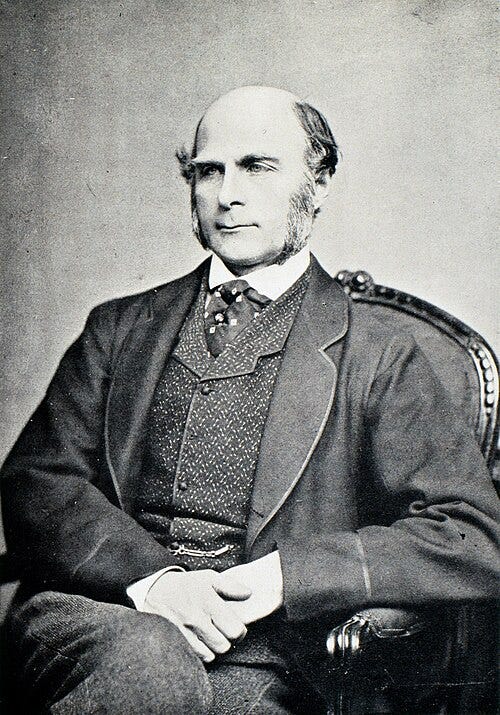
Probably the most significant of these generalizations and conclusions involved Galton’s belief that talent was heritable; this included knowledge-based talent, and by extension, artistic talent, among other things. While there are certainly elements within these fields that could be considered heritable, this was an area where Galton certainly overstated the case. Inspired largely by his elder cousin Darwin’s research into natural selection, Galton began his research. As Okrent summarizes:
If the development of species was not guided by a divine hand, he reasoned, neither were the minds of men. As physical qualities were provably heritable, so much be “peculiarities of character.” Darwin had defined the principles of natural selection in the animal world; now Galton dared to adapt them to the lives of humans. In the words of Galton’s protégé, disciple, and biographer Karl Pearson, “the inheritance of mental and moral characters in man [became] the fundamental concept in Galton’s life and work.
Ultimately, Galton collected a list of several hundred “notabilities” from a four hundred year period and concluded that about one in six were related to one another, thus “proving…what exactly?” in Okrent’s words. “Looked at today,” he continues, “Galton’s research and his conclusions seem risible. His sources were at best problematic, his measures of eminence arbitrary (they were in many cases measures of fame, not accomplishment).” In other words, Galton, like many excitable social scientists, had not done his diligence in applying experimental controls and almost certainly had a conclusion toward which he was groping before he even selected his “subjects.” This did not matter to Galton at the time (or his intended audiences), and he simply dressed up his claims with “a series of eccentric extrapolations,” to use Okrent’s words again. As an example, Galton would claim that, “Most notabilities have been great eaters and excellent digesters on literally the same principle that the furnace which can raise more steam than is usual for one its size must burn more freely and well than is common.”
This circus of claims and disconnected data eventually turned into Galton’s 1869 work, Hereditary Genius: An Inquiry into Its Laws and Consequences, in which Galton would expand his wild claims into even wilder ones, supported by ad hoc historical anecdotes about Roman genealogies and, as Okrent writes, “some extremely acrobatic math to calculate that precisely 1 in 3,214 ancient Athenians who reached the age of fifty was ‘illustrious.’” The book was not particularly well-received when it released, with the London-based Saturday Review wrote disparagingly of the “disjointed facts, inert and lifeless […] logically worth nothing.” Galton’s spirits were lifted when the great Darwin wrote to him to praise his little cousin’s efforts at expanding his thoughts of trait heritability, and gave Galton’s ideas the shot in the arm they needed when he openly praised him in his 1871 work, The Descent of Man, writing that “We now know, through the labors of Mr. Galton, that genius […] tends to be inherited,” and that “it is certain that insanity and deteriorated mental powers run likewise in families.”
This support from Darwin was enough to keep Galton’s ideas very much afloat to allow other luminaries of the time to praise and promote these ideas; ideas that would, gradually but rapidly, develop into programmatic eugenics. These promoters included inventor Alexander Graham Bell and the suffragist Victoria Woodhull. Bell, in addressing the National Academy of Sciences in 1883, proclaimed “if we could apply selection to the human race we could also produce modifications or varieties of men.” Supporting his claim, he stated “if the laws of heredity that are known to hold in the case of animals also apply to man, the intermarriage of congenital deaf-mutes through a number of successive generations should result in the formation of a deaf variety of the human race.”

Woodhull went even further, claiming that “the criminal and vicious classes were made so by their mothers during gestation,” later becoming an early advocate for negative eugenics by proclaiming that “[carriers of] hereditary sensuality and vice”—that is, prostitutes, gamblers, drunks, criminals of any kind—were “a crime against the nation.” Elevating women to the status of voting citizens would therefore, in Woodhull’s mind, prevent such maladaptive behavior from occurring in the first place. Woodhull’s comments in particular show how power a seemingly utopian idea like eugenics truly is, when it can be adopted and molded to support another idealistic program so easily. This started to become increasingly apparent as the eugenics bug began to bite across the Atlantic Ocean in the early 20th century.
Eugenics made its debut into American respectability in 1906 at the third annual conference for the American Breeders Association (ABA), with the storied Washington Post declaring in a headline, “Science to Make Men and Women Better.” As Okrent summarizes, “By adding human breeding to its remit, the ABA began the first American effort to elevate Galtonian theory into something both programmatic and, at least as conceived, scientific,” with the ABA’s committee being a who’s who of scientists and intellectuals that would “bring eugenics into wide public consciousness, introduce it into the nation’s political debate, and elevate it into the realm of respectability.” And it was indeed respectable; it was seen as a true science on the cutting edge, endorsed by leading universities such as Harvard, Yale, Stanford, and the University of Virginia. Eugenics research and advocacy was funded by the Carnegie Institution, and major media and elites amplified it—eugenics conferences were front-page stories in Science magazine, other popular magazines favorably covered “better breeding,” and public intellectuals and foundation-backed experts promoted sterilization and immigration restriction as rational social policy. Eugenics was, as they might have said at the time, the bee’s knees.
The full story of eugenics’ legitimization and its downstream effects is a long one (and one I hope to cover in greater depth one day on History Impossible), but perhaps needless to say, it was not one without ghastly consequences, not least of which being the Nazis’ use of it to disastrous ends, as mentioned earlier. But one need not even reference the Third Reich’s crimes to demonstrate just how destructive those consequences ultimately were. The main thrust of Okrent’s scholarship deals with one of those consequences, namely that of immigration restriction on the basis of eugenics deeming European immigrants—particularly Jews, Italians, and Eastern Europeans—unfit to “pollute” the American populace, arguably (and demonstrably in some cases) consigning them to a much worse fate as early 20th century Europe continued its path of self-immolation.
Then there were the sterilizations. Throughout the early-to-mid-20th century, approximately 60,000–70,000 Americans underwent state-ordered or supported sterilizations in the United States, primarily under eugenics laws targeting those deemed “unfit” (that is to say, the “feeble-minded,” criminals, or even the poor). Programs appropriately peaked in the 1930s–1940s across 32 states; my own state of California alone performed around 20,000, or one-third of the national total, between 1909 and 1979. And as a native Minnesotan (and U of M alumnus), I would be remiss not to mention the role the University of Minnesota and its Eugenics Society in legitimizing the practice of compulsory sterilization. The Society’s president, Charles Fremont Dight, is also worth highlighting if only because he was a bit of a pen pal with Adolf Hitler, writing to the Fuhrer in 1933, praising the Nazis’ new sterilization law and sharing materials about American eugenics efforts.
But most disturbingly of all, there were the instances of human experimentation, most infamously represented by the syphilis experiments conducted on 600 impoverished black American men from Macon County, Alabama. The study, titled “The Tuskegee Study of Untreated Syphilis in the Negro Male,” included 399 infected with syphilis and 201 without. No one was deliberately infected with syphilis as is often claimed in more conspiratorial versions of the story, but the subjects were deceived with promises of free care for “bad blood,” given placebos like aspirin, and subjected to painful spinal taps misrepresented as therapy. More to the point, even after penicillin became widely available in the 1940s, officials actively withheld it, even intervening to prevent participants from getting it elsewhere, in order to study the degenerative effects of the neurosyphilis that ultimately killed most of the men.

Truly distasteful as this was, it paled in comparison to a series of studies that were conducted in Guatemala in the late 1940s, which were under the direction of Dr. John C. Cutler and the overall approval of Dr. John F. Mahoney, who were also involved in the Tuskegee experiments. In the Guatemalan version of the experiments, American doctors deliberately infected hundreds of Guatemalans with syphilis as part of the wider effort to understand and treat the disease. As Martin J. Tobin explains in a 2022 paper for the American Journal of Respiratory and Critical Care Medicine, because half a million Americans were infected with syphilis every year, “investigators drew up plans for an experimental model wherein infection would be induced in healthy subjects,” in order to develop better protection against the disease. Only uncovered in 2010 by historian Susan Reverby who was researching the Tuskegee experiments, the details of these experiments truly beggar belief and are best left alone, but as Tobin summarizes:
The original plan was to induce syphilis in prisoners in Penitenciaría Central through sexual intercourse with infected prostitutes and then test the efficacy of prophylactic regimens. When the American physicians encountered unexpected difficulties, they began to conduct studies on Guatemalan soldiers, inmates in the country’s only mental hospital, and children in the national orphanage. Because the rate of infection resulting from intercourse with prostitutes was lower than expected (<10%) the NIH-sponsored researchers attempted to artificially inoculate subjects with syphilis, gonorrhea, and chancroid.
Unlike the cases of mass sterilization or immigration restriction in the United States or even the racial policies of the Third Reich, the connection to eugenics with such human experimentation is less clear on the face of it, but the connection is nevertheless there. Many historians and bioethicists now explicitly link the Tuskegee syphilis study and those like it (such as the Guatemala study) to eugenic ideology and to a broader “scientific racism” that grew out of the U.S. eugenics movement. Some of the main physicians who initiated and ran the experiments were trained at the University of Virginia, then a major center of eugenics teaching, where race was treated as a biological determinant of disease. These same physicians were publicly aligned with the eugenics movement thanks to their membership in the American Eugenics Society, and scholars argue that Tuskegee functioned as a vehicle for testing a eugenic hypothesis: that “racial groups were differentially susceptible to infectious diseases,” in the words of historians Paul Lombardo and Gregory M. Dorr.
While there was no direct effort to sterilize anyone through these studies or any attempt to control breeding patterns, the core premises—biological racial difference, differential susceptibility, and the expendability of black or Guatemalan lives in the name of racial science and social hygiene—are continuous with the mentality of the American eugenics movement. And lest we forget, such premises were all in service to another, simpler, broader premise: that the human being could be perfected, if only the imperfections could be weeded out root and stem. But more to the point, we should not forget that this dream of perfecting humanity largely began with a single source—a bit of an oddball named Francis Galton—and that this source’s ideas gained intellectual currency and respectability seemingly out of nowhere, and before anyone realized what was happening, it had largely swelled well out of any semblance of control.

…
In Deus Ex: Human Revolution, the protagonist Adam Jensen is very clearly meant to stand right in the middle of the existential battle over what it means to be human thanks to the proliferation of this new technology that has challenged, if not obliterated, everyone’s preconceptions. He is in the middle because, as he famously puts it, “I never asked for this.” The technology that makes up most of his body was put in him while he was on the brink of death (or perhaps, the game implies, already dead; this opens up a whole new can of philosophical worms). The point is, he had no choice to be part of this fight, and yet here he is; an emblem of it, thankfully (for him) fighting in the shadows, instead of the front lines where he could be made a symbol for the people in this world, rather than just the millions of us playing in it. That kind of pressure would do a number on anyone.
But this puts him in a unique position to understand just what the hell has happened to this world. The problem is that he doesn’t have time to understand the world; he has to save it, and save it he does, because that is usually what you’re supposed to do when you’re playing a video game. And yet, it does not take away from what we have seen and experienced in this game: a very real, if disturbing and pessimistic vision of humankind in our very near future. That is what ties together all of the games in this franchise, even though they were all released at different parts in our history, when we all had different concerns about our future.
The first game was released in 2000, when everything seen within it—a global pandemic that seemingly doesn’t effect elites, civil unrest and conflict, conspiracies at the highest level of government, to name just a few—were mere references to the best episodes of the X-Files. And yet, they resonate with anyone playing the game even today, well over two decades after it released, precisely because of the sociocultural anxieties that seem to have been presaged. It isn’t even the previously-mentioned details (or the eerie fact that one can’t find the World Trade Center when looking at the New York City skyline; again, this game came out in 2000) that can cause one’s breath to catch in their throat. It is the sheer audacity of this story to claim—accurately—that one of the most pressing questions to the United States (or the world) would be the role artificial intelligence plays in everything, particularly governance.
The second game was released in 2003, when the War on Terror was in full swing and civil liberties were appearing to be snatched away all in the name of security and, ironically, liberty, so the game’s marketing and dialogue frequently invoked the fear of terrorism and freedom. And yet, it was a story that fundamentally questioned the nature of government as a concept and, given the advancements being made in technology and communication in the world of 2072, what a government should look like and how should it reflect human will as that becomes ever-globalized. What would be required for such a shift that shows no signs of slowing down? A post-democracy, governed by a merged AI-human hybrid messiah? Perhaps.2 That is indeed one of the proposed solutions to the problem of inherent “otherness” created by human augmentation, intense and seemingly eternal inequality, and sclerotic (if not non-existent) democracy.
The third game, as we’ve discussed, went back in time and looked at how the quest for human perfection started down the bleak path where the first game began. The fourth game, a direct sequel to the third that takes place two years later in 2029, looks at the aftermath of the first cataclysm that comes from such a quest, and shows us that civil liberties and human rights are extremely malleable things that can always be redefined in service of a new, yet always familiar, ideal. Overwrought as the concern often was, there was a growing concern about civil liberties given the growing animus toward immigration across the West at the time of the game’s release in 2016; there was even some controversy surrounding the fourth game, with its invocation of a “mechanical apartheid.”
The concerns depicted in this trailer remained and continue to remain relevant to many people, especially so, ten years later; this applies just as much to those experiencing profound anxiety over ICE raids in places like Minneapolis in 2026 to those who experienced profound anxiety over COVID-19 lockdowns and vaccine passports in 2020-2021. The specifics are different, as are the people experiencing anxiety, and so too are the specific plot points of the appropriately-subtitled Mankind Divided that saw humans without augmentations called “naturals” and those with them “gonks.” However, the cognitive mapping in all cases is the same and the writers of this game—and all of the other games—understood that.
The real tragedy was that there was never a follow-up to the fourth installment thanks to supposedly disappointing sales numbers. The Deus Ex series’ specific plot points, entertaining and compelling as they are, honestly pale in comparison to its world-building and sophisticated exploration of such vital and shockingly prescient themes. As much as I have always appreciated most incarnations of Star Trek as a fan of science-fiction, Deus Ex is a true triumph in terms of depicting a future I don’t have to imagine, at least compared to Gene Roddenberry’s strange post-scarcity neo-socialist utopia. Ironically, perhaps, there have been moments in Star Trek’s canon where it has been stated that humankind’s purpose is for us to better ourselves. As explained above, Deus Ex has made the same claim. However, Star Trek has often made the implication that, thanks to that aforementioned strange post-scarcity neo-socialist utopia being the setting, human beings currently are not pursuing that same goal today. To pursue betterment (or perfection) for its own sake is seen, per Star Trek, as transcendence of our current or older form as a species; per Deus Ex (and I agree with this), it is merely a continuation of the norm, with the warts and all that come from the human condition. Hence, why entries in the Deus Ex series feel like a downright fortune teller and those in Star Trek feel like a doe-eyed fantasy (though there are of course some moments in the various series that deal with the theme of engineered perfection at an individual level; lest we forget, the classic villain Khan was the leader of genetically engineered ubermenschen).
The alternative to engineered perfection, especially in the context of creating meaning where none supposedly exists, is often framed as a dedication to some version of “purity,” often in religious terms, and if we are indeed in the opening stages of a new culture-wide embrace of engineered perfection (which could also be said to include GLP-1’s, improved plastic surgery, and, of course, Looksmaxxing), I doubt that would change. As much as I find all claims of “purity” to be generally distasteful, I have increasingly found myself to have more intellectual sympathy for such claims; in other words, I may not like them or their implications, but I completely understand why these claims of “purity” can resonate. This is partly thanks to my experience playing the Deus Ex series, but it is also thanks to my unease and moral disgust regarding past attempts at engineered perfection in our not-so-distant history. Near future dystopian stories of a hypothetical “mechanical apartheid” might be unsettling enough, but true stories of forced sterilization, human experimentation, and genocide from the recent past are downright terrifying. What terrifies me is not the idea that these are all “the same”; what terrifies me is that they all come from the same psychological impulse.
It must be said that this could be much ado about nothing. There have been plenty of memes made and commentary had about how, well, silly this whole Clavicular thing is. Despite my high-minded attempts to connect this phenomenon to the history of eugenics and the speculative dystopian fiction of relatively high-brow video games, “Looksmaxxing is,” as Katherine Dee recently put it, “what our society already encourages: endless self-optimization toward nothing, a life of becoming.” This could just be more cultural wheel-spinning. As Dee further explains, “The Human Potential Movement [of the mid-20th century] promised that everyone could be more. What we live with now is the hangover, the conviction that we must be. What Looksmaxxing offers is potential itself as a terminal condition, becoming that never arrives, a body always in progress and never in use.” It could well be that the inherent silliness of the Looksmaxxing meme will be a barrier to entry to anyone searching for meaning in a meaning-starved world.
So yes, it might indeed be silly for me (and probably is) to project into our near future based on the antics of a weird guy IRL streaming on Kick and how his quest for perfection kind of sounds like the calls for eugenic health a century ago. But lest we forget, the idea of a former reality TV show host with the verbal IQ of an eight year old boy and overall-consummate-douchebag running for president, much less winning (twice, NON-CONSECUTIVELY) was just as silly, especially since he resembled populist clowns of our past from Denis Kearney to Huey Long, not the monstrosities of Hitler or Stalin. History is full of things we recognize as silly, often for good reason, but they exist, have influence, and most importantly can reflect broader trends, nonetheless. I have no idea if this is one of those times because neither does anyone else. But I would not be surprised if the cultural historians of the 2050s see a through-line to their present that includes some of the silliest things we see happening now.
I am wont to often say, and for good reason, that history is not something that gives us one-to-one analogies. A Gen-Z influencer calling itself “Clavicular” is not literally the same thing as the intellectuals, politicians, and other elites promoting the eugenics craze of 100 years ago. Clavicular and this trend he currently embodies is also not literally the same thing depicted in the world of Deus Ex: Human Revolution. But all three examples—two real, one fictional—share the same impulse. That impulse—of engineered perfection—is the same regardless of external context, and one to which we should never ignore, especially if it begins to grow as a trend. Trends often begin with individuals and it does not take long—especially in the 21st century—for such trends to expand into something far larger than niche communities. And the trend of attempting engineered perfection is indeed one we have seen before, and it did not end well. There is no reason to believe such a thing would end well again if it became more widespread, especially when it is clear that the thing that deeply gnaws at people like Clavicular is the world’s supposed dearth of real meaning.
In other words, this has less to do with “Clavicular” than it does with what he and many like him—in the past, present, and in the future—are pursuing. He might be a punchline (and he is certainly that), but what he is searching for, for our entertainment and commentary, is much more than social media clout, if we are to take him at face value. What he is searching for has endured for all of human history: meaning. And for many people throughout history, meaning often comes from the pursuit of perfection. Countless numbers of people have pursued this goal via these means with far more primitive technology and have created far more devastating results, especially when their obsessions are bought up to scale. As Edwin Black wrote in his book War Against the Weak: Eugenics and America’s Campaign to Create a Master Race:
Mankind’s quest for perfection has always turned dark. Man has always existed in perpetual chaos. Continuously catapulted from misery to exhilaration and back, humanity has repeatedly struggled to overcome vulnerability and improve upon its sense of strength.
To be fair, Peters has since distanced himself from politics thanks to the cringe the viral moment of him partying with the Third Reich’s most prominent fanboys, the (probably-gay Mexican) white nationalist Nick Fuentes, the (half black) pimp Tate brothers, and (multi-racial Muslim) provocateur Sneako in a Miami nightclub to Ye’s “Heil Hitler.”
It ultimately depends on which ending you, the player, go with, but the “good ending” is basically this. Your other options include handing the world over to the Illuminati, destroying new technology and sending humanity back to the Dark Ages, or simply letting the planet continue as usual until all that’s left are cyborgs and a pockmarked wasteland. Oh yeah, spoilers.
I would have sent this as an email, but i don't know yours. This is a comment and observation about Darryl Cooper.
I have been listening to his latest which is about the German army at the end of WW1 to WW2. I think that it is plainly obvious from his appearances on Tucker's show and from his X feed that he has taken a dark turn and as far as I am concerned he is unabashedly antisemitic. I believe that in his present work that he is going to absolve the average German soldier of any complicity or agency in any of the bad things the Wehrmacht and the German nation did in WW2. He will also try to lay some of the blame on Jews. As he is describing the Russian Civil War he will let the listener know of every Jewish Bolshevik that did a horrible thing (and there were many of them no doubt, the Bolsheviks and the Red Army were monstrous and cruel). As expected, the Whites are not included in the endless litany of atrocities committed during the Civil War, even though they were as frequent and as horrible as anything the Reds did. It was a bad time and a bad place for ordinary people to be. They were indeed the Bloodlands (as Tim Snyder called them before he lost his mind and emigrated to Canada). When he related the abbreviated details of the negotiations that led up to the Treaty of Brest Litovsk, he went on about how crude the Bolsheviks were in front of the proper civilized German generals and diplomats. What wasn't discussed were the details of that treaty, and how much territory was taken from Russia as a result of losing their war with Germany.
I will listen to the whole series. I fully expect a whitewashing of Germany. He will place the blame on the USSR and the Jews and probably on the most evil character in WW2, Winston Churchill who we all know was a stooge of the Zionists.
I am enjoying the Crackpot History examination of Scott Horton's Provoked, and I look forward to his analysis of this publication of Cooper's.
Once again, I thank you for your excellent substack and congratulations on you PhD, which I assume from your posts will be forthcoming soon.
When I was in high school, my biology teacher mentioned eugenics in a quick sentence. He treated the subject with the same level of seriousness as he would give to a "flat earther."
You mentioned that eugenics was once considered cutting-edge by leading universities. While that support and research are deeply disturbing, it clashes with my previous understanding of how much importance we give it today. You made me realize there was probably a "PR" campaign to clean up the names of those big institutions. This is fascinating.
Thanks a lot for the insight!